A Really Hot Birding Hot Spot This Morning, Maricopa County, AZ

 Local Birding Hot Spot: 10/28/22

   Having allowed two months to slip by since I last visited one of the best wintering grounds for waterfowl, I was gobsmacked with the number of ducks, wading birds, and passerines feasting at Gilbert Water Ranch.

    One of my favorite ducks was back: GREEN-WINGED TEAL. This American short-bodied, stocky duck, is considered our smallest duck. Foraging from the surface (not a diving duck), the handsome male's feathers appeared worn and bedraggled. Can you imagine flying from the northern reaches of North America to Arizona without a windshield? 


    AMERICAN AVOCET, below, generally winters here. A rather quiet wading bird, they work as a flock in moving through shallow water moving their long beaks back and forth to stir up tasty morsels.

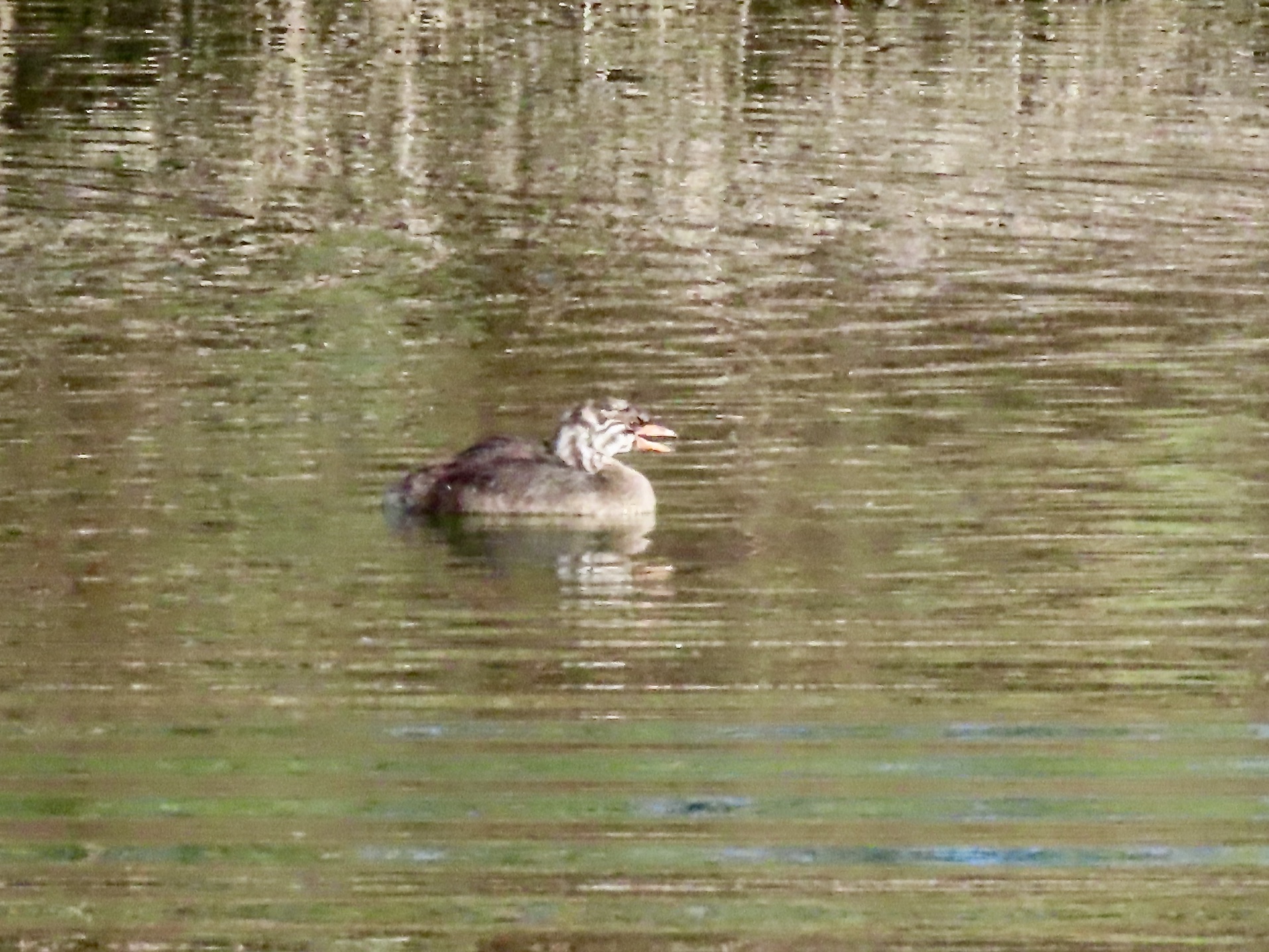
    Two Juvenile PIED-BILL GREBEs were on their own at this same Basin #7 at this water recharge facility. No adult in sight; perhaps diving nearby and I missed it.

    Photographers were gathered at this same spot for the superb and unannounced attraction: about two dozen AMERICAN WHITE PELICAN. This is a BIG bird with a 9-foot wingspan. Scooping up pouches of water filled with whatever fishy morsels it contained, the pelicans were not shy. Working the pond close to its open edges, I was thrilled to get some close-up pictures.


    All of the above photos were taken at that one Pond. 

Walking on, there were birds everywhere I turned. Some were on the ground; some in the air; a few perched, and many more were foraging in the basins filled with water.   GAMBEL'S QUAIL scratching for breakfast
COMMON GALLINULE (formerly known as Moorhen)
Juvenile GREAT BLUE HERON

    A fabulous outing! 

        More later now that cooler weather prevails.

* * *

View this checklist online at https://ebird.org/checklist/S121446370


A Bit of Birding, Pinal and Maricopa County, Arizona 9/30; 10/6; & 10/13.

Friday, September 30, 2022
    The monsoon season has kept our temperatures low enough to get out and enjoy some of our preserved spaces. Beginning at 6:15 a.m., I began walking the trails at Granite Reef Rec Area along the Lower Salt River. 
    
    A VERMILLION FLYCATCHER and a BLACK PHOEBE were both vocal and busy fly-catching close to the river. They were the early birds; many others were not yet up and about. 


River Otters could be seen swimming, sometimes with the westward flowing current; other times swimming upstream. That seemed a good omen to me that they inhabited those waters.

    At one of the trail-side clearings that enabled a good view of the river, I walked in but smelled a very strong odor of javalina. I saw none. So, I made quick work of scanning the river. I didn't want to have the river as my only escape route if a herd of javelina came upon me from the rear.

    Not to fear; none came. So I headed to and reached the very muddy spit near the dam. Taking my time identifying waterfowl, I found nothing new to report of migrating birds out on the water but did have a WESTERN WOOD-PEWEE in the mesquite bosque.

View this checklist online at https://ebird.org/checklist/S119705822


Thursday, October 7,  2022
    On winter hours, Jannie and I couldn't enter BTA until 8:00. A much later start for birding than usual for me, the temperature was a cool 72 degrees under a clear sky. Occasionally kissed by a light breeze, the day was perfect. 

    So much more than the birds captivated our attention: the blooms, the butterflies, the fragrances of more species than I could name. 

                                                                    Queen Butterflies

Salvia in background
Desert Spiny Lizard - perhaps

    Among the birds were a distant ROCK WREN; a juvenile BLACK-THROATED SPARROW; a female RED-NAPED SAPSUCKER and a male and female NORTHERN CARDINAL, all shown below in order.


View this checklist online at https://ebird.org/checklist/S120081930


Thursday, October 13, 2022
    Hinde Silver and I explored Coon Bluff Recreation Area along the Lower Salt River on Thursday, 10/13.

    Beginning at 6:30 a.m., we managed to spot 25 species over a two-and-one-half-hour walk along the river and through the mesquite bosque. River Otter swam out in the river.

    My favorite bird of the morning was the ASH-THROATED FLYCATCHER, a bird I expected to have moved on from Coon Bluff by now. Or, was it a migrating bird? Very possible. As one of my favored birds, I made certain I got a photo, below.

    A stealthy GREAT BLUE HERON moved toward a catch.


    Approximately forty (40) feral horses stood in the river along the north shore of the Salt River pulling up river grass for breakfast. Several mares were obviously reaching their birthing time.

* * *

Lite Birding along the I-19 Corridor, Pima and Santa Cruz Counties, AZ

Friday, September 9, 2022
Day One:

Leaving home at 5:25 a.m., the temperature in AJ was 84°F. Arriving at Canoa Ranch Conservation Park south of Madera Cyn at 7:45, the temperature was 76°. 

    You may wonder why I travel so far just to see birds. But wait until I tell you about a woman I met later.
 
    First, a pit stop at the clean porta-potty at this Conservation Park. Wind gusts had me hanging on! My mind went quickly to an experience at Cape Blanco, the farthest western point on Oregon’s mainland. As a volunteer at its lighthouse and adjacent gift shop, regular high winds were watched to see when to abandon our post. Preparing to leave on one such occasion, I noticed the porta-potty had blown over. Huddling against the wind, I walked up that way and was I surprised! A tiny dark wren was looking around wondering where its shelter had gone. A PACIFIC WREN! - A Life Bird!  (probably my most serendipitous such Lifer)

Winds today at Canoa Ranch were far lower than 60 mph, but still tough to find birds perched up for photos. Songbirds flew up and immediately back down into another section of grasses/weeds. But it felt good to walk there. 

    The usual Spotted Sandpiper hid successfully in reeds; I neither saw nor heard it. On the rippling pond, several domestic Mallards were swimming together. So, the REDHEAD, below, joined them. 

     Among the 26 species I located there in a little over an hour were: a pair of VERMILLION FLYCATCHER, WESTERN KINGBIRD, and SHARP-SHINNED HAWK. 


    Heading down I-19 to Tubac, I pulled into Ron Morris Park to eat a mid-morning sandwich. Watching the sky for potential migrating birds, there were no particular migrants coming through in that short time. So, I drove back a short distance, parked, and set out on the Tubac-deAnza Trail. Usually, there’s a portable bridge (raft-like) to walk over the Santa Cruz River. Well, that river was running high and fast! Someone had pulled the bridge to safety on the east side. I was on the west side! Thus I walked on the west side trail. 

    With a quiet GRAY HAWK flying over soon after I moved forward on that trail, I got excited about possible good birding. Later, meeting a gentleman with a dog walking in my direction, I asked if there was any spot where the river narrowed where I might cross to the east side. He suggested I walk to the downed cottonwood tree and use its wide trunk for a crossing. 

    Good idea until I saw it. I found a walking stick. I looked at my camera and bins around my neck. I looked at the crown on the trunk and decided I’d return the same way I came out—west side. Luckily, I found a congregation of passerines. They weren’t singing, but were feeding and scooting about.  Warblers: NASHVILLE, WILSON’S, ORANGE-CROWNED.
Tanagers: SUMMER & WESTERN.
Also:  WARBLING VIREO & DOWNY WOODPECKER. 

    The sport of identifying these quickly moving birds captured my attention. I missed some, for sure, but to see birds not prevalent in my local ventures was a thrill. Too much vegetation for any good photos.
GRAY HAWK (file photo)
      TROPICAL KINGBIRD with a long forked tail

    Although I intended to stop at Amado Ponds, winds were still high, and my spotting scope is less stable in winds. No accurate IDs that way.

    That put me into Madera Canyon where my first stop was the Picnic Area where a number of good bird sightings had been posted. The area was very wet from the fast-running spring water in the stream and, although I searched, I found no Waterthrush there. Other birds were so quiet, that I didn't even bother with a list. The most surprising sight was the two young women coming down from the higher elevation on horseback.

    It was 2:20 p.m. by the time I settled on a bench at the tree-shaded end of the bird-viewing area at Santa Rita Lodge. Good choice. The RIVOLI's HUMMINGBIRD (male, female, and juvie) were hitting that feeder most frequently. The shade provided optimum conditions for its gorget to show well. Adult male only, below.


     It was then that I met the young woman who had traveled much farther than I to see these birds. Petra was from Germany!!  She's been coming to North America for several years just to see mostly hummingbirds, but other species as well.


    At 3:00, I checked in to my Casita after arranging with Petra that we'd ride up to Mt. Wrightson trail parking lot to listen for Owls around 7 p.m. The only one we heard was a good one: the WHISKERED SCREECH OWL, with its series of toots.


Bird Lists for Day One:

View this checklist online at https://ebird.org/checklist/S118468981

View this checklist online at https://ebird.org/checklist/S118470240

View this checklist online at https://ebird.org/checklist/S118470749

View this checklist online at https://ebird.org/checklist/S118471477


DAY TWO: September 10, 2022
    Although I had considered driving Box Canyon over to the Grasslands, I changed my mind on my way south when I passed Red Rock from I-10. It occurred to me that I should check to see if any Crested Caracara were back. And, it was closer to AJ.

    At the Red Rock Feedlot, the west entrance to the Santa Cruz Flats, I birded from the car spotting nine (9) species total. No photos of the mostly blackbirds and doves.

    Then, I drove toward the known birding spot Baumgartner/Wheeler on the east side of the  Flats. My posted eBird report covered a 5-mile radius of the exact spot mentioned. One of the best finds along the way was a WESTERN WOOD-PEWEE.

    If I had spent more time walking the tree lines beside agricultural fields, I might have been able to ID many more sparrows and HORNED LARK, but it was hot. I was thrilled to see three (3) separate GREATER ROADRUNNER; five (5) RED-TAILED HAWK that included one Intermediate (colored) Adult; five (5) AMERICAN KESTREL and many BARN and CLIFF SWALLOWS.
BARN SWALLOW

    And, yes!  I did spot one CRESTED CARACARA at the far end of an ag field, thus the poor photo.
    Below is a closer view of a CRESTED CARACARA, taken in 2021, also at Santa Cruz Flats.

  Pleased that my CRV was giving me 30.6 mpg, I had logged 425 miles from start to end, including all the running from one good location to another. Well worth it!!


Bird Lists for Day Two:

View this checklist online at https://ebird.org/checklist/S118471892

View this checklist online at https://ebird.org/checklist/S118472423


*.* *


Early-morning Birding at a local Hotspot, Maricopa County, Arizona

 Thursday, August 18, 2022

    Although the sun is rising later each day, my arrival at a local hotspot at 5:51 was still a bit early for good photos. Taking pictures has become my secondary joy in this activity called "Birding."

    As the sun rose in the sky, it remained clear and reasonably cool at 86°F, but for desert dwellers like myself, the humidity was way beyond our 10% comfort zone. It was over 60%. An occasional light breeze helped evaporate accumulating perspiration. I rarely sweat.

    For those of you familiar with the best birding places in the Apache Junction - Mesa area, I'll post photos first to let you decide where I went to see the birds this morning.

American Kestrel

        Common Gallinule; above and below. Note the dramatic feet!


Great Egret
Killdeer
Greater Yellowlegs

    The best opportunity for an unusual photograph arrived when a COOPER'S HAWK landed on a mesquite limb along the path. It held tight to prey between its talons, pressing it down against the limb so it could begin tearing it apart.

       Bigger than a Sharp-shinned? Check!. Long barred tail rounded at white tip? Check! 
    Orange-buff chest-No! Streaked breast of Juvenile?  Yes!                      

    The Cooper's had landed on my way to look for the rare BLUE-WINGED WARBLER at Gilbert Water Ranch (if you hadn't already guessed), but it was still fairly early and I didn't stay very long for my search. I did see movement in the top of the Ash tree, but with it fully leafed out, I never saw the bird. Already having seen this rare warbler for GWR in Texas several times, I chose not to stand out in the heat to wait for its appearance. 

    The proximity to the COOPER'S HAWK would have remained my special treat of the morning in any event!!

    I'll be getting out and about a bit more as temps cool down. Maybe, I'll see you in the field.
Link to the checklist, below.

* * *

 https://ebird.org/checklist/S117152533


When Passion Persists: Eastern Egg Island, Knox County, Maine

 Sunday, August 14, 2022 -- ATLANTIC PUFFIN TRIP

     Eastern Egg Rock is a 7-acre island located in outer Muscongus Bay, perhaps twelve miles from Boothbay Harbor. Highest elevation on the island is seventeen (17) feet. Having done scant preparation for this trip, I was shocked. Tufted Puffins out on St. Paul Island in the Bering Sea were perched on rocks up and down one shoreline that was several hundred feet elevation.

    Here in the waters off the mid-coast of Maine, I felt grateful for the chance to see the ATLANTIC PUFFIN. Why? Were they not always here? Yes and No.

    In the 1800s, puffins (called water chickens by those who ate them) were hunted for food; they tasted good. Hunted also for their feathers for financial gain (they were great for stuffing pillows), the colony of puffins on the Eastern and Western Egg Islands disappeared by 1887. 

    And, stayed disappeared from Maine's mid-islands.

    How, then, was I able to take a boat trip to see and photograph the Atlantic Puffins just eight to twelve miles offshore from Boothbay Harbor?

    Because of a young man that developed a passion for restoring the Atlantic Puffin to its former nesting place, I was now, in 2022, able to visit a viable Atlantic Puffin colony on almost flat rock and the steep boulders of East Egg Island.

    Stephen Kress's 1969 invitation to work at the Hog Island Audubon Camp, just off Maine's mid-coast opened his eyes to the fact that the Atlantic Puffins used to nest on the nearby islands. At approximately this same time, efforts were underway in other states to help sustain Osprey, Bald Eagle and Peregrine Falcon populations. Their eggs, too thin due to the toxins of DDT, were harvested, carried to incubators until the chicks were viable enough to be returned to their original nests.

    [I was keenly aware of this activity due to Dr. Byrd's work from the College of William & Mary, to go with, and then send his graduate students to climb the trees along fresh-water rivers leading to the Chesapeake Bay, to secure the too-thin-shelled eggs of Osprey, to carry them to an incubator at the College. Once the young hatched, brave students needed to return the hatched young to their parents at the nest. No small endeavor in this taking and returning, I imagine the humans wore hard hats and protective clothing. But it worked!]

     While Stephen was showing Audubon campers gull colonies, he began to realize that puffins and terns were missing. Deciding to find a way to restore the puffins to East and West Rock, met with official nixing. The wildlife managers and others that could open the way to restore the puffins held the notion that humans should leave nature to nature; humans should not interfere with nature. Since humans had caused the demise of the former Puffin colony, Stephen felt that humans should now attempt to restore them to their former habitat.

    Finally, he met an important and well-connected man who said, "If we let nature do its thing on these islands, the gulls become God." These words from Dr. W. H. Drury, Jr., one of  New England's leading seabird experts at the time was also the Research Director at the Massachusetts Audubon Society. Through his connections and time, Stephen was able to get permits to visit puffin sanctuaries in islands farther north. Thus, he needed to collaborate with the Canadian Wildlife Service to visit Newfoundland and its islands.

    He was encouraged to re-write his proposal to create a seed colony of puffins from one of the huge northern colonies to Eastern Egg Island. So accustomed to rejection of his proposals and not having received a response for some time, he called for a status check of his revised proposal. Astounded at the fact it had not only been approved but he was permitted to visit the largest colony of puffins in North America on Grand Island in Newfoundland. Plus, his grant application had been approved for $2,700 from Audubon to help with the pilot study.

    With little more than his passion, Stephen studied the nests of the puffins living on Grant Island. Many of the nests were dug so deeply, his arm could not reach the bottom! With other wildlife workers and some interns, the Puffin Project had gotten underway.         

    With hit and miss efforts, the first six (6) chicks carried by workers and volunteers from Grand Island to Eastern Egg Island by plane and truck managed to grow into fledglings. The humans learned from the puffins. They had to make adaptations to be certain that they would survive and fledge. Puffins leaving their nests at nighttime had pushed past a small deterrent for their exit. Thus, the workers knew when one had left for the sea. They scanned the ocean and sometimes found them; sometimes not.

    If Stephen thought the process of getting permission for this Project was long and tedious, imagine how he felt about the return (or lack thereof) of his banded Puffins returning to Egg Island. He and his co-workers were now, permitted higher numbers of chicks: 58 and 100 chicks, then 200. These chicks needed to pass quarantine at the border, so a few ended up going to zoos under quarantine. But other than that, all went well with constant monitoring, making adjustments, and adapting learning curves for the human-to-bird relationship. They stopped talking around the nesting birds to prevent socializing the birds with humans.

    Puffins normally return to their original birthplace within four to five years. Stephen was not the only one on the lookout. All of his helpers were very invested in the Project and kept a lookout. After five years and no returning puffins, Stephen began to "think like a puffin." He determined to find carvers to create decoys in various positions to set on top and around Eastern Egg Island. Then he added taped sounds of puffin colonies. Next, it was mirrors. He remembered from having a caged bird in the house where he grew up, that the bird loved to look at itself, preen, then look in the mirror again. Four-sided mirrors the size of a large television screen were set up.

    Arctic Terns also were encouraged to return. That was a very good move as these Terns hate gulls and became the Gull solution for the Island. 

    Eight (8)years after the first Atlantic Puffins fledged, one returned. Hallelujah!! Celebration!  Can you imagine waiting that long for the result of a program????  Wow!  

    Then another arrived....and another until 188 pairs of ATLANTIC PUFFIN were nesting at East Egg Rock by 2019. 

    Thus, I was privileged to see some of these handsome, active, swimmers and divers. You can read the complete story of this first Seabird Restoration Project in a book by Stephen W. Kress titled, THE PUFFIN PLAN (2020). 

    The plan ended up being a template for wildlife lovers around the world to restore not only seabirds but various species in their own locations.


* * *


explanation for abrupt end to previous blog

Sunday, August 14, 2022