Early-morning Birding at a local Hotspot, Maricopa County, Arizona

 Thursday, August 18, 2022

    Although the sun is rising later each day, my arrival at a local hotspot at 5:51 was still a bit early for good photos. Taking pictures has become my secondary joy in this activity called "Birding."

    As the sun rose in the sky, it remained clear and reasonably cool at 86°F, but for desert dwellers like myself, the humidity was way beyond our 10% comfort zone. It was over 60%. An occasional light breeze helped evaporate accumulating perspiration. I rarely sweat.

    For those of you familiar with the best birding places in the Apache Junction - Mesa area, I'll post photos first to let you decide where I went to see the birds this morning.

American Kestrel

        Common Gallinule; above and below. Note the dramatic feet!


Great Egret
Killdeer
Greater Yellowlegs

    The best opportunity for an unusual photograph arrived when a COOPER'S HAWK landed on a mesquite limb along the path. It held tight to prey between its talons, pressing it down against the limb so it could begin tearing it apart.

       Bigger than a Sharp-shinned? Check!. Long barred tail rounded at white tip? Check! 
    Orange-buff chest-No! Streaked breast of Juvenile?  Yes!                      

    The Cooper's had landed on my way to look for the rare BLUE-WINGED WARBLER at Gilbert Water Ranch (if you hadn't already guessed), but it was still fairly early and I didn't stay very long for my search. I did see movement in the top of the Ash tree, but with it fully leafed out, I never saw the bird. Already having seen this rare warbler for GWR in Texas several times, I chose not to stand out in the heat to wait for its appearance. 

    The proximity to the COOPER'S HAWK would have remained my special treat of the morning in any event!!

    I'll be getting out and about a bit more as temps cool down. Maybe, I'll see you in the field.
Link to the checklist, below.

* * *

 https://ebird.org/checklist/S117152533


When Passion Persists: Eastern Egg Island, Knox County, Maine

 Sunday, August 14, 2022 -- ATLANTIC PUFFIN TRIP

     Eastern Egg Rock is a 7-acre island located in outer Muscongus Bay, perhaps twelve miles from Boothbay Harbor. Highest elevation on the island is seventeen (17) feet. Having done scant preparation for this trip, I was shocked. Tufted Puffins out on St. Paul Island in the Bering Sea were perched on rocks up and down one shoreline that was several hundred feet elevation.

    Here in the waters off the mid-coast of Maine, I felt grateful for the chance to see the ATLANTIC PUFFIN. Why? Were they not always here? Yes and No.

    In the 1800s, puffins (called water chickens by those who ate them) were hunted for food; they tasted good. Hunted also for their feathers for financial gain (they were great for stuffing pillows), the colony of puffins on the Eastern and Western Egg Islands disappeared by 1887. 

    And, stayed disappeared from Maine's mid-islands.

    How, then, was I able to take a boat trip to see and photograph the Atlantic Puffins just eight to twelve miles offshore from Boothbay Harbor?

    Because of a young man that developed a passion for restoring the Atlantic Puffin to its former nesting place, I was now, in 2022, able to visit a viable Atlantic Puffin colony on almost flat rock and the steep boulders of East Egg Island.

    Stephen Kress's 1969 invitation to work at the Hog Island Audubon Camp, just off Maine's mid-coast opened his eyes to the fact that the Atlantic Puffins used to nest on the nearby islands. At approximately this same time, efforts were underway in other states to help sustain Osprey, Bald Eagle and Peregrine Falcon populations. Their eggs, too thin due to the toxins of DDT, were harvested, carried to incubators until the chicks were viable enough to be returned to their original nests.

    [I was keenly aware of this activity due to Dr. Byrd's work from the College of William & Mary, to go with, and then send his graduate students to climb the trees along fresh-water rivers leading to the Chesapeake Bay, to secure the too-thin-shelled eggs of Osprey, to carry them to an incubator at the College. Once the young hatched, brave students needed to return the hatched young to their parents at the nest. No small endeavor in this taking and returning, I imagine the humans wore hard hats and protective clothing. But it worked!]

     While Stephen was showing Audubon campers gull colonies, he began to realize that puffins and terns were missing. Deciding to find a way to restore the puffins to East and West Rock, met with official nixing. The wildlife managers and others that could open the way to restore the puffins held the notion that humans should leave nature to nature; humans should not interfere with nature. Since humans had caused the demise of the former Puffin colony, Stephen felt that humans should now attempt to restore them to their former habitat.

    Finally, he met an important and well-connected man who said, "If we let nature do its thing on these islands, the gulls become God." These words from Dr. W. H. Drury, Jr., one of  New England's leading seabird experts at the time was also the Research Director at the Massachusetts Audubon Society. Through his connections and time, Stephen was able to get permits to visit puffin sanctuaries in islands farther north. Thus, he needed to collaborate with the Canadian Wildlife Service to visit Newfoundland and its islands.

    He was encouraged to re-write his proposal to create a seed colony of puffins from one of the huge northern colonies to Eastern Egg Island. So accustomed to rejection of his proposals and not having received a response for some time, he called for a status check of his revised proposal. Astounded at the fact it had not only been approved but he was permitted to visit the largest colony of puffins in North America on Grand Island in Newfoundland. Plus, his grant application had been approved for $2,700 from Audubon to help with the pilot study.

    With little more than his passion, Stephen studied the nests of the puffins living on Grant Island. Many of the nests were dug so deeply, his arm could not reach the bottom! With other wildlife workers and some interns, the Puffin Project had gotten underway.         

    With hit and miss efforts, the first six (6) chicks carried by workers and volunteers from Grand Island to Eastern Egg Island by plane and truck managed to grow into fledglings. The humans learned from the puffins. They had to make adaptations to be certain that they would survive and fledge. Puffins leaving their nests at nighttime had pushed past a small deterrent for their exit. Thus, the workers knew when one had left for the sea. They scanned the ocean and sometimes found them; sometimes not.

    If Stephen thought the process of getting permission for this Project was long and tedious, imagine how he felt about the return (or lack thereof) of his banded Puffins returning to Egg Island. He and his co-workers were now, permitted higher numbers of chicks: 58 and 100 chicks, then 200. These chicks needed to pass quarantine at the border, so a few ended up going to zoos under quarantine. But other than that, all went well with constant monitoring, making adjustments, and adapting learning curves for the human-to-bird relationship. They stopped talking around the nesting birds to prevent socializing the birds with humans.

    Puffins normally return to their original birthplace within four to five years. Stephen was not the only one on the lookout. All of his helpers were very invested in the Project and kept a lookout. After five years and no returning puffins, Stephen began to "think like a puffin." He determined to find carvers to create decoys in various positions to set on top and around Eastern Egg Island. Then he added taped sounds of puffin colonies. Next, it was mirrors. He remembered from having a caged bird in the house where he grew up, that the bird loved to look at itself, preen, then look in the mirror again. Four-sided mirrors the size of a large television screen were set up.

    Arctic Terns also were encouraged to return. That was a very good move as these Terns hate gulls and became the Gull solution for the Island. 

    Eight (8)years after the first Atlantic Puffins fledged, one returned. Hallelujah!! Celebration!  Can you imagine waiting that long for the result of a program????  Wow!  

    Then another arrived....and another until 188 pairs of ATLANTIC PUFFIN were nesting at East Egg Rock by 2019. 

    Thus, I was privileged to see some of these handsome, active, swimmers and divers. You can read the complete story of this first Seabird Restoration Project in a book by Stephen W. Kress titled, THE PUFFIN PLAN (2020). 

    The plan ended up being a template for wildlife lovers around the world to restore not only seabirds but various species in their own locations.


* * *


explanation for abrupt end to previous blog

Sunday, August 14, 2022

Birding in and from Boothbay, Maine

 Boothbay, Maine. 7/18 to 7/21/22

Monday, July 18, 2022

Arriving in Boothbay around noontime on Monday after a six-hour drive from Queens, NY, Andy, Carmen and I were too early to check into our B&B but were able to leave the car in its lot. 


Taking a much-needed walk into town to take a look around, I also wanted to locate Cap’n Fish’s boat tours for our Puffin trip tomorrow. The excursion was my son, Andy’s 85th Birthday gift to me and I was thrilled. Carmen (daughter-in-law) was less than excited due to potential sea sickness.


We located Cap’n Fish’s boat trips at Pier 7. We would be out on the water for three hours from 9 until noon.


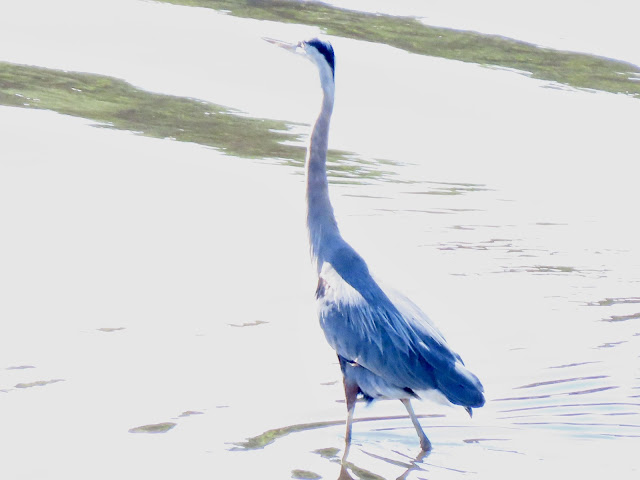
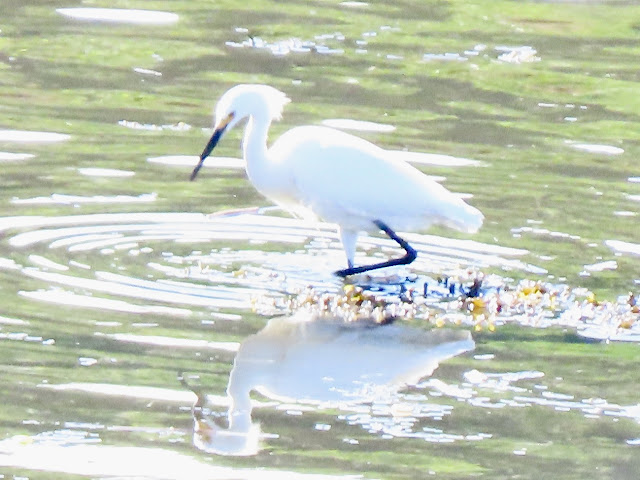
Meanwhile, we returned to our Harbor Towne B&B to sit out on the pier at an inlet from Boothbay Harbor. The photos below caught the only sighting I had there of a GREAT BLUE HERON and a SNOWY EGRET. 


    Venturing out again later in the day, we decided to get an early dinner at Harborside 1901 Bar & Grill located at the Footbridge of 1901. Thus began our seafood fest for the week.  


Tuesday, July 19, 2022

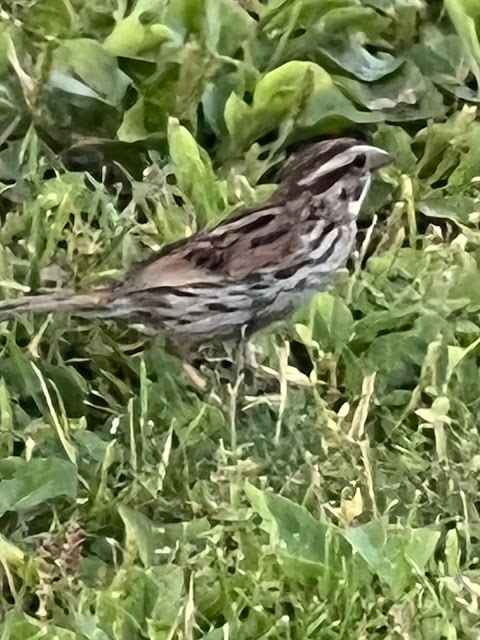
Although breakfast was served at 8:30 a.m. (late for me), coffee and tea were always available. With coffee in hand, I returned to our second-floor deck shared with one other room. With wicker chairs and tables in front of each room, the layout was conducive to meeting our neighbors. On other days, I would sit in the front yard (garden) lush with grass, hedges and trees. There were at least four SONG SPARROW residents along with at least one AMERICAN GOLDFINCH making themselves at home in the lush grounds of the B&B. Hydrangea blossoms were huge.

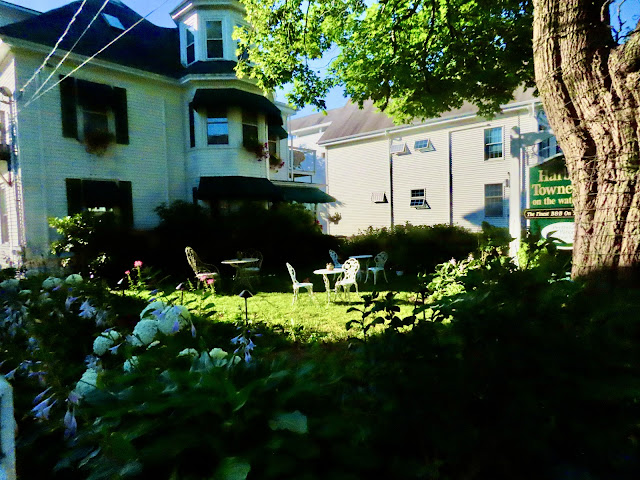
Front view of our Harbor Towne B&B

                  SONG SPARROW - note how dark-colored it is compared to AZ species

Arriving at Pier 7 in a timely manner, we were able to get seats just a few rows behind the cabin on the starboard side. Lawn chairs were bolted to the floor. Carmen, with her Dramamine protocol in place, was quiet but determined to do this. 


With great weather and calm seas, I was excited about this opportunity to see Atlantic Puffins.  For the past forty years, Audubon’s Seabird Restoration Program in the Atlantic Flyway has restored breeding Atlantic Puffins and other seabirds to islands off the coast of Maine. Books are available that describe the innovative use of decoys, mirrors, and recordings to attract birds to suitable nesting sites. And, now, I would get to observe the results of this hard, sustainable work  To see an ATLANTIC PUFFIN for the first time made it a LIFE BIRD sighting for me.

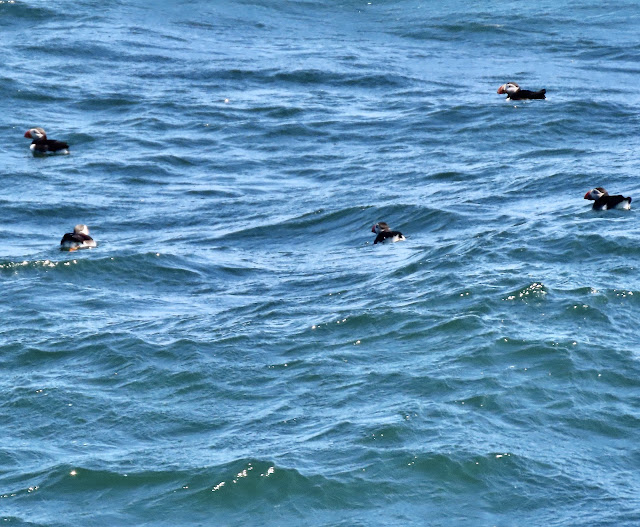
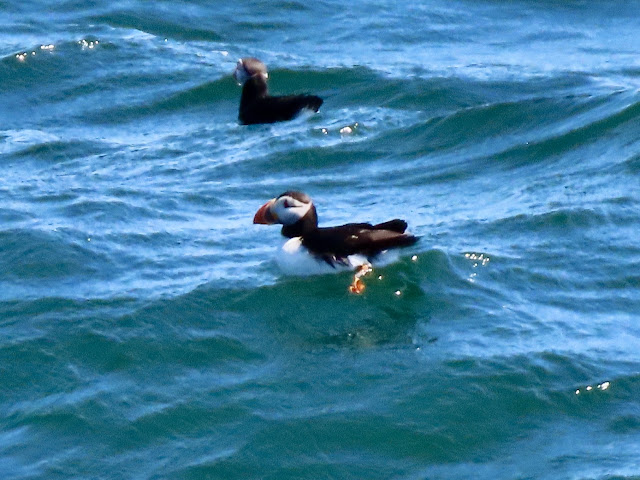
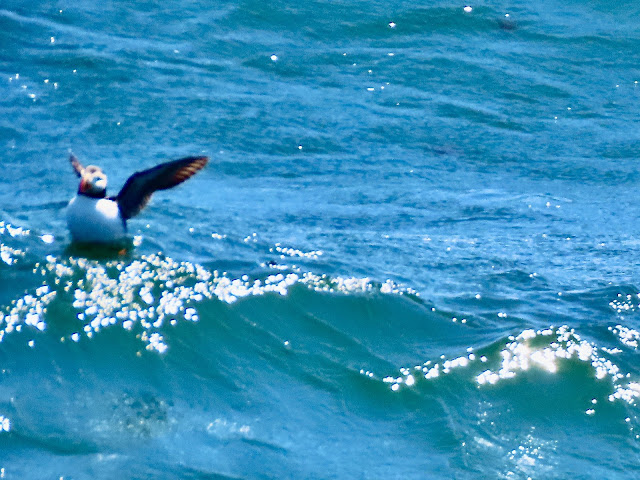
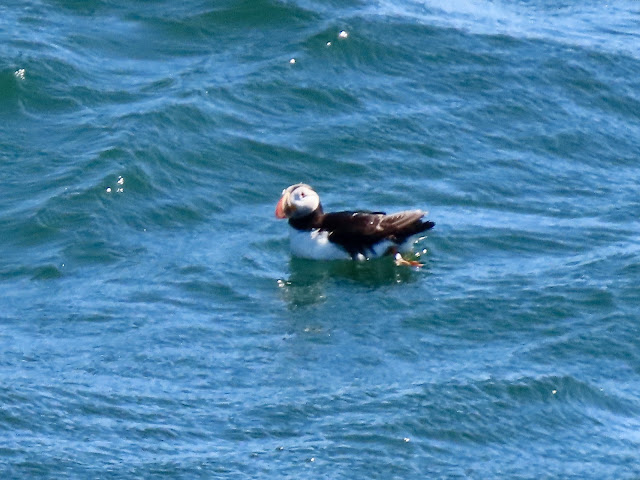
A small flock of Atlantic Puffins

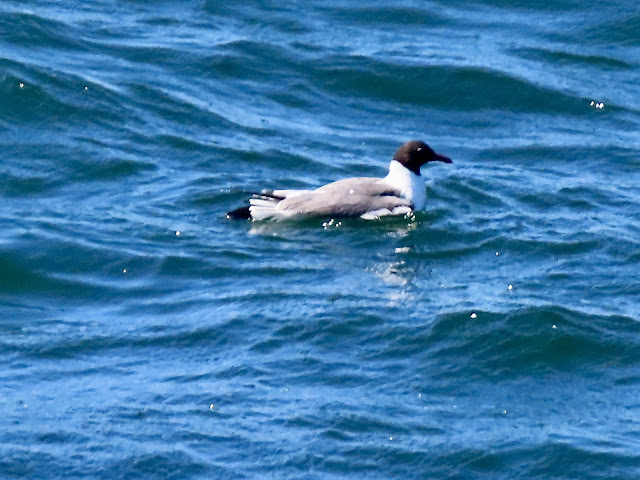
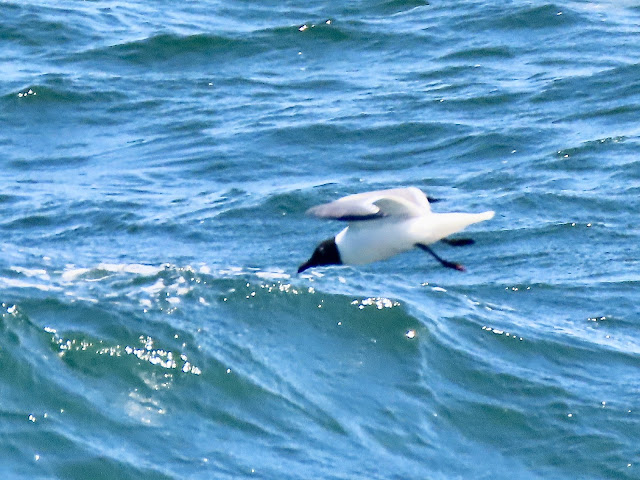
Two LAUGHING GULL of the many flying about:


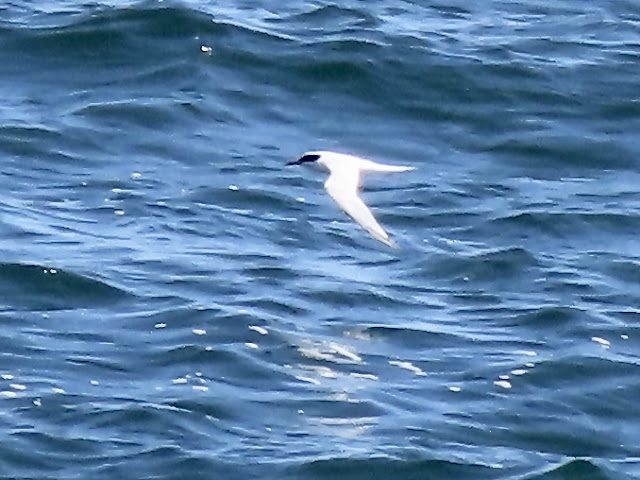
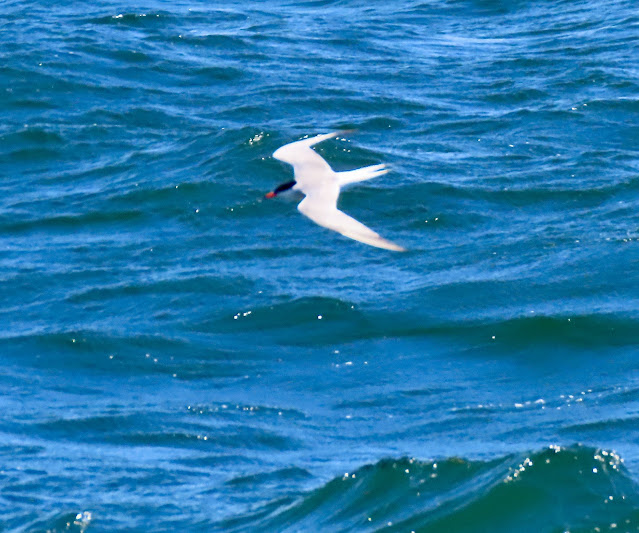
ROSEATE TERN

COMMON TERN

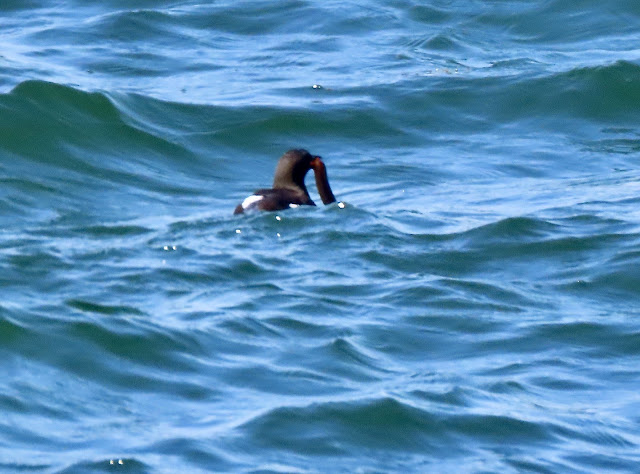
BLACK GUILLEMOT, below, was a second LIFE BIRD for me.


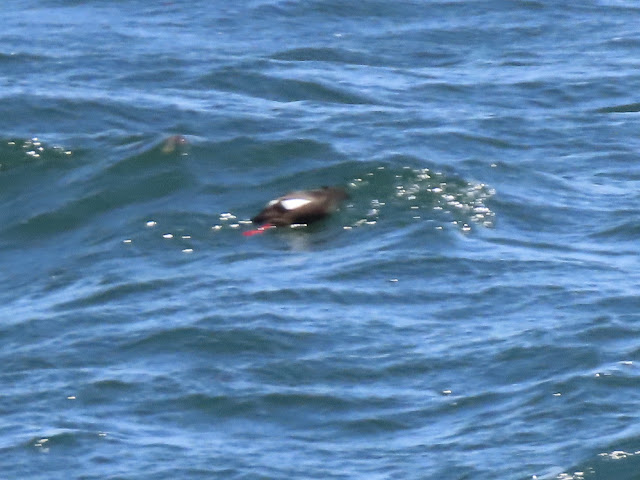
Black Guillemot diving through a wave
C0MMON EIDER was my third Life Bird

    My fourth Life Bird was a RAZORBILL that dipped into a valley between swells that I missed with my camera.
    ATLANTIC PUFFIN, although not easy to photograph, was more numerous giving me the opportunity to gather several decent shots.


So, it's fair to say, I got my Puffin fix!  And, Carmen, during the higher swells with water flying into the boat on the return trip sat like a mummy, her face stoic, her body unmoving. Yay!

    Though the boat trip was the highlight of the visit planned for me, there were also birds in the inlet behind our room at the B&B.
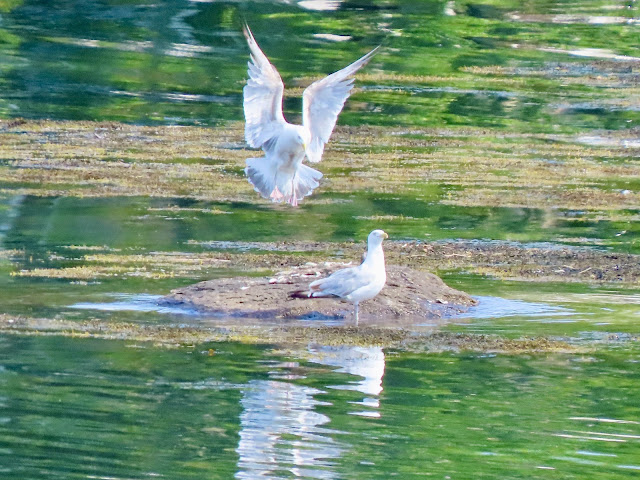
Distant HERRING GULLs above.
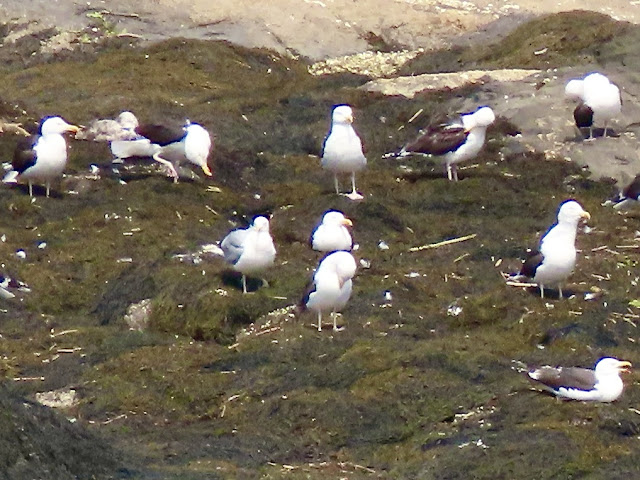
GREAT BLACK-BACKED GULLs

    So, that is it for photos of birds. But, I was always on the lookout, so my eBird lists frequently just list one or two species I happened upon along the way. On a tip from Andy and Carmen's friends from the NY Schools, Connie told me about an Osprey nest right before crossing the bridge into Southport. We spotted it with an adult and one young, fairly grown up, but did not stop for a photo.

    Since I do much of my birding at home at our local Arboretum, I thought the Coastal Maine Botanical Garden would prove to give me some warblers or other song birds. Maybe they were there, but nothing new that I spotted. This could be our time of visiting or it could be because I became so enthralled with the Giant Trolls throughout the beautiful gardens, that I simply wasn't tuned in.

    So, indulge me while I share the three of five GIANT TROLLS we saw.


More local birding at one of our best sites. Maricopa County, AZ

 For local summer birding, I’ve vowed to stay home if the early morning temperature is 90°F or higher.  So, in the past several days, with somewhat cloudy skies, I was additionally motivated on 6/18, being my Mother’s birthdate, and 6/21 being the first day of summer. My Mom loved to walk. She did it on Rockville, Maryland’s city streets, but would have loved the Water Ranch’s wide dirt trails. The first day of summer is always worth celebrating but I must admit the seasons in the Sonoran Desert are quite skewed compared to most of the country with its four identifiable seasons. It is not our growing season; it is our shrinking season…unless we have a wet monsoon.  Some monsoons are all bluster that bring Haboobs with incredibly large waves of dust and dirt. In summer months, light rainfall often evaporates prior to hitting the ground. But a good monsoon is worth celebrating and we’re moving into that period of potential wetness.

Taking advantage of the cloudy sky, I set out early enough to begin birding around 5:30 at the Riparian Preserve at Gilbert’s Water Ranch. Consisting of well-planned 110 acres of streams, marshes, upland, and seven recharge basins of water managed by the City’s water treatment facility, it is a great place to visit. Walkers (with and without dogs), runners, and cyclists are among photographers and bird watchers who frequent the place.


With many waterfowl already having departed for their breeding grounds farther north, many of the ponds are allowed to dry up with just enough water to support the birds that stay for the summer, providing some open water and a lot of open mudflats. The shallow waters are helpful for some of the wading birds that breed right there. 


        Some of the white fluff on the ground is from cottonwood trees; some may be white downy feathers.


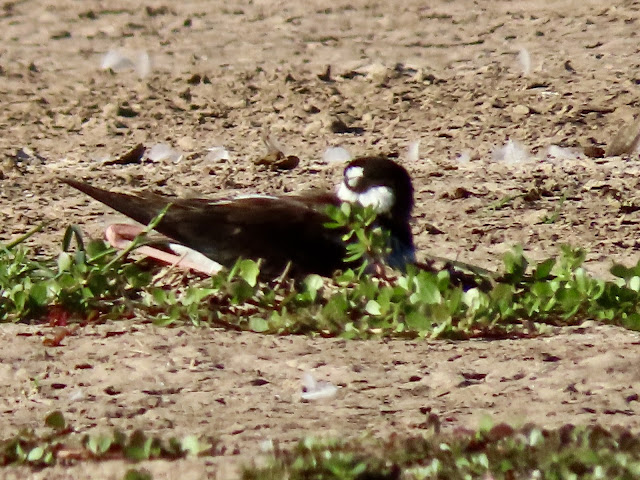
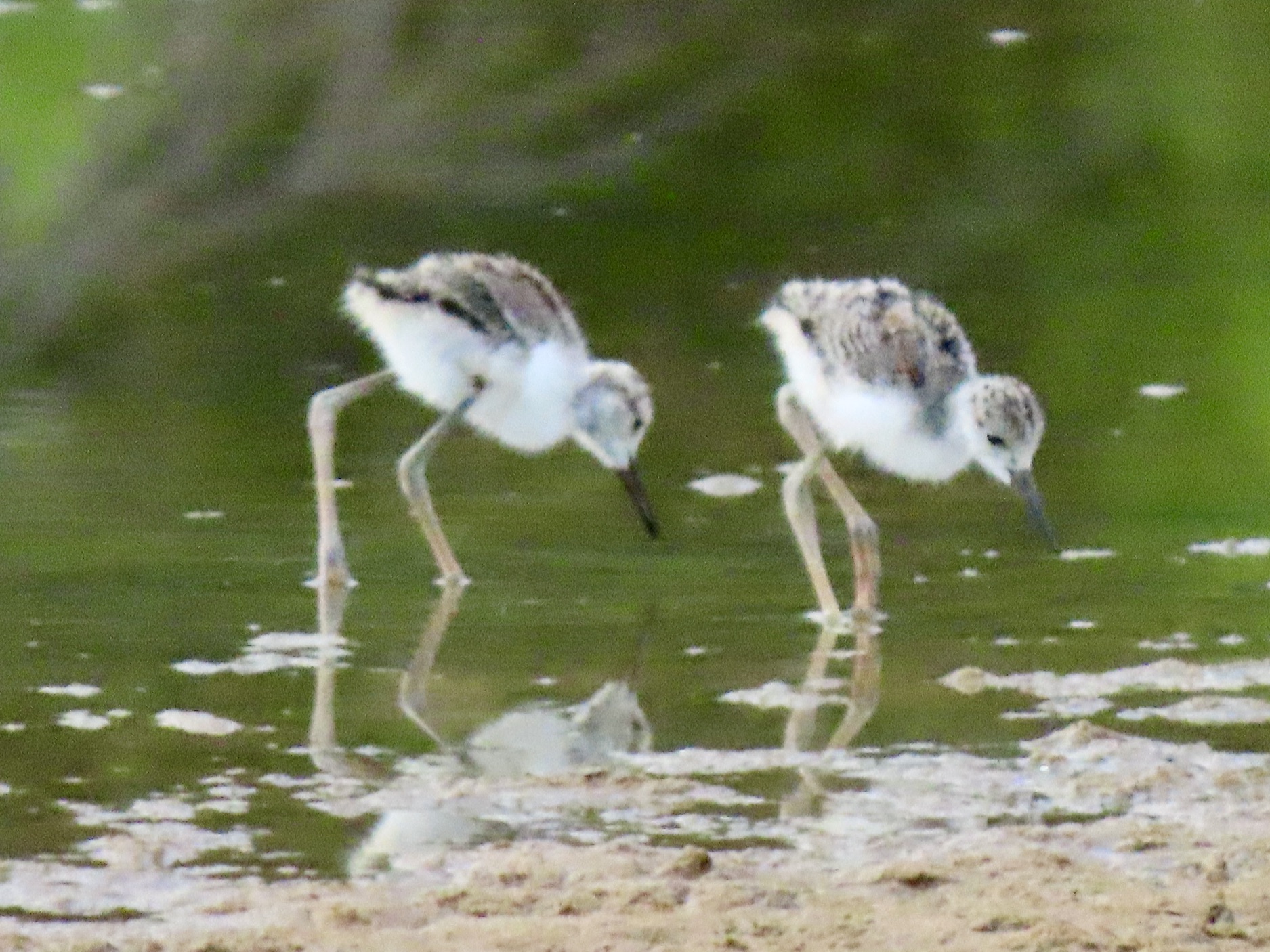
        BLACK-NECKED STILT have had good reproductive success. Photos below.


Adult Black-necked Stilt watching its three fledglings

These Black-necked Stilt above are Immatures, smaller and not yet with the pink legs of the adult, as shown in photo above this one.    

  Always surprising me, four AMERICAN WHITE PELICAN chose to swim and forage in Pond 7 on 6/18. 


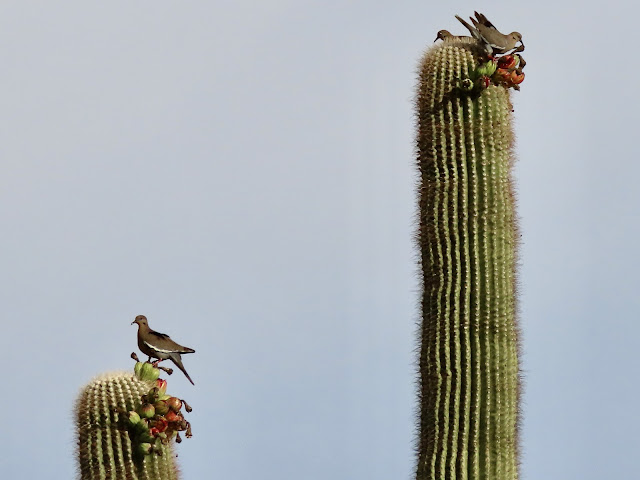
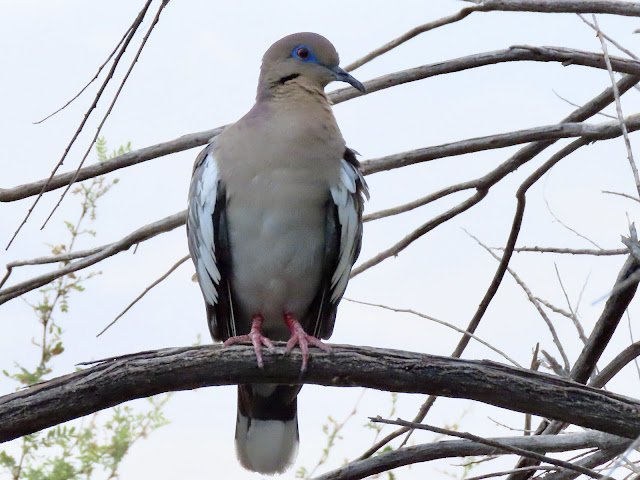
        The WHITE-WINGED DOVE arrives just in time to pollinate the saguaro by eating its flowers at the top of the tall cactus.


              INCA DOVE often forage on the ground


    Juvenile GREAT BLUE HERON, still lacking the full orange bill and white face of the adult.
   SNOWY EGRET, agitated about another bird, perhaps being too close to its feeding grounds.

    On 6/21, I discovered Lindsay Story checking out the bridge at the fishing pond when I arrived. She saw the Least Bittern fly in. I have a hard time finding birds in the marsh reeds and missed it.  We continued birding together until I eventually left after almost two hours.


    Until next time, hope to see some of you other birders out and about in the early a.m.


    As always, my eBird reports can be seen by clicking the links below.


View this checklist online at https://ebird.org/checklist/S113181460

View this checklist online at https://ebird.org/checklist/S113455862


Early Morning Birding at a popular local site, Maricopa County, AZ

 Wednesday, June 1, 2022

    Sensing that it had been many weeks since I'd checked out the birds at Gilbert Water Ranch, I headed there after breakfast. Arriving at 5:20, the parking lot was far from empty. It's light at this hour. With the temperature at 71°F for a June morning, it was definitely time to grab the opportunity.

    A BLACK-CROWNED NIGHT HERON, from its perch in the bushes, was watching its juvenile in another bush. Top photo is adult; lower one, the juvie. Both have red eyes.


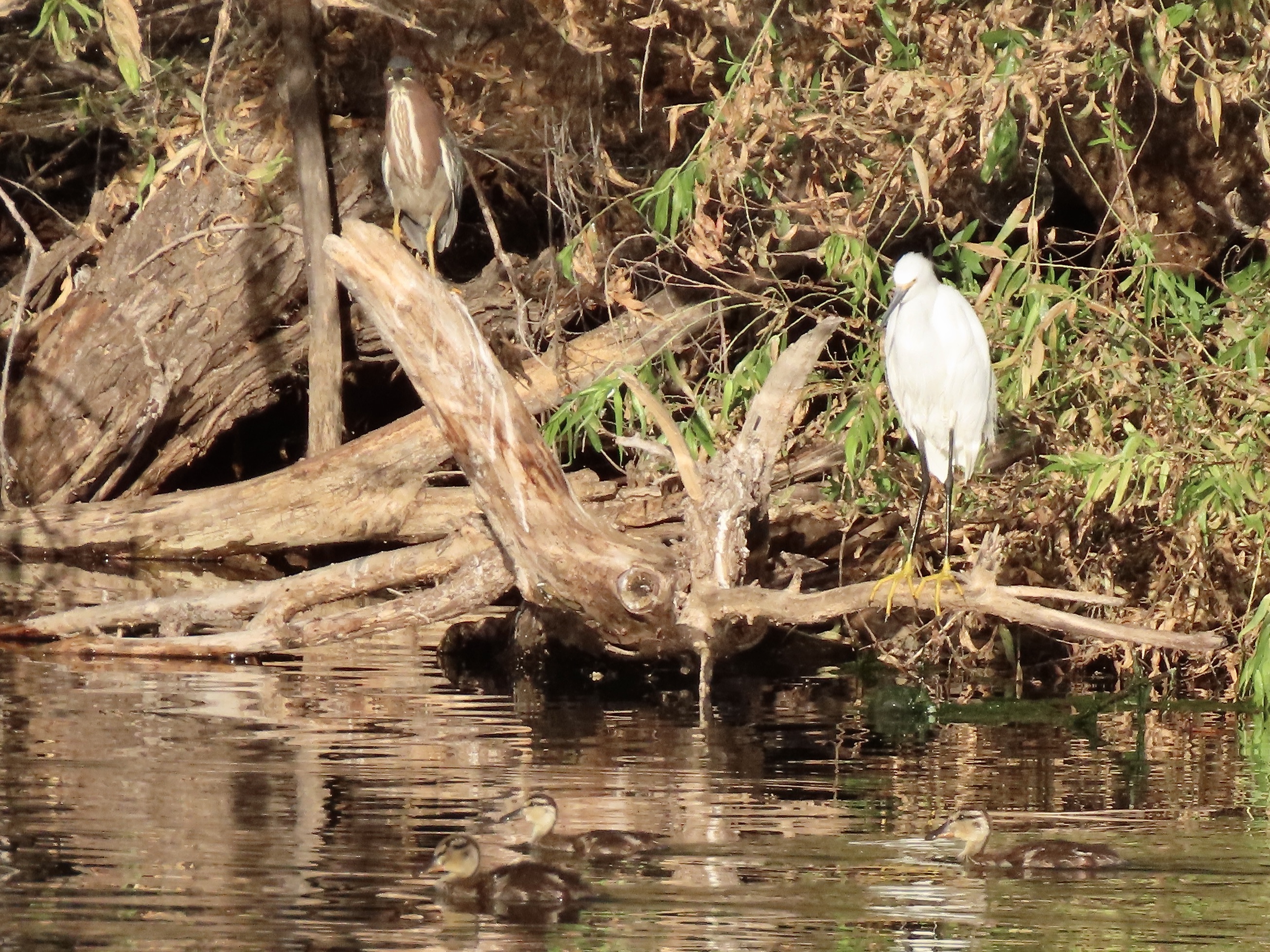
At several ponds, Mallard females with juveniles were a common sight; below.Below is a juvenile Mallard duckling losing its fuzzy down feathers in favor of more practical ones.In the foreground, below the observing GREEN HERON and SNOWY EGRET, swim juvenile Mallard ducklings.

Adult BLACK-NECKED STILT, followed in the second photo by its juvenile.


Juvenile CANADA GOOSE growing out of its fuzzy feathers, below.

Not all the waterfowl were accompanied by young. Pleasantly surprised to find a pair of CINNAMON TEAL on one of the ponds, I clicked off their photograph, too. Most waterfowl have already migrated North. Drake has the red eye; female, the dark eye.
Another lingering duck was one AMERICAN WIGEON, below:

Since a juvenile NEOTROPIC CORMORANT is browner than the darker adult's black appearance, I'll venture to say this may be a young bird, above. Or, the beautiful color may be a feature of sunlight and shadows. At any rate, I was quite taken with it.

There were many more birds, but photos are not always worthy of including here. If you care to see the eBird list, check out:

View this checklist online at https://ebird.org/checklist/S111875723


                                Hope to see some of you birders out in the field soon.