Good Birds still hanging around Maricopa and Pinal County, AZ

Sunday, March 14, 2021 

A last-minute decision found me at Gilbert Riparian Preserve instead of pursuing an indoor agenda. After several days of overcast skies and a touch of rain, the sun rose brightly where I live and I just couldn't stay inside.

Waterfowl were still abundant on the many ponds; I took a few photos. Below are the best sightings with pics:

NORTHERN SHOVELER (Drake)
CINNAMON TEAL (Drake)
COMMON GALLINULE (top and bottom photos here)
 Although the Peregrine Falcon was quite distant, it appears good enough to add below:

PEREGRINE FALCON
My favorite photo of the day was of the RING-NECKED DUCK since the "ring" seldom shows above the waterline shown below.


View this checklist online at https://ebird.org/checklist/S83394666

Wednesday, March 17, 2021

With the sun out again, I birded at Lost Dutchman State Park. With only a light breeze and temps between 51-58°F, it proved to be a good birding day.

With only a few - but important photos - it was a very rejuvenating day.

BENDIRE'S THRASHER prefers desert habitat and it continues to thrill me each time I see it whether at Lost Dutchman or at Apache Junction's Prospector Park.

Similar to our plentiful Curve-billed Thrasher, Bendire's has a shorter beak and very fine triangular spots on its breast--looking more like embroidery than the mish-mash strokes on the Curve-billed. It was so busy singing, it allowed multiple photographs.  Since it's a bit of a rarity, I took advantage of its persistent vocal presentation. After the first darkish photo, I continued to walk around it for better light. Never knowing when a bird will fly, this is the best approach. It was not disturbed by my presence but continued to provide better and better photo ops!


The other photo I'll add is the one I needed to convince myself I was actually seeing a COSTA'S HUMMINGBIRD. Approaching from its backside, I couldn't see necessary ID markers but felt sure by its size, it was a COSTA'S HUMMINGBIRD. Again, the bird stayed perched until I walked abreast of it to get a photo showing some of its front ends. Yep!  Note its smaller size than that of an Anna's Hummingbird as well as the very extended gorget (fu-manchu mustache-like appearance) which did not flash its purple color but extended much farther down its neck into its shoulder area than that of the Anna's HB.


Again, after a few more overcast days, this was a lovely sunny cool day out in the foothills of the Superstition Mountains.

Until I get out in the wild again . . .

View this checklist online at https://ebird.org/checklist/S83566297


Historic Canoa Ranch and Madera Canyon, Pima County, AZ

Tuesday, March 9, 2021

    The best laid plans! One of the three of us setting out for Green Valley this morning had a malfunctioning alarm clock!  Always worth a tease, but our plan was to allow plenty of time to start birding at Canoa Ranch by 8 a.m. - and we did. Sticking to the back route to I-10, we made good time leaving at 5:30 instead of 5 a.m.

    The Raul M. Grijalva Canoa Ranch Conservation Park comprises 4,800 acres of the original San Ignacio de la Canoa Grant and is open to the public. I first stopped to check it out after its lake was in place about two years ago. It has continued to develop with smooth walking trails, benches and ramadas. The Ranch is well-signed along I-19 as the Historic Canoa Ranch, Exit 56 off of I-19 South. A left turn under the highway and another left turn to head back the way you came - on the access road this time, will get you to the entrance in ten minutes or less.

    Hinde Silver, Roxy Squires and I spent about an hour there trying to identify the waterfowl with their heads tucked in...and those that didn't.  With an overcast sky, light was not good for me with pictures, but in a bit over an hour, we identified 24 species. My favorites were the three female Costa's Hummingbirds that, as Roxy pointed out, may have been working on a nest in one of the trees. One came right up to us a couple times, looking at us as we returned the "greeting."  A very yellow-washed Lincoln's Sparrow was also a joy to behold.

View this checklist online at https://ebird.org/checklist/S83074527


     Arriving at Santa Rita Lodge in Madera Canyon, elevation approximately 5,000', we were glad to get a parking spot and noted fewer people than we would have dealt with there on a weekend. So many species at one time at the feeders!! Overwhelming at first, but then we settled down and looked at each bird. Roxy caught on so quickly, she was calling them by name by the time we left!!

    Despite the great photo opportunities here, I had never been satisfied with the photos I took of the special birds. Today, I thought we might get to see the colors better under clouds than direct sunlight!  Whoa!  Did we ever!  

    The BROAD-BILLED HUMMINGBIRD (below) is common at Boyce Thompson Arboretum and  it's possible it could stop by to visit feeders in our community. (I'm seldom home to watch my feeder.) Note its red bill with dark tip; blue throat, bluish-black tail with gray tips. Seldom have my photos caught the colors of this bird here - or anywhere else. It has to do the with the light, that on a cloudy day, appeared to be just right!!


Other birds were bopping around all over the feeding station and to the trees surrounding it,.

WHITE-BREASTED NUTHATCH (above)
SPOTTED TOWHEE (above)
ACORN WOODPECKER (above)

MEXICAN JAY. -  photo by Hinde Silver

    The MEXICAN JAY is neither a Blue Jay nor a Scrub Jay, the two species we are most likely to have seen at one time or another.

    The photos I was able to get of a very special bird, RIVOLI'S HUMMINGBIRD, thrilled me for a change instead of making me ask what I could do differently. Under sunny conditions, the following bird photos would have made the bird appear black all over. For you birders in the community, this has long been called the MAGNIFICENT HUMMINGBIRD but it's name has been changed to Rivoli's.  Apparently, with the advent of eBird that works around the globe, there are other Magnificent Hummingbirds (that I suspect may top ours).  Rivoli's was this bird's former name and I don't quite get the name-changing deal; just go with the flow. 

The remainder of the photos are of the RIVOLI'S HUMMINGBIRD, a very magnificent bird as you will see.


Restraining myself from posting all 50 shots, I'll post the best for last.

Front: Roxy Squires, the Selfie photographer
Back Right: Hinde Silver
Back Left: Babs Buck

Until next time. . .

View this checklist online at https://ebird.org/checklist/S83087185

* * * 


Another look at Coon Bluff Rec Area along the Lower Salt River, Maricopa County, AZ

 Friday, March 5, 2021

With photographer, Jannie Blok along, we explored the bluff area before heading east along the Salt River. A chilly 38°F when we started it warmed up to 63° during our casual birding for three hours.

It's not every day COMMON MERGANZER swim the waters at Coon Bluff but it sure was great to see them. It appeared to be a day out for the ladies. See photos below:


Although a BALD EAGLE flew eastward up river, it was too high to catch a photo. Getting sneaky.

Getting photos on the ground within the mesquite bosque is tough with quick feeders like the DARK-EYED JUNCO we saw, but the female RED-WINGED BLACKBIRDs were more patient in their foraging. The first time I saw these birds, I clueless to their species. How different the female RED-WINGEDs are than the males!

Female RED-WINGED BLACKBIRD

Although I know at least one pair of NORTHERN CARDINAL live at this recreation site, they make themselves known only when they want to. Only the male called to us.

As always, though, the pair of VERMILLION FLYCATCHER, in addition to chasing one another from tree to tree, took time to pose for photos.

Male Vermillion Flycatcher above; Female, below.
Handsome Couple!

Trekking back through the mesquite toward the parking area from the distant east trail, we came upon five (5) JAVALINA, common name here in Arizona for the Collared Peccary (wild pig).  It appeared to be a family group with one young (maybe born last year).  A limb shadow crosses the snout of this first Javalina; it's not a part of it. The collar runs across its nape and under its chin. 


Somedays are just made better by getting outside (we stay masked) but few people were around.

A very pleasant day out there and seeing 34 species of birds makes it even better for me!!

To see the eBird record for today, click on link below.

Until, I get antsy again and find myself outside. . .

* * *

View this checklist online at https://ebird.org/checklist/S82803654


BIRDS, ART, ANIMALS AND FLOWERS, Maricopa County, Arizona

Tuesday, March 2, 2021

    With Roxy Squires, I started birding at Coon Bluff Recreation Area along the Lower Salt River, Mesa, AZ at 7:55 a.m. with sun already well up in a comfortable morning temperature of 58°F giving us a good start to find birds at breakfast.


Most prolific were the male and female PHAINOPEPLA chasing one another from one tree to another. Note the red eye!

Female 
Male


HOUSE FINCH like desert food sources, too. Between foraging they enjoyed the morning sunshine. 


House Finch: Male is growing brighter and brighter in breeding plumage;
Female on lower left snag.


Out over the river, a BALD EAGLE flew circles over our heads.


Some birds are big; others small.
CURVE-BILLED THRASHER - above
BLACK PHOEBE  - hawking insects over the river --(above)
PIED-BILLED GREBE - small duck with breeding bands across bill showing well

A RED-TAILED HAWK was spotted perched high on the bluff, then later, cavorting with another over the river.


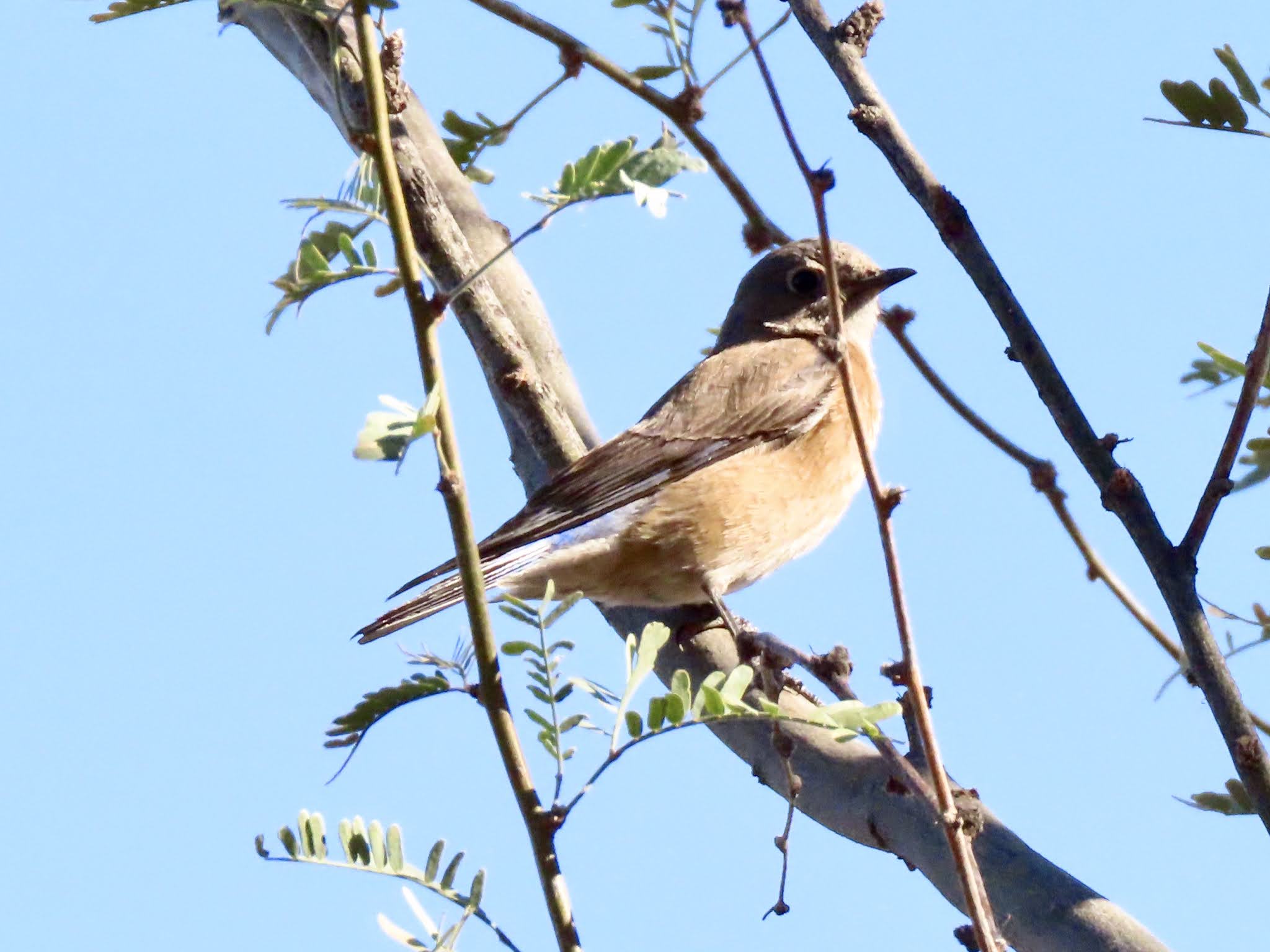
Always a treat, we found a small flock of WESTERN BLUEBIRDs sunning and flitting back and forth over the river to the mesquite bosque.

MALE - above;   pale FEMALE below

Two birds that touch our hearts (viewers, too, it seems) are the male and female VERMILION FLYCATCHER BELOW.
MALE
FEMALE

While we didn't start out in search of wildlife, we hit the jackpot, so to speak, Big ole JAVELINA are hard to miss with their size and stiff-haired backs: wild pigs in the PECCARY family.  


The wild or feral horses are a much more common sight.  With the river water running high and swift only a few full-grown horses crossed.  The rest of the band turned back onto the north shore.


We walked about 2.5 miles, first heading east along the Salt River; then returning through the mesquite bosque. A memorable day!!

For a complete list with photos, click the eBird link below:

View this checklist online at https://ebird.org/checklist/S82631457


_______________________________________

Wednesday, March 4, 2021
Art work called WIND
 by a SFO Studio: WATERLILY POND    
Natasha Lisitsa & Daniel Schultz

Hinde is posed within the support system for WIND and considering how windy it got later in the day after we had returned home, we were thrilled to have seen it this way rather than blasting us and the birds.


The other piece of their art called WATER was interesting. Using yellow rods to show the flow of water did not work for me. But that's art!


Pansy and Anthurium

Birds were active (we spotted 25 species) but moving quickly around the wonderful plants, cactus and exhibits.  NORTHERN FLICKER - Red Shafted is always a nice bird and seldom observed farther east in our part of the desert. 

CACTUS WREN were singing from saguaro all through the Garden.


A pair of GAMBEL'S QUAIL was a nice sighting. There were many many of them out and about so it looks like babies will be in the forecast.

One exhibit about Native American Life: Housing and Kitchen


It's rare to find a Cristate or Crested Cactus available for photos. When a cactus mutates, it grows wide at the top as shown below:


Also present was a grove of ORGAN PIPE CACTUS such as is found in Arizona's southern area known as Organ Pipe Cactus National Monument.  It is full of cactus like these below:


Another sculpture within the Gardens was the one below that I did favor:


Rarely do I try hard for photos of hummingbirds, but I felt certain I was watching a female COSTA'S HUMMINGBIRD but wanted to document it.  Females are not as well marked as the males as you know, so, not seeing that species with any regularity, the photo confirmed my suspicion.


It's a very tiny bird with slightly decurved beak and, when perched, its wing tips touch its tail tip.


After about 3 hours of walking, we were ready to head home again, following the Covid-safe exit as more people entered. Masks were mandatory and the Gardens were limiting numbers of guests by requesting reservations for a time slot.


Many years back, glass artist Chihuly created a spectacular desert presentation of his art work. One still stands at the entrance.


View this checklist online at https://ebird.org/checklist/S82684668


* * *