Local Birding along the Lower Salt River, Maricopa County, Arizona

Saturday, July 18, 2020.
Coon Bluff Recreation Area along the western section of Bush Highway.
Due to Arizona’s governor restoring Stay-at-Home orders because of alarmingly high cases of Covid-19 after many restrictions had been released without proper protocols, almost three weeks had passed before I now ventured out again to do some solo birding. Almost in my backyard, the Lower Salt River offers some really good semi-developed birding areas. This morning, darkness was still hovering when I arrived at 5:18 am.

Two cars in the parking lot indicated possible fishermen already out at the river. Too early for kayakers and paddle boarders, I took advantage of the quiet dawn sky and lush mesquite forest to track down the birds I was hearing.

Below the massive red-rock formation towering behind and above me, I birded the trees on the river banks and its islands, and in the shallows of the river itself. The reddish rock appears to be sandstone…permeable enough to provide a footing for wrens and warblers searching its crevices for bugs like a woodpecker does on a tree.  I’m standing too close, right beneath this uplift to be able to spot any eagles or osprey that might be perched along its higher edges or even on the top of the rock.  When I walk farther east, I’ll look back to check that out. 

With insects thick above the high-flowing river, LESSER NIGHTHAWK are circling and snapping.  My C-V mask keeps those teeny insects from my nose and mouth. I wear it more for filtering the air around me than for its Covid purpose on an outing like this where I rarely see other people and, then, not very close by.

Taking my time, I walk east 2.4 miles from the parking lot on a horse trail lined with willows,  cottonwood and mesquite trees and manage to identify 33 bird species in a little over three hours. Some of that time, I must admit I was interacting with the wild horses with which I was sharing space.
ASH-THROATED FLYCATCHER
Not the greatest photo, but this was a First for me: a juvenile BRONZED COWBIRD
Wild Horse on far (north) shore of the Salt River
VERMILLION FLYCATCHER (male)
 [Saw 5 males and 1 female]
BLACK VULTURE
With skin, no feathers on its head, and long bare legs, this bird is able to scavenge deeply into smelly carcasses without getting its feathers terribly involved. Although a young Turkey Vulture also has a gray head, while this bird was preening, I spotted its silvery patch on its wing tips. A bit smaller than the Turkey Vulture, the Black Vulture has a shorter tail and doesn't ride the thermals with the ease of the TUVU. It needs to flap its wings more often.


While it had been a cool 76°F when I started birding, the temperature inched upward to 93° by the time I returned to the parking lot. Hydration is always important out there as this colt reminded its Mama.

View this checklist online at https://ebird.org/checklist/S71600920

================================================
Tuesday, July 21, 2020
This sunrise under dark clouds just reminds me that days are already getting shorter and I no longer need to arrive by 5:00 a.m.
Granite Reef Recreation Area is the first picnic area accessed if traveling North on Power Road. As Power Road drops down and curves into a hard right onto Bush Highway, Granite Reef is but a couple car lengths on Bush High before a left-hand turn leads into its parking lot. [It is also, then, the final recreation area along the Lower Salt if coming from the east.] Granite Reef Dam is located at this site and provides wide flat river water and nice messy mudflats for a few shorebirds on the south side of the river where I stand, and tall thick reeds on the north side.

Up on the berm, a female BROWN-HEADED COWBIRD had me stumped for a while.

The best birds for photos were down on the mud flats near the dam. There's a SONG SPARROW that lives there and it sat up and sang.

Many birds were out on the wide flat water - mostly MALLARD, but also COMMON GALLINULE.  Had never before seen five (5) BLACK-CROWNED NIGHT HERON there - all perched on one low bare-limbed bush. (lousy photo but good enough to ID; too hot to carry the spotting scope)

To count nine (9) COMMON YELLOWTHROAT at one location was a first for me. There were more in the reeds than I counted; I could hear but not see each of them. Down at the mud flats, several males were singing while females chased each other about. One masked male perched as if it knew I had my camera.


Getting even that distant photo was the highlight of a very good birding day where photos were almost impossible from that point forward. After returning to and walking through the picnic area to the east, I walked along the river as long as the narrow path lasted, then scrambled up to Bush Highway and walked inside the guard rail out to the large dirt parking lot for hikers and fishermen. 
By the time I returned to the car, 2.5 hours had elapsed; I had stayed hydrated and was feeling very refreshed from walking along the Salt River and back.

View this checklist online at https://ebird.org/checklist/S71694851

My blog format is going to change. I'm not sure what that means as to whether it will be the beginning of a whole new blog or a continuation of this one.  Sigh......


Birding the “HASYAMBO”, Wickenburg, Maricopa County, AZ

Saturday, June 27, 2020
Although many rare birds have shown up in Arizona this year, it has been my choice to skip running to various places around the state to see them. With Covid-19 cases in Arizona still ongoing, it didn’t make sense to me to even chase the only Life Bird that showed up (Eared Quetzal) in Eastern Arizona’s Chiricahua Mountains. I’ll see it later, hopefully, in its traditional territory of Central America….without being among hordes of birders/photographers homing in on one bird out in nature.

That decision held until a rare STREAK-BACKED ORIOLE from Mexico decided to build its nest at Hassayampa River Preserve in Wickenburg, Arizona, less than 100 miles from home. It wasn’t a Life Bird, but I’ve been itching to get up there and had yet to do it.

The River Preserve is on 770 acres of land that has been occupied since the 1860s, serving at different times as a stagecoach way-station and a dude ranch. Because of its ecological and cultural value, it was purchased in 1986 by The Nature Conservancy (TNC). Only recently, in 2017, did the TNC donate the property as a conservation easement to Maricopa Parks and Recreation Department to manage. That Department has already proved itself in the management of other critical areas such as Spur Cross Ranch in Cave Creek and Morgan City Wash at Lake Pleasant. 

The word, Hassayampa, appears to be what early settlers picked up from the indigenous Yavapai calling it:  “Hasyambo, meaning the water that disappears.”  
The Apaches referred to it simply as “upside down river” because most of its 100-mile waters run underground through the desert with only intermittent above-ground flows. But, the magic of the Preserve is that the Hassayampa River emerges there and runs above-ground throughout the year.

In my opinion, the Preserve is still one of the “wild” places we can visit without feeling the encroachment of management. Within its three (3) miles of trails, mostly dirt and dust, it’s very easy to spend a full day birding throughout the trail system. 

Friend, Jannie B., joined me for this visit with camera in hand. I discovered she had a good eye for birds, too. Hearing that many birders were already present at the controlled rare bird site, we decided to bird our way to the farthest barrier taking the trail past Palm Lake.

SONG SPARROW walking the trail ahead of us

At the the spring-fed Lake, Jannie was first to spot the young GREEN HERON, with fuzz still on its head, perched perfectly still on a rotting log just above the water line at Palm Lake, staring at the water beyond it.
Young GREEN HERON. (Babs photo above; Jannie's photo below)


We were hearing and seeing lots of birds but many were hidden behind large cottonwood leaves or hanging willow leaves.

At the far end of Palm Lake, we took the trail to the Mesquite Meander where we soon came upon several other birders sitting/standing in order to catch sight of the rare STREAK-BACKED ORIOLE flying into her nest carrying interior decorating softness.  

We joined seven birders behind the yellow tape crossing the trail from where we could see an even larger group on the other side of the nest behind their taped barrier.  On both sides we were watching the nest hanging out over the trail, staying alert to each bird in the area, waiting....waiting....for the rarity to show itself. Some had already seen the bird but said it was intermittent and stayed out for quite a while before returning.

Streak-backed Oriole nest, hanging over Mesquite Meander Trail
I was delighted that each of the birders was wearing a protective mask that does not happen everywhere I bird. If I respect you by wearing a mask, then, thank you, for doing the same.
Ah, here's the bird!!  Click, click, click.  Oriole is gone.  Did I get it????

Female STREAK-BACKED ORIOLE
So, I barely got a photo, but as I mentioned this is not a Life Bird. My first sighting was out in  Yuma in 2016 when a male was present in Riverside Park. (below)

Male STREAK-BACKED ORIOLE, Riverside Park,Yuma 2016.  (above & below) 


While other birders continued to hang out and wait for the male to show up, Jannie and I took off to continue birding the other side of Palm Lake before heading to the River Ramble. There we came upon Eric Hough, a birder I knew from years past and who got the job as Manager of the Preserve for Maricopa County Parks & Recreation. We walked with him for a while before he had to check on some folks who had gone off trail.

Eating lunch under the trees by the entrance later, we checked out the hummingbird and seed feeders to add more birds to our list.  Best bird there was the HOODED ORIOLE who was feeding on the juicy red fruit of a saguaro.

Male HOODED ORIOLE
We wrapped up there by 11:00 a.m. (they open at 7 a.m.) and headed for home. Quickest route for us, even though we live in the East Valley of Phoenix is to take the 202 to I-10 West to the 303 North to Rt. 60 right to the Preserve about 5 miles before reaching Wickenburg.  (left side of road a couple miles past the highway rest area)

The 73°F temperature at start time (7:35) had climbed to 97° so even this wonderful oasis in the Sonoran Desert was letting us know it was time to head out.

Another wonderful day in the wilderness.

You may view our list of 37 species by clicking on the link below.

* * *

View this checklist online at https://ebird.org/checklist/S70887667


Several Sierra Vista Birding Hotspots, Cochise County, AZ

San Pedro RNCA (House and Trails)
Lower Miller Canyon (driving)
Miller Canyon [Beatty’s Guest Ranch and CAS - Donation $5]
Ash Canyon Bird Sanctuary. [Donation $10]
Brown Canyon Ranch


Monday, June 15, 2020
While I own up to being a creature of habit for efficient living, I’ve learned that changing up ordinary routines can add a bit of adrenalin to my birding adventures.
Thus, to avoid our usual overnight motel stay during this Covid-19 pandemic, Hinde Silver and I agreed to depart AJ at 2 a.m. to get to Sierra Vista at a reasonable time for birding. Even though I drove the back way to reach I-10, there was little traffic and we made terrific time due to little if any waiting at traffic lights.

At 5:00 a.m. under a morning sky highlighted by a bright low-hanging crescent moon, we started birding from the parking lot at San Pedro House & Trails. We continued down to the San Pedro River toward the bridge; then out to the mostly dry Kingfisher Pond before turning back. In a bit over two hours, we observed 35 species. Due to the early hour and distance of many of the birds, I held back on photos on the outer trails. The birds featured below were close to the house.

GILA WOODPECKER with young male (which it had been feeding). above & below

SUMMER TANAGER
Young CURVE-BILLED THRASHER
Same bird as above showing no fear of me - almost to my feet. Adult was calling to it but it paid no heed and
did walk all the way up to me, too close for photo!
BLUE GROSBEAK (M) above & below


View this checklist online at https://ebird.org/checklist/S70494822


Driving up Miller Canyon, we spotted our only SWAINSON'S HAWK of the day, but it was high above, its bi-colored underwing showing the opposite pattern of Turkey Vulture light and dark, with light in front and dark at the rear. Dark chest was also visible.

From the parking lot at Beatty's Guest Ranch, we heard several song birds out and about. This was the only place we really wanted a "target bird" - an Arizona rarity: WHITE-EARED HUMMINGBIRD. [This has been an amazing year for rarities in Arizona; however I haven't chased.). Having seen the WHITE-EARED HUMMINGBIRD before at Beatty's, as soon as we settled ourselves at the Gazebo, I called it immediately.  There was our bird, drinking nectar from a feeder. [Life Bird for Hinde]
WHITE-EARED HUMMINGBIRD
The hummingbird feeding station up the hill and across the bridge was humming with activity: 

This bird, female BROAD-BILLED HUMMINGBIRD, I used to mistake for the as yet unseen WHITE-EARED HUMMINGBIRD. Much easier to see the difference once the rare bird has been observed.

BROAD-BILLED HUMMINGBIRD (female)
RIVIOLI'S HUMMINGBIRD
The RIVOLI'S name when I first learned this hummer was "MAGNIFICENT".  For this large colorful hummer, I still prefer MAGNIFICENT HUMMINGBIRD. Scientifically, the DNA groups it with another species. No matter its name, when its full colors are apparent, it is, indeed, magnificent!

Returning toward the parking lot, we continued to see interesting birds:
CANYON TOWHEE
SUMMER TANAGER (male) above and below


View this checklist online at https://ebird.org/checklist/S70495575
View this checklist online at https://ebird.org/checklist/S70495788

We continued to munch on healthy foods and I added iced tea I had carried from home to keep me energized for the long day.

ASH CANYON BIRD SANCTUARY is a beautiful place with some good rarities if you arrive at dawn or dusk. At almost 10 a.m., we were surprised at the amount of bird activity still going on but none of the "goodies" :(Montezuma or Scaled Quail, nor Lucifer Hummingbird)
LESSER GOLDFINCH (male at top; females/young below)
BULLOCK'S ORIOLE (male) 
Juvenile Male BLUE GROSBEAK
Adult Male BLUE GROSBEAK

View this checklist online at https://ebird.org/checklist/S70496632

Our next stop was at Mimosa Restaurant where we both ordered our favorite: Margherita Pizza to eat outside.  They had just opened the inside but we didn't consider temps in the high 70s as hot and it gave us more space.  We birded there, come to think of it, but didn't enter it into eBird.  A SAY'S PHOEBE had built a nest on the cover of one of the porch lights attached to the front of the building and was busy bringing food to two young. It looked like she found some good bugs on my car!

Our final stop, Brown Canyon Ranch, was one that is usually an afterthought, but when we have plenty of time, the trail to the south at that location provides some very good birds. This was just a, "Let's stop and see what we find around the ranch house and pond."

With a reputation of surprising us with a good bird (in the past, Cassin's Finch); today, it was a perched and singing CRISSAL THRASHER!  Not an easy bird to find but not rare; it's found at some of the recreation areas along the Lower Salt River.  It's just more secretive, usually, than the Curve-billed Thrasher.  We were thrilled!!

A slightly larger bird than our familiar Curve-billed, this thrasher has a longer thinner curved bill than the Curve-billed's heavy bill.  Its under-tail coverts, not easily seen here, are very dark, almost a mahogany color as opposed to the lighter UTC of the Curve-billed. 

CRISSAL THRASHER - two birds above
What a way to end the day!!


View this checklist online at https://ebird.org/checklist/S70496929N

It had clouded up at bit at Brown Canyon Ranch, so I commented as we headed out for Apache Junction that it was one of the few times I'd visited Sierra Vista with no rain interruptions.  About two miles later, we were in heavy rain!!  Once we left town, it slowed and then stopped. The mountains must bring the rain.  Cochise County probably has the best record in the state for its Covid-19 control (468 cases; 6 deaths).

When you check these bird observations in eBird, you'll also see some of Hinde's photos.

59 species from 5 sites
Our time birding in the field:   8 hours
Driving out and back:             6 hours.
We were gone from 2 a.m. 'til 4 p.m.  = a good 14-hour birding day!


* * *


Two local spots: 6/10 & 6/12/2020. Maricopa County, AZ

Wednesday June 10 & Friday, June 12, 2020
At Goldfield Recreation Area along the Lower Salt River on 6/10/20, temperatures were cold enough at 4:56 a.m. to stiffen my fingers for writing legible field notations of our sightings. Unusual during these hot summer days.
(iPhone is temporarily broken and awaiting appointment with Apple to transfer, if possible, former data from kaput phone to a new one. Already missing the ease of listing with eBird online by smart phone.)

Habitat of the two places I birded exhibit a strong contrast.  At Goldfield, with Hinde Silver, we spotted two BALD EAGLE from the parking lot.  They were perched quite a bit north of the river beyond my camera range, but we got good binocular views.

Walking down the concrete path (west side of pkg lot), we reached the river rock "beach" but found no waterfowl; no herons, no egrets.

ABERT'S TOWHEE were numerous everywhere among the shrubs growing up on the rocky beach. They continued to be constant when we went up hill to the deep sandy trail leading eastward. Habitat is a mix of mesquite, willow and cottonwoods with ground cover of tiny flowering plants: blue, purple, white.  

The only heron we did spot was a GREAT BLUE perched on the north shore in the distance.
GREAT BLUE HERON - juvenile based on dark head, bi-colored bill.
Birds were actively singing and flying about. Walking into the rising sun made for difficult photography so pictures are slim; I just didn't take many.

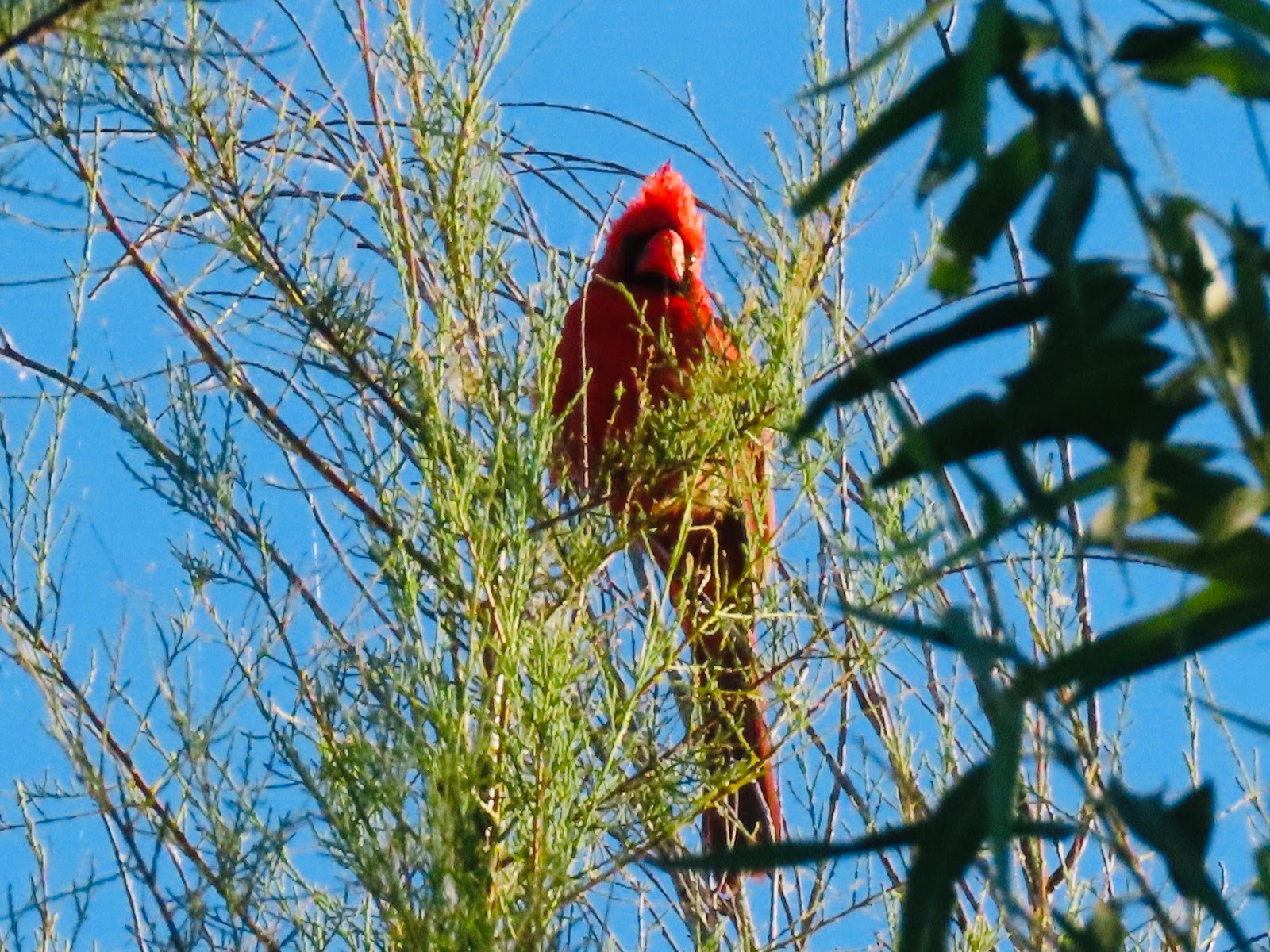
A NORTHERN CARDINAL was singing away.

ASH-THROATED FLYCATCHERs with their flashy rufous colors were active throughout to the point we weren't sure if they were the same birds or more. Our count of four sightings may be a conservative count.
Front view ASH-THROATED FLYCATCHER with pale yellow bellY
Profile view: ASH-THROATED FLYCATCHER
When we reached the sandstone bluffs and pillars, the air was full of swallows, mostly adults flying to and from their nests in the bluff with food for young. Not just three or four swallows; it looked like close to 100 in the air above us. CLIFF and NORTHERN ROUGH-WINGED SWALLOWs made up the majority with a couple VIOLET-GREEN also seen, but could not verify their nesting in the cliff. Just joined the party, I think,

Close to the shore of the river on our side of the bluff, several RED-WINGED BLACKBIRDs were displaying in hopes of attracting a female. 


While on the ground, the red on the wings is obviously in full color and thick.
The red is trimmed with a thin yellow band.
When displaying for a female, the blackbird hunches its back, bringing the wings forward to
let the sunlight catch the brilliance of its red epaulets. (Above & below)

Today at The Riparian Preserve at Gilbert Water Ranch, the seven RED-WINGED BLACKBIRDs I spotted were flying from place to place and not displaying.

Here, the hard wide dirt trails are packed and easily walked. With shrubs, bushes and trees on both sides of the trails, it is easy to spend 4-5 hours here to cover everything. I didn't do that today.

SONG SPARROWs were singing out in the open along most trails.

HOUSE SPARROW were abundant, also. The only photo I took was of a young under a ramada on a picnic table. It had been shaking its wings and calling, but the best pic was when it calmed down to see what would happen after its tantrum.
Fledgling HOUSE SPARROW waiting for food


BLACK-CHINNED HUMMINGBIRDs are not always easy to photograph but I lucked out today. See two photos below.


Many of the birds at the Water Ranch are in the ponds or dry basins.


Juvenile BLACK-CROWNED NIGHT HERON next to one of the ponds
My "spark" bird, the GREEN HERON
The BLACK-NECKED STILT can stop your breath with their dainty calm steps as they go about foraging for food.


In under two hours I had enjoyed watching 33 species in their various habitats. For me, there is not a whole lot that surpasses that experience.


* * *

Links to eBird lists:
View this checklist online at https://ebird.org/checklist/S70277007
View this checklist online at https://ebird.org/checklist/S70346646