Escape from Desert Heat to the White Mountains, Apache County, AZ

September 27 & 28, 2018
With high summer temperatures lingering into the final week of September, I checked the weather in the White Mountains. With an unusual two sunny days in a row forecast up there, I decided to throw my gear together and go!! 

Thursday, September 27th:
Ah! Just the drive through open space where aspen leaves were turning a hint of yellow, seeing pronghorn in the fields and a NORTHERN HARRIER flying low along grasses beside Route 260 East, made me feel very glad to have sought out the higher elevation.

What shocked and surprised me were:
I had slowed because of the young one aiming for the highway and stopped immediately.
Then I realized it was a large herd of BIGHORN SHEEP.
They appear to be part of a herd of twelve Rocky Mountain Bighorn Sheep released in this Eager area a few years ago. I had never seen them up there before.
Large ram was one of another group of six on both sides of this fence


Couldn’t resist taking time for photos. They were across the highway from that big reddish cinder cone along 260E (toward Eager).

As if that wasn’t sufficent indicaton of my having a good day up there, as I pulled into the entrance road for my first birding stop at the South Fork of the Little Colorado River, a very white hawk (as seen from below) came flying toward me. Jumping out of the car, I got my binoculars on it and confirmed what I suspected: SHORT-TAILED HAWK!  What is that bird doing up here?? It’s usual and rare location is SE Arizona. I knew I had to get a photo but by now, the bird had flown into the rising sun and I lost it temporarily.  By the time, I refound it, the SHORT-TAILED HAWK was way off in the distance. The sun was interfering and I never got an identifiable photo of the STHA. The Broad-winged Hawk (also short tailed) is much darker and its head color wraps around its neck and throat. This bird was so white below, I’m thinking it may have been a juvenile. It showed black fingers on the wings; a black band at the end of its short spread white tail and its “white panels” toward the end of its wings were brilliantly white in that early sun. Quite a rush!! 

With such a rare sighting, I drove forward toward the usual birding spot, parking just before the bridge over this tributary of the Little Colorado. No soon did I step out of the car than a flock of PINYON JAY flew overhead! Always delighted when I find them here.

After crossing the bridge and walking up the paved road to the corner, I heard a GRAY CATBIRD off to the left. That was new spot to hear that bird but I entered it into my field notebook. 

Returning to the bridge, I heard and then saw a BELTED KINGFISHER at the east end of the pasture/grasslands and found a GREAT BLUE HERON perched on the usual snag by the bridge - often a good spot to find woodpeckers.

GREAT BLUE HERON

Back at the bridge, as I followed a path along the stream to the east, I heard a beautiful song between two birds. It wasn't a robin song; who is that??

Finally, I located two of them: TOWNSEND'S SOLITAIRE - in that same thrush family as robins.


The TOWNSEND'S SOLITAIRE were in the pines and other tall trees singing away. (I counted at least four.)  I stood and listened for some time before walking on. They were still singing when I wrapped up later. Not far from the Solitaires was a good-sized beaver dam that I chose to use for a standing spot. Good choice.

No photos, but soon a GRAY CATBIRD flew out from the shrubs across the stream and landed a bit downstream. It called back to another still in the shrubs.

AMERICAN ROBINS were present, too. 


And, as I walked back to the car, LESSER GOLDFINCH were calling its descending whistle sound.

Continuing on, then, to the South Fork Campground, I continued to hear good birds:
PGYMY NUTHATCH, MOUNTAIN CHICKADEE, NORTHERN FLICKER, AMERICAN KESTREL, and a WHITE-BREASTED NUTHATCH among other expected species.

Morning was fast disappearing; it was noontime when I reached Butler Canyon Trailhead in Greer. The absolute worse time for birding! Birds seem to lie low between noon and 2 p.m.! After eating a sandwich I had carried, I began the walk up 8600-9000' to search for two elusive birds (for me this year): WILLIAMSON'S SAPSUCKER and AMERICAN THREE-TOED WOODPECKER. It was cool among the fire-scarred but still live very tall pine trees, aspen and undergrowth. The American Three-toed Woodpecker favors burned bark so I took my time looking up and down each trunk on each side of the trail. In no hurry, especially at high elevation, I moseyed up and around, taking two hours to cover the one-mile loop trail. 
Four woodpeckers but not the one I was seeking!  HAIRY, DOWNY, RED-NAPED SAPSUCKER and NORTHERN FLICKER gave me good but quick looks.

It had been an early-morning start and I was slowing down. Driving to the end of the Greer Road, I checked out the trees and stream there but found a family swimming/splashing around in it so I left.

Sipe White Mountain Wildlife Area was the last spot for the day. While my hopes had dimmed for finding a Calliope Hummingbird there, I was still startled to hear that a cold spell two days previous had sent all the hummingbirds away! Still, Sipe is a nice place to stroll and I spotted twelve species in an hour. Among them was this Red-shafted NORTHERN FLICKER. 


Friday, September 28th:
Beginning my journey homeward with two major birding stops along the way, I reached Pole Knoll at 7:10 a.m. where I was able to find a pair of WILLIAMSON'S SAPSUCKER.
The female is totally different, being brown with narrow bands across the back but retains the yellow on the belly.

WESTERN BLUEBIRDs were flitting all over the place.


Spending over an hour there was delightful! There were other birds, it was a comfortable 55°F, and I was breathing fresh air. And, I had found one of my nemesis birds for this year, the WILLIAMSON'S SAPSUCKER.

But that meant, I needed to hike the Mt. Baldy #94 Trail at Sheep's Crossing. That was my next stop and that hike, too, was pleasant.

A RED-TAILED HAWK cut through the trees like an accipiter! Was amazed to see its red tail!

It wasn't terribly long up the trail before I saw a woodpecker fly into a tree, maybe three back from the trail. Not knowing specifically which one I saw, I guessed it was the rare one I was searching for. When I stopped and listened, I heard pieces of bark hitting the ground...and smiled. That's my bird! The AMERICAN THREE-TOED doesn't always drum like other woodpeckers, but will flick the bark aside to get a grub or two. I found it high up!  Then, with the speed of a hummingbird, the male flew in and passed the female, landing on another nearby tree.  Wow!

There were other birds around so I continued up the trail. At an opening I heard GRAY JAYs now known as CANADA JAY. (Its name was "Canada Jay" from 1772 until 1957 when the American Ornithological Society changed it to "Gray Jay". After debate this year, the committee restored the species' official common name (9-1). 

The CANADA JAY'S  habits remain the same as ever. It can be loud and noisy, but among people it appears curious and unafraid. Several worked their way forward from the forest to the opening, coming closer and closer.


To me, the CANADA JAY is a handsome intelligent social bird; I like the bird, by whatever name it's known!

Also present were the typical forest birds. After getting the CLARK'S NUTCRACKER, I found a path down to Sheep's Crossing and birded that area prior to heading home. 


The highlight down Sheep's Crossing was the SWAINSON'S HAWK that flew in. Immediately, the RED-TAILED HAWK, deeper in the forest came flying out to send the Swainson's away from its territory. I chuckled but then realized I had a heck of a walk in front of me all the way back to the car at the Mt. Baldy #94 trailhead!

Til next time.


* * *


Local Birding, Maricopa County, AZ

September 25 & 30, 2018
Birding too often right now to maintain my blog, I'll do a quick show of some nifty birds that can be seen within easy traveling distance.

This first group were observed at the Chart House grounds -- yes, that tony seafood restaurant in Scottsdale on McCormick Parkway. Leaving before dawn to miss commuter traffic, it was a beautiful morning.


EGYPTIAN GOOSE - it's wild, but considered an exotic. It shows up here and there from time to time.
EGYPTIAN GOOSE hanging out with the CANADA GEESE.
Walking the edge of the pond, I came across a Black-crowned Night Heron that, when I went to photograph it, was incredibly hard to discern among the rocks. It seemed really well camouflaged.


Note the bird's colors among the rocks: BLACK-CROWNED NIGHT HERON

It felt good to see the BELTED KINGFISHER. They smartly leave for the summer!
BELTED KINGFISHER  (male)
A quick run south on the 101 took me to the Gilbert Civic Center area where a flock of MONK PARAKEET have nested in the median palm trees of the shopping center across from the Civic Center. Parking near Gilbert Road in the S.C. lot in front of some restaurants should give you a good view of these unusual birds in the wild.
MONK PARAKEET, across from Gilbert Civic Center

Who would have guessed that sewage treatment ponds (water settlement basins or whatever name is used for these filtration water systems) would attract so many interesting birds?

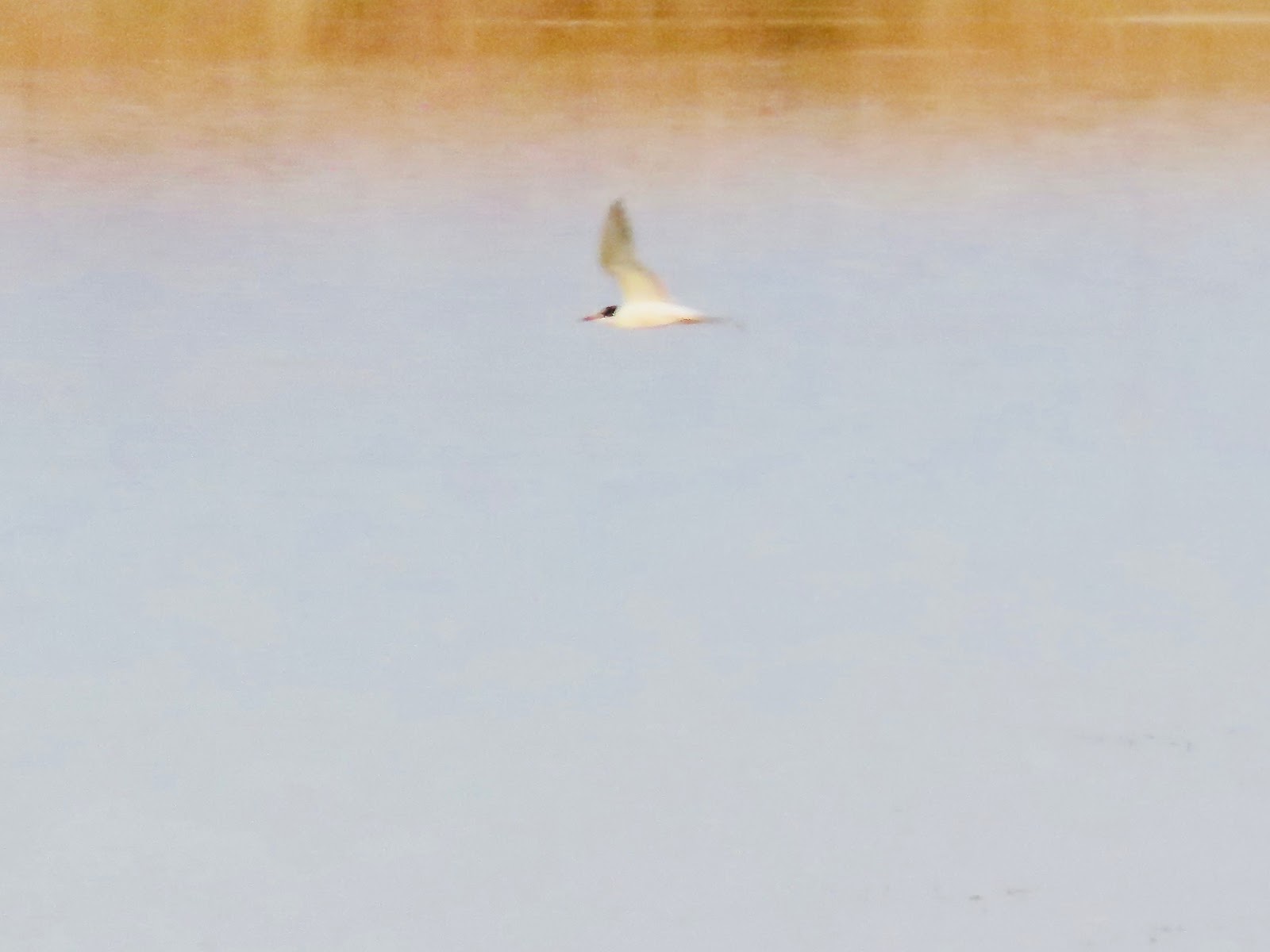
Hinde Silver and I drove out to Glendale Ponds on Sunday, 9/30/18, to catch a glimpse of a COMMON TERN if it was still visiting the ponds. It was!  Again, we arrived early. Jeff Ritz was already there at dawn and other birders soon arrived. The COMMON TERN showed up but my camera is not always up to the distance I needed to cover to catch the bird in action....the only way we saw it.
COMMON TERN - more of a shorebird than an inland bird
Then, driving farther west and south, we visited Arlington Wildlife Area to catch a glimpse of another rare bird! A ROSEATE SPOONBILL had been stopping by the ponds there. It's a gorgeous bird seen more frequently in Texas and Florida than here in the desert.

While we waited for the bird to show, flocks of WHITE-FACED IBIS landed at the remnant of the eastern-most lake. 
WHITE-FACED IBIS - basic plumage
A few weeks ago, the sandy part of this pond was filled with water. Today WFIB were preening.
Finally, overhead: WOW!  And, WOW!  Sometimes birds just blow my mind.
ROSEATE SPOONBILL in ARIZONA!
Same ROSEATE SPOONBILL, a bit closer in flight
Although we had one more stop for a "target" bird (rarity to add to our Arizona Bird List for this year), I didn't manage a photo. It was fully across a pond at Gilbert Water Ranch, but I was delighted we found it.  AMERICAN BITTERN are stealthy with highly camouflaged feathering and are exceptionally difficult to spot - especially in the brushy area where  it had previously been reported. But it was almost mid-day and heat was building; this would be the only spot we would check. 

What are the chances?  I'm usually an upbeat optimistic person, but I know this bird; I didn't give us the odds. As I scanned the shrubs and limbs, though, I stopped short. 

"Hinde! Take a look!  Over there--on that tiny curved limb."
She said, "That's it!!" 
And, sure enough, we were looking at an AMERICAN BITTERN ever so slightly beyond the brush on a snag branch! In the past this bird has taken my breath away with its full persona -- it's secretive, furtive behavior; its 28" of beauty when fully stretched out with bold soft brown stripes running from its throat to belly so that it blends in with reeds; its small head with a beady yellow eye and narrow pointed yellow bill ready for the kill. I tried to find it in my viewfinder, but couldn't.

Hinde said, "It disappeared." 

That's what this bird does best!

We were thrilled with a day of target birding: three for three! Not often that happens. Frankly, I don't enjoy target birding but these rarities were too good to pass up. When you miss the target bird, there is nothing quite like the feeling you get either...more than a bummer; it seems like a real downer. And, it's just a bird. But it is a quest; and missing is not the object!

My objective to make this the best personal birding year of my life continues to materialize very well. With my pelagic trip out of Half Moon Bay, I exceeded my hope of reaching a goal of seeing 500 species in the USA. (AZ, CO, TX, CA, AK)  
Thanks to eBird that does all the calculations, my count now stands at 517 species. 
Must not have aimed high enough; I'll move forward a step at a time: 
New Goal: 525 species.


* * *


Half Moon Bay: Land and Sea Birding, San Mateo, CA PART TWO


Today I went out on the sea to see
The birds that rarely come to land
How will I greet them?
Will they eat right from my hand?
Might they really come to me?


Saturday, September 22, 2018
My friend, Kathe, had opened the gate to our hostel to let us out of the grounds prior to the usual opening time of 7:30 a.m. We needed to be at the dock by 7:00 a.m. sharp - or risk being called out (as in the movie, THE BIG YEAR), or, worse, being left behind. Anyone who knows me well, knows that I’m an early riser so we arrived with time to spare along with other birders. 

For an introduction to Debi Love Shearwater, check out Part One of this blog.

For orientation, Debi communicated all the rules and expectations including: 1) NO STANDING IN FRONT OF THE CABIN WINDSHIELD - Stay Seated. This had to be repeated on the boat since we get excited about the sightings and forget the pilot needs to have visibility. 2) NO PUKING IN THE HEAD - Go to the back of the boat. This was also repeated for cause; I heard only one person get sick at the back of the boat. So, I think most of us did fine.

Debi is as interested in the sea mammals as the birds. For our help and to satisfy the scientific requirements of eBird, two bird guides were on hand to help with listing and counting species so we birders could just enjoy. The trip was broken down into two specific territories: a) near shore; and 2) as we cruised out toward the Continental Shelf calculating each hour with many stats (co-ordinates; depth, etc) to provide time and place of bird sightings. And, OMG! We had some unusuals.

Bird Guides were: Steve Hampton (see article about him in most recent Bird Watching Magazine); Alex Rinkert; and Tom. Tom’s job was chumming from the rear of the boat; he was a great spotter and full of information about each species so I learned a lot from him. Steve had the gargantuan task of preparing the lists - for which he and Alex coordinated the details each hour. All told, the sea was calm; we went out 27 miles (including two miles over canyons in the Continental Shelf where swells reached 3-4’).  This is the place to find Storm Petrels.

Steve (left); Alex (right)
Having looked forward to this adventure with Debi Love Shearwater for some months, I was thrilled with good weather - despite a threatening forecast. No storms; just marine layer and even lack of any spray onto the boat that the guides said was highly unusual. It was that calm. To Tom, I suggested the cause was the Autumn Equinox; he countered that it’s always sun and wind. But he also gave the idea some world-wide weather pattern thought.

Taking photos from a moving boat of moving birds on moving water was a daunting challenge!! So, I’ve taken some photos from the internet and labeled them as such.

Among the birds you probably know well, we saw BROWN PELICANS along the jetties: total count of them for the day was 4,500!  Below is one of many photos I took of them.

Shorebirds foraged from the low rocks close to the water, including this LIFE BIRD! (First time I've seen a SURFBIRD) But this was my first attempt at taking pics from the boat and I failed completely. 
SURFBIRD    (internet photo)
BLACK TURNSTONE  (also internet photo)  It, too, was on the low rocks of jetty.
The BRANDT'S CORMORANT (Left rear) is probably a juvenile with significant light feathering on the neck.
WESTERN GULL -- yellow bill with red dot on lower mandible; pink legs and feet  (Right rear)
DOUBLE-CRESTED CORMORANT are among the ones that visit our inland waterways. (2 front)

As we moved out of Pillar Point Harbor, we began to see the alcids I came to see!  First up were:
MARBLED MURRELET - two swimming away from me beside the boat
COMMON MURRE - basic, not breeding, plumage
These birds look very different on summer visits to the west coast 
In breeding plumage, the COMMON MURRE looks more like these two below.

COMMON MURRE - breeding plumage (taken in St. Paul, Pribilofs, earlier this summer)

Quite distant from the boat was this TUFTED PUFFIN in basic, not breeding, plumage
We saw two such puffins on the whole trip.
Compare with how it looks in breeding plumage, below.
TUFTED PUFFIN, taken this summer at St.Paul, Pribilof Islands, AK
The one I really wanted to see would be a Life Bird: RHINOCEROUS AUKLET. Debi told me they usually see between two and five on any given trip so she pretty much assured me I would see the bird! Did we ever!  50 total.  Each time I looked up and saw a small black bird swimming too far for photo but close enough for binocular view - there was my LIFE BIRD! It's a strange-looking one and out of breeding season, it doesn't have the "horn" on its bill that provides good ID. It's in the puffin family but still considered an auklet.

RHINOCEROUS AUKLET  - in breeding plumage - horn on bill.  Internet photo.
RHINOCEROUS AUKLET - basic plumage. This photo from internet is way better than mine.
More than birds were out on the water, of course. Tom talked about the heavy infestation of jellyfish as we moved through them. The next thing I saw was a big white blob on the water.
Turns out it was an OCEAN SUNFISH!  Weird looking. Jellyfish are a part of its diet, but they are large fish that weigh anywhere from 545-2200 pounds. One's weight was compared to that of an SUV.

OCEAN SUNFISH right beside the boat.
Everyone on board got excited about some RISSO'S DOLPHIN, a very deep-water dolphin.
It gets in battles with other large mammals and bears the scars until its head looks white.

Older battle-worn Risso Dolphin - internet photo
Having heard of land birds crossing a large body of water only to land on a boat to rest, was an event I had never before experienced. Alex spotted two land birds. The first circled the boat and flew off. About two hours later, he called another one. As we watched, we could identify it with our naked eye -- a BLACK-THROATED GRAY WARBLER!
It circled and circled; it flew off; it returned. Finally, it got brave, flew in very close over my head (I know I ducked; gentleman behind told me it had flown in right over my head), and landed on a birder's outstretched hand.  
BLACK-THROATED GRAY WARBLER (above; below)

After allowing the bird to perch on his finger for 15 minutes or so while we all took photos, he handed the bird off to his wife, Diane (a non-birder, come along). The bird perched for a short time, seeming to like her gloved hands.

BLACK-THROATED GRAY WARBLER held by Diane.  Land Bird on our Pelagic trip.
Who knows why it was out so far in the Pacific Ocean! But here it was. Diane's gloves must have felt good; she sat down in a wind-protected area and the BTGWA immediately tucked in for a nap. She must have held it for a good 45 minutes or so before Steve brought a box for it. None of us had high hopes for it, but it lived quite a while in the box (from which it would have been released to some trees when we disembarked). By the end of the trip, however, it had peacefully passed. 

Fortunate to spend the bird's last hours providing comfort.
Back to sea birds, I had recalled talking to Deb about the presence of BULLER'S SHEARWATER.  Having seen it previously, I thought it was one of the sleekest, most handsome shearwater of my minimum experience.  Instead of the usual 2-5 Deb said I might expect, we had flocks of them, numbering 250 in all for the day. I couldn't have been happier!

BULLER'S SHEARWATER (above and below)


Another shearwater, likely a Sooty, provided an interesting photo op when two were flying closely over the water with the camera making it appear that their wings were touching. Not a reflection; it's two birds.

Shearwaters
We had two BLACK-FOOTED ALBATROSS come close to the boat for the chumming.
On my previous pelagic, this species had followed the boat almost all day but looking like it was half a mile behind us....very graceful, its long  (7') wings, almost touching the water as it just flew along behind us. 

Today, they were swimming all around the boat! Had never seen one ON the water, so I took lots of photos.

BLACK-FOOTED ALBATROSS (above and below)


While one continued to swim, the other took off.
Two BLACK-FOOTED ALBATROSS
Of course none of this could have happened without Debi Love Shearwater running these trips each fall - from Half Moon Bay and from Monterrey.

Debi talking to Tom, the chum tosser

When we had a good group of birds at the back of the boat, the 'BIRD OF THE DAY' showed up -- a SOUTH POLAR SKUA. It was close enough for a photo but I was too busy keeping my bins on it before it took off.  Debi immediately asked for bigger chum - a salmon to go into the wake to try to call it back. Good-looking salmon went overboard...and again...and again.  But the Skua didn't return.

This is what I saw:

SOUTH POLAR SKUA - internet photo
It had come close enough for me to see everything this photo shows, but I just was frozen at looking at the bird until too late.  

With 42 species for the day (9,693 individual birds), I was more than pleased with everything about the pelagic - from the calm waters and wind, to the extraordinary looks at species I may never see again.  

Deb wrapped up the day by saying it was by far, her best trip so far this Fall.

* * *

Mammals:  
90 Pacific White-sided Dolphins
  3 Risso's Dolphins

Links to eBird:
View this checklist online at https://ebird.org/view/checklist/S48807886
View this checklist online at https://ebird.org/view/checklist/S48807887
View this checklist online at https://ebird.org/view/checklist/S48807889

View this checklist online at https://ebird.org/view/checklist/S48807891


View this checklist online at https://ebird.org/view/checklist/S48807893


View this checklist online at https://ebird.org/view/checklist/S48807894


View this checklist online at https://ebird.org/view/checklist/S48807897


View this checklist online at https://ebird.org/view/checklist/S48807900


View this checklist online at https://ebird.org/view/checklist/S48807899
View this checklist online at https://ebird.org/view/checklist/S48807901