Although I normally bird rather spontaneously, this five-day trip to Southeastern Arizona had been planned a full month ahead of time when Glenda Jones and I found five days open on our respective calendars.
Even though, when the time arrived, very high winds were predicted for both of our major destinations (Sierra Vista and Chiricahua Mountains), it appeared that the highest winds wouldn’t arrive until noontime each day. So, off we went to see how well we could bird in unfavorable conditions.
Spoiler Alert: On none of the five days did our bird species-list exceed 60. But many of the birds we saw were the adrenalin-rush kind. In all, Glenda would get good looks and photos of three LIFERS while I picked up a few “AZ Year Birds”.
DAY #1 - Friday, 3/23/18
At Carr Canyon’s Reef Townsite Campground site, it was hard to believe our good fortune. At 9:30 a.m., we stepped out of the car (parked between the restroom and the wash) into a frenzy of bird activity. The air was full of bird calls and paired songbirds chasing one another. OLIVE and GRACE’S WARBLERs joined the rare Mexican species of two TUFTED FLYCATCHERs. So, ka-ching! Just like that - with sky overcast and a light breeze whispering through the pines — we saw each of the three species we had hoped to find! We hung around, of course, to watch their behavior and to try for photos (and to count other birds present).
Photos of hyper-active birds diving into the depths of dark trees are another issue! I was certain I had managed to get one each of a GRACE’S AND OLIVE WARBLER - but no! It was tree limbs or bellies and tails. These birds, though, I’ll be seeing again closer to home. Not so, the TUFTED FC, so I was really glad to see these lovely strong little cinnamon-colored birds!
 |
| TUFTED FLYCATCHER |
 |
| TUFTED FLYCATCHER |
 |
| TUFTED FLYCATCHER |
Another treat at the campsite was the ARIZONA WOODPECKER — not a common bird in the Phoenix area. With its plain brown back against a pine tree trunk, I usually spot it as it drums — its head pounding back and forth with its large white cheek and dark ear patch.
 |
| ARIZONA WOODPECKER |
From there, we continued on Route 92 to Turkey Track Road and Ash Canyon B&B. Much birdier than I expected (considering the increasingly dark clouds and higher winds) my favorites are shown below in this one photo. How many of the birds can you identify?
 |
| Male & Female Pyrrhuloxia; female Cassin's Finch; 2 Chipping Sparrows |
Although we had hoped the Montezuma Quail would show up during our visit, it didn't. But just as we were preparing to leave, two SCOTT’S ORIOLE flew into the yard and promptly buried themselves in the top of a juniper near the photography blind.
With a tally of 27 desert mountain birds there, we decided to move on with a brief stop at Brown Canyon Ranch. A mind-blowing look at a female VERMILION FLYCATCHER gave me goose-bumps. Normally, her belly and vent area (between her legs) is a nice peachy color. Today, it was “oriole like” with a bright red ripe-peach color! I was so taken with her brilliance that by the time I lifted the camera, she escaped with a quick flight from the pond area into the desert. . .followed quite quickly by the very brilliant male VERMILION.
DAY #2 - Saturday, 3/24/18
Arriving early for the 7 a.m. Bird Walk at San Pedro House and Trails, Glenda and I enjoyed the outside walkways beside the gift shop with an amazing number of birds. Hummingbird feeders were commandeered by GILA WOODPECKERS.
 |
| Five GILA WOODPECKERs |
I looked for the resident RED-TAILED HAWK and found it on a recently trimmed-back tree.
 |
| RED-TAILED HAWK |
This place is the only bird location I’ve ever seen so many PYRRHULOXIA (6) and GREEN-TAILED TOWHEE (4).
 |
| Female PYRRHULOXIA |
 |
| GREEN-TAILED TOWHEE (above & below) |
Other birders began to arrive. I recognized some leaders from a previous walk I had happened upon last fall. They told us the web site start-time is wrong this time of year; the walk will start at 8 a.m. Fine with us. Birds were all over the place near seed platform feeders.
As I continued walking around, I felt a great unease in my stomach. It resolved prior to the start of the walk which I joined to great advantage. The more eyes, the better when it comes to birding. Immediately, we spied a LOGGERHEAD SHRIKE, a striking contrast of black, gray and white color, that impales its extra prey on a barbed wire for later snacks.
 |
| LOGGERHEAD SHRIKE |
On the walk, we had two SWAINSON’S HAWK, the first sightings of the season for me. One was the dark form; the other, light.
Despite the increasing winds, an AMERICAN KESTREL hovered while being blown to and fro, until it dived down. When it perched up, our leaders decided it had come up with a deer mouse! Identified by the tail hanging down??
 |
| AMERICAN KESTREL |
 |
| Birding along the San Pedro River (I'm 3rd from left) [photo by Glenda] |
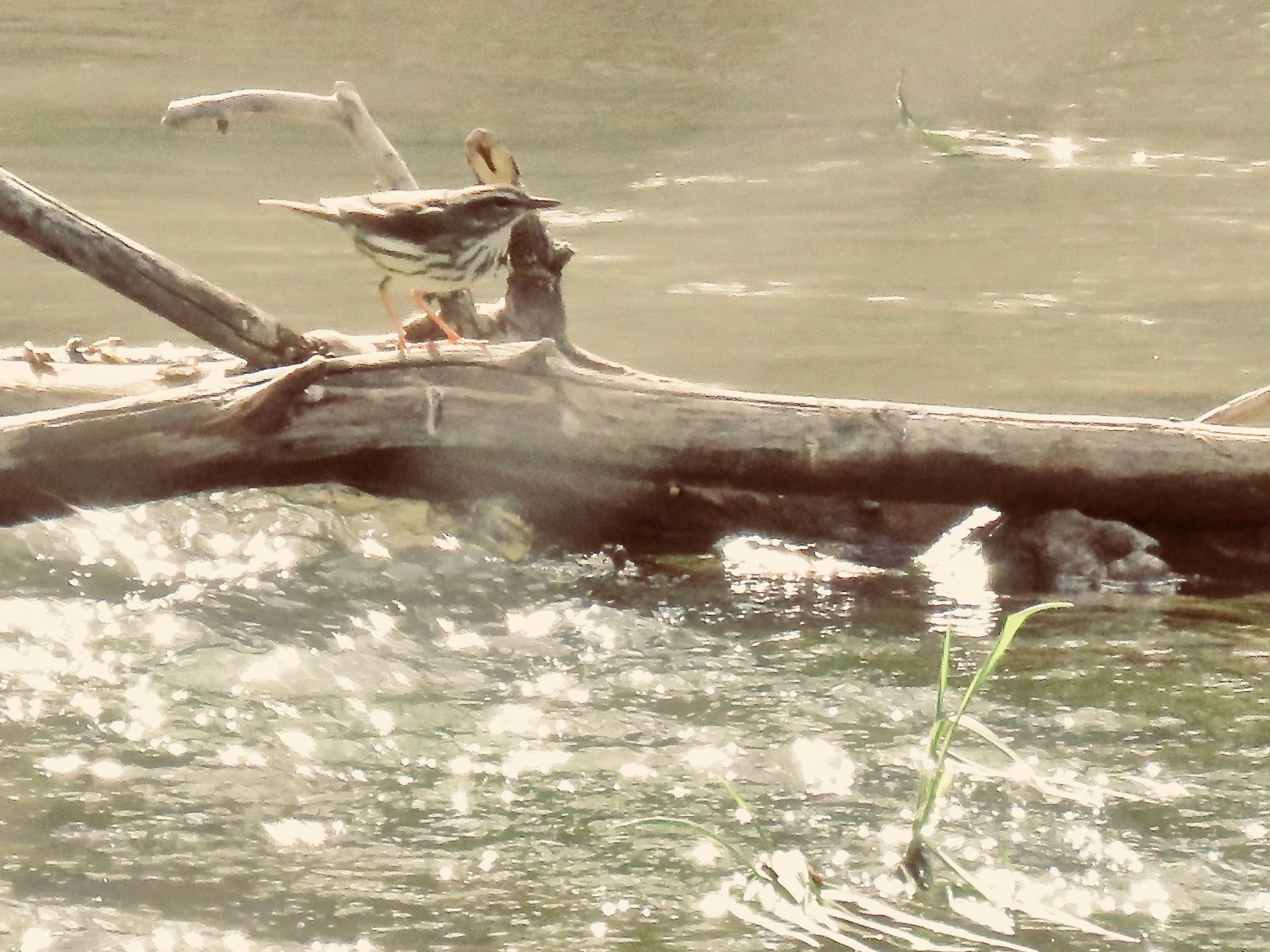
Best for me on the walk were the two separate LOUISIANA WATERTHRUSH. Not a usual bird, yet not unheard of in Arizona. Apparently, six had spent the winter, so the guides called them as two separate lingering LOWA.
 |
| Three above photos are of the first LOUISIANA WATERTHRUSH we spotted |
 |
| Two above photos are of the second LOUISIANA WATERTHRUSH we observed |
With 44 species seen there by the time I left the group (tired), I returned to the seed-feeding area near San Pedro House until Glenda returned. She said they weren’t seeing nearly as many birds and the walk would continue to the pond, so she also returned prior to the end of the walk. Glenda reminded me that a “bug” was going around our community. Except for now feeling worn out, it appeared that all was well with me.
Despite increasingly threatening thick black clouds overhead and increased winds, we headed to Ramsey Canyon, the internationally known site for hummingbirds.
Usually, we hike the loop trail but folks coming down the mountain reported no birds on the loop. However, there was a bushy spot right where we had arrived along the trail with a mixed flock of song birds PLUS a very unusual sight — a COOPER’S HAWK standing beside the creek. It must have been full; it didn’t move.
 |
| COOPER'S HAWK |
When we returned downhill to the hummingbird feeders, swinging in the wind, they did not disappoint! From the familiar ANNA’S HUMMINGBIRD to BROAD-BILLED, BROAD-TAILED and RIVOLI’S (formerly Magnificent) hummingbirds, we couldn’t have been more pleased.
Winds increased. We headed back to the car. It was an easy decision to stay out of the high winds with a stop at a nearby restaurant to do “dinner” early and wait out the approaching storm.
Winds grew; the light standards leaned and swayed in the restaurant parking lot. We learned that wood-burning pizza cooks very slowly under heavy clouds, wind and horizontal rain! But we had time! Pizza, when it finally arrived, was tasty. With such a good birding morning, we decided to stay out of the rain and wind. Back in our room for the remainder of the day, we caught up on entering data to eBird (me) and photos (Glenda).
DAY #3 - Sunday, 3/25/18
Today’s travel to Portal in the Chiricahua Mountains of eastern Arizona provided the opportunity to stop by Lake Cochise and Twin Lakes Golf Course in Willcox. In 2.5 hours there, we spotted ten (10) species of waterfowl including the rare EURASIAN WIGEON, too distant for photos. Another birder came over to us saying she thought she had seen that wigeon and wondered if we had it in the scope. We gave her that much better view.
The other oddity there was the large flotilla of GREATER WHITE-FRONTED GOOSE! My past views of this goose were seeing it as a lone “different” goose among other geese. This gathering of so many together (20+) called for an attempt to photograph them.
 |
| GREATER WHITE-FRONTED GOOSE |
An altercation between a SWAINSON’S HAWK and a CRESTED CARACARA was exhilerating to watch as the big bird dropped way low before rising again to fly off leaving the SWAINSON’S to its own territory. Too quick for photo; the scene - cherished.
While we checked the trash pile for potential Scaled Quail (a known place to find them), I turned to Glenda: “I hear SANDHILL CRANEs.” Looking up, we watched the front group (as it turned out) fly directly over our heads. This small group of sixteen (16) circled around and around, then finally started to descend. They had found a good spot.
What we didn’t realize for quite some time was how much space they would need in their “spot”. Small groups continued to fly in intermittently. When I next looked up, the flock was at least 300 - 500 or more cranes. And, more were on the way. We ended up with a count of 1200 SANDHILL CRANEs.
Another special memory is the cranes’ special conversational voice as they fly together.
Winds were picking up again so we continued onward to Portal.
 |
| Chiricahua Mountains |
At Portal, I knew we could bird at Dave Jasper's yard not far from the intersection of Portal Road and Cave Creek Road. Arriving at 2:10 p.m., I picked up one of the heavy metal chairs that had blown over and plopped down with binoculars up. Birds were hungrily visiting this feeding station!
In addition to BLACK-CHINNED, BROAD-BILLED, BROAD-TAILED and RUFOUS HUMMINGBIRDS, this was the place Glenda got good Lifer views of the BLUE-THROATED HUMMINGBIRD.
 |
| BLUE-THROATED HUMMINGBIRD [photo by Glenda Jones] |
 |
| Rivoli's Hummingbird (formerly Magnificent HU) |
Dave came out wondering who his "hard-core" visitors were! He was generous in sharing birding information with us, especially the location of his previous house, now continuing to be maintained as an open birding sanctuary by Bob Rodrigues.
Onward then to the Southwestern Research Station, we registered and settled in to our unit. Prior to our arrival, the Station had been full, but we were the only registered guests for the night. This was cool! We ate our meals with staff and got to know them and the cook, Vicki. Felt like family.
 |
| Coues' White-tailed Deer from window inside my room |
 |
| Glenda--outside our room |
Our greeting committee consisted of AMERICAN ROBIN and about a dozen Coues' White-tailed Deer.
DAY FOUR - Monday, 3/26/18
After a hearty breakfast, we took Vicki, the cook, along to show us her favorite little WHISKERED SCREECH-OWL.
 |
| WHISKERED SCREECH-OWL |
It's hard not to do a blog about all our good meals at the Research Center! We had packed a lunch for our day of birding, but winds were making themselves felt already in the morning.
Our first stop after taking Vicki back was to look for a Life Bird for Glenda, the Mexican Chicadee. Where East Turkey Creek meets Paradise Road, I found it while Glenda was getting her camera gear out. Bad on me. We couldn't coax it back so she'll need to return for that one.
At the George Walker House, while chatting with Jackie Lewis, we saw an assortment of good mountain birds.
 |
| ARIZONA WOODPECKER |
As we walked to the car, I spied a tree full of CASSIN'S FINCH.
 |
| Two male CASSIN'S FINCH among the group |
Our exploration to Willow Tank in Portal turned windy and wild; I could barely stand up. But I'll definitely return on a better day--next visit. Very well laid out area with berm around the tank, benches and blinds on the berm.
So, it was on to Bob Rodrigues yard that was fairly sheltered from the worst of the winds and birds were hungry.
 |
| RUFOUS HUMMINGBIRD |
 |
| Harris's Antelope Ground Squirrel |
The above ground squirrel kept trying to climb the supporting pole of the flat seed feeder but invariably ended up back on the ground!
On our return to the Research Station, we stopped by Portal Store for a look at the GREAT HORNED OWL there.
This wrapped up our two days in the Chiricahua Mountains.
DAY #5 -Tuesday 3/27/18
Returning toward home on Route 80, we stopped at the Monastery in St. David to stretch our legs, eat our lunch and get a bird fix. We checked out the pond and the trees with arriving warblers. As we pulled out of town, I spotted the MISSISSIPPI KITE lift off from the west side of AZ80, lift over our car toward where we had passed. A U turn got us back to Golden Bell Road where the KITE was perched in all its glory on top of a short pole. Got wonderful looks, but our cameras were in the back seat. Dang!
The GPS found a way over to Madera Canyon that I had never used but will remember. This visit was to search for another Lifer for Glenda. The folks we talked to at Whitehouse Picnic Area said no one had seen the bird all day, but then Melody Kehl arrived and told us they had seen it that morning at the first bridge. So off we went to the trail from Whitehouse Picnic Area toward the Proctor Road trail. The first bridge was still the spot. Folks had just seen the bird that was flying, at will, where it chose to go up and down the wash. We followed. At one stop, Glenda got a very clear photo of its back - an important shot, but never managed to get the more colorful one. Thanks to my shortness (for a change), I was able to kneel down and take a few pics of it where it landed low in a tangle of limbs.
 |
| ELEGANT TROGON |
 |
| ELEGANT TROGON [photo by Glenda Jones] |
Exhilarated with the find, we managed the climb back up to Whitehouse parking lot and headed for home. We arrived back to our start point at 5:00 p.m. on Tuesday after having left at 5:30 a.m. on Friday -- five nice birding days in lovely areas with good birds and friendly people.
111 species of birds in 5 days is a slim count. Given the weather that cut short several of our days, we aren't complaining. We had some very good views of many special birds.
'Til next time, if you're still reading!
* * *