Yuma: Riverside Park, East Wetlands and South Agricultural fields, Yuma County, AZ


Friday, January 15th:
After birding for several years, it seemed completely logical to do a one-day run to Yuma, way out at the southwest corner of the state along the Colorado River, to see if I could locate the rare Streak-backed Oriole that showed up there on my birthday (December 24, 2015)!  

Orioles tend to be very brightly colored birds and this one was no exception.  A rare visitor from Mexico, it was first found and photographed by birder, Jim Taylor on December 24, 2015. This was only the second recorded sighting of the bird in Yuma County.

I simply couldn’t get away any sooner so I invited Glenda Jones, an Ontario birding resident and first-time winter visitor to Arizona, to join me for this one-day adventure.

With Glenda driving, we departed the Phoenix area at 4 a.m. and arrived 210 miles later at 7:35 a.m. to begin searching for the Streak-backed Oriole at Riverside Park, adjacent to Yuma’s East Wetlands. At first light, we were the first birders present; temperature seemed balmy at 48°F.

Riverside Park

Recent reported sightings had me feeling optimistic that TODAY - its 21st day as a drop-in rarity - the Streak-backed Oriole would show up for my first view of it - a LIFE BIRD.

Other birders arrived. Among them was Jeff Coker, a Graham County AZ birder. Without actually knowing each other, we recognized one another’s names from our state’s hotline of unusual sightings. Birders spend little time talking with one another but spread out to make good use of as many eyes as possible. Jeff was stopping in the middle of a trip so his wife remained in the car.

Jeff, who had walked up to the canal berm, called out, "Prairie Falcon!"


Prairie Falcon -- Glenda's photo


It's not a common bird for me but I got to see it fly over. 

Another birder pointed out the Sharp-shinned Hawk perched high in a eucalyptus tree….that would explain the lack of very many passerines in the park.

Just as I started walking toward the East Wetlands, a gentleman from San Francisco was the first to spot our target bird. But, it flew down and away before he or anyone else could see it again. Glenda and I walked briefly in the East Wetlands, but I wanted to return to the park where most recent sightings had occurred.  

Almost two hours had passed. The Sharp-shinned Hawk had flown out. Jeff finally got in his car and pulled out to continue his family trip.  And, THEN, it showed up.  As Jeff drove up the hill, I waved my arms just as he looked back to see if anything was happening.  It didn’t take him long to join us taking photos of the beautiful Streak-backed Oriole.

Streak-backed Oriole - first one I ever saw - LIFE BIRD

Looking similar to a Hooded Oriole, the Streak-backed has a much more red-orange face and less chin patch

The Hooded Oriole is more slender and has NO STREAKS on its back like this rare visitor; Photo by Glenda

This LIFE BIRD showed itself from about 9:20 to 9:30 a.m.  It flew from its original perch in the mesquite at the back of the parking area to a small palm next to a deciduous mulberry tree, both of which are shown in the photo of the park (the first photo in this blog), 

Mission accomplished. Bird and birders came eye to eye!  We relaxed. 

After strolling through the East Wetlands a bit more we returned to our car at the park where we ate our packed lunch. Just as we finished, the Streak-backed Oriole showed up again in the mesquites. We were giddy with this second sighting!!  And, took more photos!


Knowing that we still had "birding time" left for Yuma, I suggested we visit Yuma's south agricultural fields for raptors and some other birds that might be new to Glenda who sees mostly eastern birds in the Toronto area.

Photos of some of the birds at the ag fields:
American Kestrel perched in a field looking for a meal
With hundreds of American Pipits in the fields, some took time out on the overhead wires or bushes.
American Pipit
Usually, I see American Pipits on the ground like this one that Glenda photographed

A perched Prairie Falcon that had flown over the field before landing

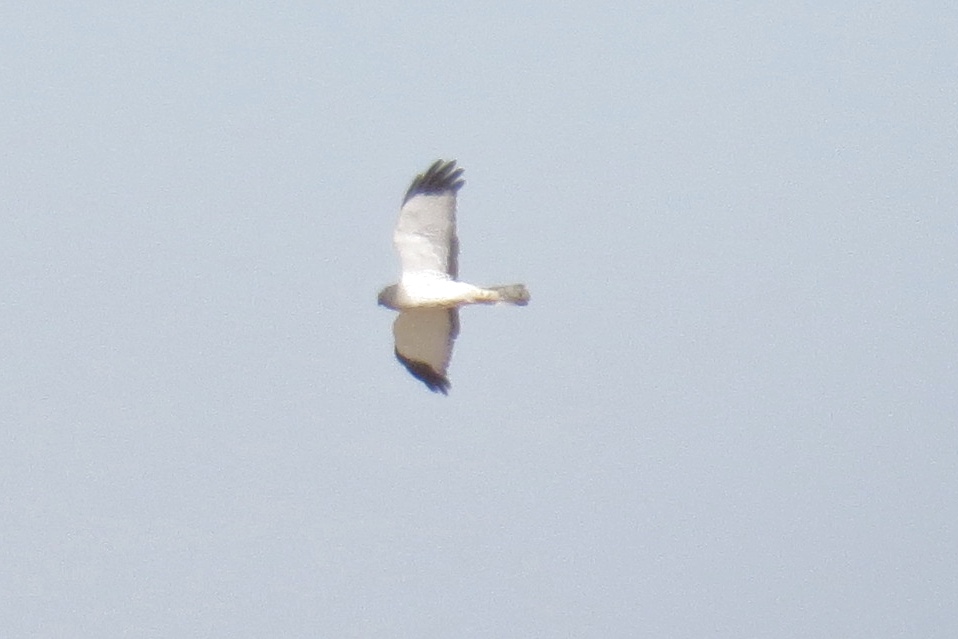
Male Northern Harrier "Gray Ghost"---photo by Glenda
Ferruginous Hawk - photo by Glenda

"Gray Ghost" -- male Northern Harrier 


With a birding day like this, who could ask for more?  We snacked again around 12:45 p.m. (60°F), then headed home.


* * *


San Rafael Grasslands-Patagonia, Santa Cruz County, AZ

Saturday, January 9th:
As frequently happens, I awoke prior to my alarm going off — this time set for 2:30 a.m. I was excited about heading out on a Desert Rivers Audubon field trip to a new place where I hoped to see a Life Bird — a bird less than 6” in size called Baird’s Sparrow. 

The uncommon Baird’s Sparrow breeds in the northern prairies of western and central Canada and our most northern prairie states. In winter it flies to north-central Mexico, unless it finds the grasslands of southeast Arizona inviting. Already this season, it had been spotted at the San Rafael grasslands near Patagonia so that was my quest.

With Dr. Dave Pearson (ASU ornithologist) in the passenger seat and Barb Meding driving her car, another birder (Nancy) and I shared the back seat when we departed from our meeting spot in Tempe at 4:30 a.m.  We would meet the rest of our small group in Patagonia 2.5 hours later.

We birded Patagonia City Park while waiting for some of the birders to arrive at the colorfully mural-painted public restroom building there. The known Hepatic Tanager was located but the more rare Yellow-throated Warbler was a no-show in the below-freezing temperature.

It was 20°F when we arrived at the short-grass prairie designated as an Important Bird Area for its 85 square miles of  contiguous (not fragmented) grassland habitat.  Both year-round birds and wintering species of sparrows, pipits, longspurs and raptors thrive in the yellow-tan grass. Just days earlier, our driver, Barb, had come upon a Short-eared Owl perched on a fence post there. As a group, we hoped for, perhaps, a sighting of some Chestnut-collared Longspurs, a Sprague’s Pipit, Grasshopper Sparrows, Prairie Falcon and/or Short-eared Owl. 

The frozen mud of San Rafael Valley Road led through beautiful alligator juniper and live oak habitat until it opened out into the beautiful grassland valley.
San Rafael Grasslands framed by snow-covered mountains.
Headwaters of the Santa Cruz River are located in this area
Would you believe? Among the first three birds huddled on top of a barbed-wire fence was my target bird, BAIRD’S SPARROW, with two very similar-looking Savannah Sparrows.

Baird's Sparrow (internet photo)
Unlike the Savannah with chest stripes extending down along its flanks and belly, the Baird’s “necklace” of sparse wide streaks stops at the end of the breast revealing a white belly. That was my clue to the one bird being BAIRD’S, not Savannah. The two dark spots at the bottom of its ear patch were visible, too.

Highlights as we drove to the end of the grasslands road and back included: Peregrine Falcon, Loggerhead Shrike, Sprague’s Pipit, 3 species of towhee (Canyon, Green-tailed and Spotted), and the Lilian’s subspecies of Eastern Meadowlark (much lighter than the Eastern with more white tail feathers), and a male and female Northern Harrier.

The Lilian's subspecies of the Eastern Meadowlark found in SE Arizona has a white cheek and is lighter overall than the Eastern Meadowlark (internet photo)
Rare (for Arizona) Sprague's Pipit  (internet photo)
Gorgeous male Northern Harrier (internet photo)

By the time we left the grasslands, the frozen mud on the hill down to Harshaw Creek Road had thawed. Barb was uncomfortable with the tail end of the car fish-tailing in the deep mud almost to the point of taking us sideways down the steep hill, so Dave took over the driving.

Once on Harshaw Creek Road, we again began to see good birds. A covey of nine Montezuma Quail crossing the road in front of us was extremely gratifying. It had taken me several years to find my first one (when I saw several, thanks to some good birding friends who knew where and how to locate them).

My photo of Montezuma Quail two years ago
Also two years ago

Another great treat along this road was a pocket of Azure Bluebirds, the name given to the subspecies of Eastern Bluebird that transitions through the mountains of southern Arizona to Mexico and northern Guatemala.The male birds were very bright blue and easy to follow as they flew from limb to limb, seeming to never stop. Many of the birds behaved that way today; thus, so many drawn from the internet so I could enjoy the birds instead of taking pictures.

Azure Bluebird (internet photo)

From Harshaw Creek Road, we continued on over to Tucson Audubon's  Paton Center for Hummingbirds (formerly Paton's yard) to check out the birds and enjoy our lunch at the picnic table.The temperature had risen to 48° F but winds began to pick up and clouds gathered. Birds that I found interesting here were the Broad-billed Hummingbird who has left the Phoenix Valley and the Bridled Titmouse with its handsome contrasting facial pattern.


With one more stop in the center of Patagonia before heading home, we took a quick look through the wide median full of trees and birds where we saw a Cassin's Kingbird - which seemed very early to me (not close to springtime).


While we may not have seen a great number of species (my total was 57 out of the 60 seen by the whole group), we saw birds that are very difficult to find and that made it an extraordinarily great birding adventure. I arrived home around 5 p.m., tired but thrilled with the birds that revealed themselves to me today!


* * *


New Year's Day 2016: Birded 9 out of 12 Recreation Sites at Lower Salt River, Tonto NF, Maricopa County, AZ

January 1, 2016
When, in mid-December, birder friend, Lois Lorenz, invited me to bird with her on New Year's Day, I joined in readily. When she gave me the option to choose location, she may not have realized that when a birder says "day" - I think all-day. Lois was game to see how many of the twelve (12) recreation areas situated along the local Salt River we could cover on Friday, 1/01/2016.

[Before leaving home with my old camera, I double-checked the Canon SX50 that went into Sonoita Creek with me on the 30th and had not yet responded.  TODAY - HAPPY NEW YEAR'S DAY to me == it worked! (after hair dryer treatment and sitting in bowl of rice for 24 hours] 

Marcee Sherrill joined us on our quest from 7:30 a.m. until noontime, but Lois and I continued until 5:30 p.m. And what a day!

These are the sites and the order in which we birded nine (9) of the twelve (12) recreation areas from dawn 'til dusk:

Coon Bluff
Phon D. Sutton
North pond of Granite Reef (Moorhen City Marsh)
Granite Reef
Blue Point
Pebble Beach
Water Users' Area
Butcher Jones (cove of Saguaro Lake)
Saguaro del Norte (north portion of lake by boat ramps)

The ones we missed were:  Goldfield, Foxtail and Sheep's Crossing.

Having arrived soon after sunrise at Coon Bluff, we set off to the east along the Salt River to see if the Rusty Blackbird(s) might still be around. We stopped for birds all along the way.

Female Western Bluebird in early sunlight
Female Western Bluebird preparing to take off
Salt River at Coon Bluff

As we neared the blackbirds in the water, we spotted a Bald Eagle flying toward one that we saw perched in the distance on the north side of the river. Our Arizona Bald Eagles are smaller than those in Alaska and the northwest.

Two mature Bald Eagles greeting


The Rusty Blackbird breeds in the north, but they all head south in winter, along most of the east coast and west to South Dakota and Nebraska. It's a rare bird in Arizona. Its first reported sighting was back in early December.  From the one bird seen then, recent reports have bumped it up to two. 

We had just reached the various blackbirds in the water when top birders, Tommy DeBardeleben and Jeremy Medina showed up. Always helpful! Two Rusty Blackbirds close to our shoreline provided a photo op for ID purposes. Note the light iris and short pointy bill. Its smaller size also sets it apart from the Great-tailed Grackles and Red-winged Blackbirds that were at the same location all foraging in the shallows.
Two rare Rusty Blackbirds in the Salt River; one in sunlight, one in shade.
Rusty Blackbird
Since we were on a mission to bird as many recreation areas as possible, we headed back, then, to the mesquite bosque within Coon Bluff to see if the temperature had risen enough for the songbirds to get active. Oh, yes!


Male Silky Flycatcher: PHAINOPEPLA

Vermillion Flycatcher
A nice Gray Flycatcher eluded the camera. Highlights from Coon Bluff included not only the two rare Rusty Blackbirds, but a perched and singing Crissal Thrasher and a flyover flock of Cedar Waxwings. In addition to the two Bald Eagles, we also saw a Harris's Hawk and an Osprey before we left this STOP #1.

Phon D. Sutton Recreation Area has been the wintering spot for a Golden-crowned Sparrow but we failed to come up with it in our 50-minute visit. There was no rushing from place to place, but we also didn't bird deeply. Often times, I bird one of these rec areas for over four hours since they have varied habitat and interesting places to explore. Today, we checked the river - or I should say "rivers". This is where the Verde River flows into the Salt and from where they continue as one river (the Salt) downstream toward Phoenix.

Having just told Marcee that Moorhen City Marsh was a shoo-in for Common Gallinule, the American Birding Association's new name for the "moorhen", we saw none when we arrived. The area (named by a small group of us birders) is a back water of the Salt River that is full of marsh reeds off shore but also includes a nice ring of water flowing in, out and around it. Lois spied our first Greater Roadrunner of the day but when we reached the marsh, there were no Common Gallinule in sight. Given that we had been hearing hunter's guns all morning, there may have been good reason.  Before we left, two birds ventured out from the marsh grasses to swim right beside them.


Common Gallinule (formerly Moorhen)
Granite Reef was Stop #4. The temperature had become comfortable -- 52°F. Marcee carried her spotting scope here since waterfowl was present on the wide river from the picnic area where we began all the way west to the dam. Without the scope, I could not have discerned 75% of the ducks out there. Common Goldeneye and Bufflehead were outstanding among the usual Gadwall, American Wigeon, Northern Pintails, Ring-necked and Ruddy Ducks. Across the river close to the dam, we could also pick out Black-crowned Night Heron and Great Blues perched in trees on Tribal Land (north side of river).

Most surprising to me here were the two wild horses. This is the first time I've seen them at Granite Reef although evidence of prior visits was visible. 


Wild horses at Granite Reef - parking lot area

Marcee left at this point (noontime) but Lois and I had decided to continue on with our quest.
So, we began at Blue Point Recreation area where we birded for a while, then ate our lunch at a picnic ramada. We were visited by a nice guest.

Beep-Beep! -- Greater Roadrunner
Before we finished lunch, at least 20 cars had arrived full of families ready to enjoy the out-of-doors. Wind was picking up and too many people at Blue Point made it an easy decision to walk across Bush Highway to explore Pebble Beach. I seldom bird here but found it interesting with possibilities for deeper birding. Phainopepla have a corner on the real estate!  Our estimate of 15 birds is conservative.

Next stop at the Water User's Area (put-in for tubers) turned up very few birds -- ones we had already seen, so we continued on to Butcher Jones Beach area, where we hoped the crowds might be dwindling.  Well...somewhat.  A photo shoot of a beautiful blue-clad "mermaid" was fascinating but we turned our focus to the ducks off shore. Among the expected species were some gulls that I concluded (?) were all Ring-billed Gulls. 


Last stop of the day (#9) was at Saguaro del Norte. We turned left as soon as we entered Saguaro Lake to go past the unmanned gate. I have the necessary pass. The road leads along the north shore of the lake with two wide boat ramps. Beyond that, the road continues with parking next to a sidewalk by the lake -- on our right side (south); and on the north side of the road is desert habitat and canyon wall. With winds getting stronger, I didn't bother with my spotting scope or we may have had more species here. With boats still running up and down the lake, I doubt we would have had much success. That being said, we were totally jazzed by the sight of so many WHITE-THROATED SWIFTS flying in to roost for the night beginning around 5:00 p.m. We estimated 75. . . with more to come, I'm sure.

The first day of 2016 gave me the basic opportunity to enjoy the energy of the universe where it seems most available to me - outside, in natural settings. That the sun was shining and the temperature rose from 35-65 degrees also boosted our energy throughout the day. When exhilaration turns to quiet and peaceful exhaustion, I know I've had a wonderful day of birding. Thank you, Lois! == 73 species of birds for the day.

And HAPPY NEW YEAR to all of you!


* * *


Birding with Susan to put a few more birds in her AZ Year List

December 30, 2015

What a fine way to close out the year 2015!  Susan Fishburn sent me a late-night email on Monday (28th) after she heard from Laurens Halsey (bird guide) who had agreed to help her find the McCown’s Longspur today to add to her Year List of Arizona Birds.

Not checking my email until 8 a.m. or so the next day (12/29), I was surprised to see Susan’s invitation to join her in seeking three target birds which would help her regain her #1 spot among the Top 100 e-bird Birders.  The #1 spot was being contested among three women — with lots of admirers watching to see who might end the year as #1.  Susan had held that spot for quite a while up until December when the competition and listing picked up and she and Janine traded #1 & #2 spots frequently.

posted by Magill Weber on her Facebook page on Dec. 22, 2015:


Susan had suggested we meet about noontime at her place and go together from there to search for three rare birds within a reasonable (in birding terms) distance. With her intense chasing of birds, our previous joint birding trips had faded away. After canceling one appointment for the day, I met Susan as planned at 12:15 p.m., on Monday, December 29th.  It was a clear cool (50°) day and we were off to look for a PINE WARBLER in Tucson's Reid Park today and a MC COWN'S LONGSPUR in Quail Creek Veterans Park, Green Valley; and a GREEN KINGFISHER in a reserved natural area adjacent to Patagonia State Park tomorrow.

Birding began behind the Randolph Recreation Center on S. Alvernon Avenue in Tucson where we listened for and checked out every bird we could find but none was a Pine Warbler. Best sighting there was a healthy-looking coyote walking the golf course as if it was its private domain - proudly strolling. Driving, then, to the main entrance of Reid Park, we searched the pines there - filled with many Yellow-rumped Warblers but no bright yellow male Pine Warbler that had been previously reported.

Hungry by the time we checked into the Best Western in Green Valley, we decided to skip the restaurant in the B.W., for the Italian one just across the back parking lot - Rigazzi Italian Restaurant. Having eaten there once before, I highly recommended it so we arrived for an early dinner. Without reservations, our early arrival enabled us to enjoy a fabulous meal in its dining room with quietly elegant ambiance.

On the 30th (Wednesday morning), Laurens Halsey met us at the Best Western around 7:30 a.m., with most of the frosted windshield cleared in Susan's Pathfinder by the time he got behind the wheel. Laurens lives not far from Quail Creek Veterans Park where the McCown's Longspurs have been seen. It was a new place for me.

Wearing almost all the warm clothes I had stuffed in my pack, I was able to keep my binoculars on the big flocks of Horned Larks, Lark Buntings and a variety of sparrows as I searched for the special longspur in the 27° cold. (Not our usual AZ winter temps.)

Laurens kept searching the flocks with his spotting scope. The first time he found it, Susan, of course, got the first look. But then the whole flock lifted, flew around a bit, but then returned slightly closer to us.  Again, Laurens started searching for the longspur that would be a LIFE BIRD for me - the first time seen!  This longspur looks pretty much like many other LBBs (little brown birds) about 6" in size comparable to many sparrows. It breeds in the northern prairies  but migrates out in winter. Keen birders find them from time to time in Arizona, so I was thrilled to be on this quest. When Laurens got on it, I was right beside him ready to look through the scope to view the smaller longspur with its broad light eyebrow and short pointed pink bill that contrasted with the many birds around it.  It kept busily foraging on the ground in the bigger mixed flock of feeding birds.  YAY! - Life Bird for me!

Photo?  Not by me. My camera is very sluggish in cold weather and I knew it would be very difficult for me with this point-and-shoot to single out the longspur from the rest of the flock for a decent shot. I left it in its case in the car. This shot is from the internet.

Winter-plumaged Mccowen's Longspur
Since Susan wasn't sure I'd go with her when she had asked Laurens to help her find her birds, she thanked him for finding the McCown's Longspur for us and let him go off to enjoy the rest of his day. We headed south to see if luck would travel with us to see the Green Kingfisher.

Arriving at Patagonia State Park at 10:20 a.m. (42°F), we birded the Visitor's Center area even though it was closed. We had gone there for the special permit needed to visit the Sonoita Creek State Natural Area where we hoped to find the Green Kingfisher. This was the second new spot I visited on this trip. We got our permit at the front gate. As usual, Susan had done her homework and discovered that on her previous try for this bird, she had not walked far enough. So, we tackled the longer walk today going beyond the concrete abutment for another 300 yards to the wider pools where the bird had most recently been spotted.

Mostly, we walked on trails formed by cattle that peered at us through desert scrub and trees along the creek.  

Ever-present cattle

Susan along the Sonoita Creek Trail

After walking over 3 miles from the parking area to the wide lazy pools in the creek, we decided to eat our lunch there. It was pleasant with a Black Phoebe snapping insects from the air above the creek before returning to its post to just go out again and again.  Lunch time for the Black Phoebe, too. 

Sonoita Creek

Many interesting birds that we don't see frequently in our Phoenix desert showed themselves as we hiked and rested: Gray Flycatcher, Dusky Flycatcher, Canyon Towhee, American Pipit and three wren species: Canyon, Rock and Bewick's. But NO Green Kingfisher. It was not a Life Bird for either of us, but it's definitely a stunning bird to see. Susan saw them in Costa Rica; I saw several on an Audubon trip to the Lower Rio Grande Valley of Texas a couple years ago. This rarity would, however, be an AZ YEAR BIRD for each of us in 2015.  

Instead, our familiar Arizona Belted Kingfisher showed up. No slouch in the "looks" department either, it perched briefly for a quick photo.

Belted Kingfisher

Somewhat disappointed, we turned back to the parking lot. For eBird, when we retrace our steps, we count only the birds we saw as we walked out. On the return over the same trail, we add only new sightings of which we had several - the Red-tailed Hawk and Common Raven being two of them.

Susan as we hiked back to the parking area

On our creek crossing going out, I had used the concrete blocks and stones while Susan, in her waterproof shoes, found a shallow spot to cross. I should have followed suit on the return. This time, instead of moving easily from the large blocks to the smaller ones, I needed to balance on the small river rocks to step up to the very sturdy chunks of concrete. Didn't go exactly as planned - I got one foot up but hit a slick spot of algae with my left foot and slid off into the creek - about a foot deep. Water cushioned my slip but, for the second time this year, I doused my camera in a creek!  My Swarovski binoculars and iPhone survived but not my Canon camera. I pulled the card from the camera while still hiking out, tucked it into one of my wool gloves in my pocket and hoped to not lose the few photos I had taken.  (card worked; camera - no - not even after using hair dryer and putting it into a bowl of rice overnight)

When we reached the Gathering Ground coffee shop in Patagonia, it was just closing (4 p.m.), so I quickly got a cup of herbal tea and took time to change my wet socks, roll up the wet bottom legs of my jeans that were still soaked (rest of me was mostly dry) and kept my wet shoes on the floor of the passenger seat under the heater to dry. Susan, meanwhile, had walked up to the Stage Stop Inn to pick up a pair of shoes left there by birding friend, Tommy, on one of their recent forays to that area. As happens in this interesting town, no one was present in the lobby, office or anywhere in the downstairs, so another birding friend will pick up the shoes within the next couple days.

As I'm writing this blog on New Year's Eve day, I'm aware that writing IT was one of my 2015 intentions for this year, I'm pleased that I managed to continue blogging throughout the year. And, I'm planning to continue it into 2016. 

Although I birded most of 2014 without knowing that the eBird stats recorded the names and number of species for its Top One Hundred eBirders each year (in every state), I became aware of that fact in the fall when someone mentioned that I was close or among the Top Ten. I think I was No. 9 on December 29th and No. 10 on December 31st.  But when I awoke on January 1, 2015, I had dropped to No. 11.  - Dang.  Not shabby by any means but I had not birded on the 31st and whoever was below me, did!  I hadn't done much "chasing" at all - I just bird a lot.  

But, under the tutelage of two of the present Top 3 eBirders (Susan and Barb) I learned  strategy. Birding hasn't been a competition for me, although I definitely have a competitive streak. Fortunately, I can turn it down or turn it off. But I learned more about the State of Arizona by visiting many new places and I needed to get a lot sharper with my birding skills to end up in my present position at No. 6. Good birding friend, Chris Rohrer is No. 7 and I cheered when on our recent outing, he mentioned he was going home to Wisconsin for the holidays pretty much guaranteeing my No. 6 spot at year's end! December 31st postings of bird sightings will be reflected in eBird stats as of midnight, December 31, 2015.

On my next year's list of intentions will be to become a much better birder than I am right now. Another intention is to focus on finding Life Birds in North America that will be taking me out of state so I may not be in the Top 10 again next year. But, it has thrilled me to have reached that level.

Because I became aware of eBird's statistical benefits, I know that I saw 108 more species this year (354) than I did last year (246). In 2016, I hope to get to know these birds a lot better.


* * *