Urban Birding, Scottsdale and Fountain Hills, Maricopa County, AZ

Saturday, December 12th:
A spontaneous choice for birding local rather than distant on this cold (48°) and drizzly morning provided some good bird action and, of course, a miss on the target bird.
Taking Glenda J, visitor from Ontario, with me, we hoped to find the Red-breasted Sapsucker at Scottsdale Ranch Park. After birding for 55 minutes, we both were cold and moved on without seeing the target bird at or near either of its frequented locations, per reports. Magill Weber reported seeing it this afternoon at 2:15 p.m., so I know it's still around and will give it another try another day.

Second stop, a quick visit to the lake at Paradise Memorial Gardens before heading to Mercado del Lago (McCormick Ranch--Margaurite Lake) where our best sighting was a WESTERN GREBE. With its head tucked, and its low body floating around with a massive flock of Ruddy Ducks, it was difficult to discern until it lifted and unfurled its neck.


Distant Western Grebe
When we walked to the area below the dam, we found the small pond filled mostly with American Wigeon.


L-R: Female & Male American Wigeon
Female American Wigeon on left; wears a smudge on its eye
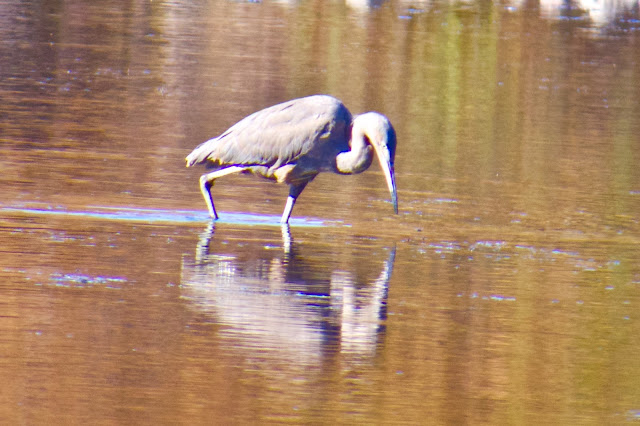
From there, we traveled a short distance to the ponds around the Chart House restaurant identified as McCormick Ranch-Camelback Lake.  Aside from the many coots that filled the surface of the west finger of the lake that was easily viewed from the parking lot, we found one of 12 Great Egrets standing on the grass. About nine (9) Snowy Egrets lined the distant bank (sw corner) and were interspersed among Neotropic-cormorants providing a nice black-white pattern.


Great Egret
Our final stop was the lake at Fountain Hills and what birds we found!  Never have I seen so many HOODED MERGANSERS (20) in one place, nor for that matter, EARED GREBES (35). It looked like water was being pumped into the lake (or perhaps it was a submerged aerator), but something was stirring the water and the ducks were going crazy for such easy food.They were diving and surfacing so fast it was hard to count them!  Obviously, I could only take pics of those on the surface between dives.


A Bufflehead got into the act on this pic, along with male and female Hooded Mergansers, two Eared Grebes and a Pied-billed Grebe.

A Bufflehead (just right of center) got into the action, too.


Pied-billed Grebe

Eared Grebe

Eared Grebe
Despite the cold sprinkles of rain, we held fast for as many photos as we could get.


Female Hooded Mergansers

Male Hooded Merganser who separated itself from the crowd to, perhaps, swallow a BIG ONE!

For local urban birding, we felt like Fountain Hills Lake had delivered the jackpot experience.
It was a 3-GREBE DAY (Western, Pied-billed & Eared) PLUS a mad communal feeding show by several species.


Unless I wander out to see what's happening, I sense that I'll miss something for certain.
So, it was another good day in the field with a birding friend who will be visiting through the winter months.

* * *


Glendale Recharge Ponds, Maricopa County, AZ

December 11, 2015
I had an ulterior motive when I volunteered to take a friend to the airport this morning. When I'm at Sky Harbor, I'm about 2/3 of the way to a good birding spot.  So, after dropping Bari Silver off at Terminal 4, I continued west on I-10 for about 20 miles, arriving at Glendale Ponds at 11:30 a.m.  Usually, I'm early for birding, but with waterfowl, the time isn't quite as significant as it is for songbirds that lie low in mid-day.

As soon as I hit the dirt road, I started counting and was able to pick up a Vermilion Flycatcher, abundant Abert's Towhees and the first of several American Kestrel.

What I really wanted to find out there, especially with overcast skies, were some gulls other than Ring-billed, the most common on our desert lakes. Other gulls show up from time to time but I just haven't connected with them this year.

One of my favorite birds showed up early over Pond 6 -- a Belted Kingfisher.


Male Belted Kingfisher (above & below)

A flock of Horned Larks flew overhead while many birds perched on the same stretch of utility wires that the Belted Kingfisher used.

Also in Pond 6, I counted 13 Canada Goose, many Gadwall and American Wigeon.
On my way to Pond 1, I scanned the farmyard across the canal where I spotted a dozen Gambel's Quail.

The 6 rectangular ponds are laid out in a grid, beginning with No. 1 on the NE corner and ending with #6 on the SE corner, so they are directly across from each other with dirt roadways and a water flow channel separating them.

With more mud in Pond #1, the shorebirds were active. In addition to the Least Sandpipers, Killdeer and Long-billed Dowitchers, there were Black-necked Stilts, Great Egrets, and three Lesser Yellowlegs.  Ring-billed Gulls walked around in the midst of these shorebirds grabbing anything they stirred up!


Above:  Ring-billed Gull with fish;
Below: Ring-billed Gull posing
Ring-billed Gull - adult

Although I had spotted a perched Osprey when I birded Pond 1, that was the only raptor I saw until I birded Pond 5.  Then, two Bald Eagles flew over making all the waterfowl take to the air and re-arrange themselves on other ponds. With the adult Bald Eagle was a younger one that appeared to be, perhaps, a 3rd year bird, since it showed a fairly white tail but still had many dark flecks in its whitish head. Their fly-over brought me two birds from the most distant ponds (# 3 & 4) -- a Western Grebe and a Clark's Grebe, two beautiful long-necked birds that landed on Pond 5 in front of me but very distant on the water.  (No pics)

Then more raptors started showing up. Stirring up the ponds this time were two Northern Harriers, soon followed by a Peregrine Falcon that may have been doing clean-up after the harriers!  And, as I started walking past the ponds toward the parking area, a Red-tailed Hawk got into the act but stayed higher, didn't strafe the ponds like the harriers.

I paused long enough to take a photo of the nearby Arizona Cardinals Stadium mainly because the cotton field next to it was ripe for picking. It reminded me of the historical 5 C's of economic growth in Arizona: Copper, Cattle, Cotton, Citrus, and Climate.


Amazingly, in the middle of the desert I see more waterfowl than I ever did in tidewater Virginia!

* * *

 View this checklist online at http://ebird.org/ebird/view/checklist?subID=S26243624


Coon Bluff Recreation Area, Lower Salt River, Maricopa County, AZ

Monday, December 7, 2015
I was shocked to hear a report yesterday that a rare bird was spotted at one of my favorite local birding spots just a 25-minute drive from home.  So, I headed out early to see if I could relocate the RUSTY BLACKBIRD that Chris Benesh had seen there.

After arriving at 7:10 a.m. (42°) and checking my coordinates against those given for the location of the Rusty Blackbird, I knew it had been seen a distance away on the east trail. However, this would be a LIFE BIRD for me so I didn't know its habits or whether IT would know its coordinates!  Birds have wings.  So, my strategy at that early hour was to start at the tenting location but going down over the bank to water's edge where I saw a fair number of birds including Black Phoebes and Rock Wrens in the pebbly shallow water.  

It wasn't long before I heard other birders - friends, actually, so I went up the bank to join them as they made their way quickly toward the spot it had been seen yesterday. Steve and Joan Hosmer, Susan Fishburn and Janine McCabe had all arrived at the same time, so we had many eyes looking for the rarity.

At one opening as I looked far upstream with my binoculars, I saw blackbirds in the shallow river, so we all walked a bit faster toward them. It's not everyday a rare bird is found almost exactly in the same spot it had been reported seen previously, but so it happened. We spent about 15 to 20 minutes taking photos and looking at how it differed from the Great-tailed Grackles and Red-winged Blackbirds that were also present.


Pale-eyed Rusty Blackbird is rare in Arizona

Life Bird: First one I've ever seen; It's range is mostly eastern to mid-west USA

Rusty Blackbird in center; female and male grackle on either side

I would never have looked in the Salt River for this Rusty Blackbird!
* * *


Santa Cruz Flats, Pinal County, AZ

Saturday, December 5th
At 6:00 a.m., I departed home to meet a group of 12 Desert Rivers Audubon birders meeting in Tempe to travel together in three cars to Santa Cruz Flats which lies a bit south of Picacho Peak and west of I-10 South to Red Rock. 

Ornithologist, Dr. David Pearson of Arizona State University, our guide was in Car #1 with Judy driving. Dwayne drove Car #2 and I was in Car #3 with Cynthia driving her Land Rover. When traveling dirt roads thick with dust, it’s obvious that Car #3 had the least desirable position, but with Phyllis and Leslie along, we had a grand time. 

It was the second long birding day in row for me (and Phyllis & Leslie who had been on Kathe’s Big Loop yesterday). Since the extensive Flats consist of many agricultural fields and salt-bush desert, birding is done by stop and go from the vehicles.

Since most birds we spotted were distant, but verifiable with our binoculars, my picture taking was limited. 

The group had a total of 88 bird sightings, of which I saw 73, best of which was the LOUISIANA WATERTHRUSH along the Santa Cruz River not terribly far south from where it crosses Sasco Road. Dr. Pearson heard the waterthrush and led us through the trees along the river until we all had an opportunity to see the bird come down the muddy bank to water's edge, flit up to a fallen branch, drop down again, and repeat!  It's only the second time I've seen the Louisiana Waterthrush.  The Crested Caracara, Mountain Plovers, Prairie Falcon and Sprague's Pipit were also cherished sightings of birds I seldom see.


American Kestrel - male
White-fronted Goose - Photo by Dwayne Morse
Wilderness provides table and seats for lunch break
Leader, Dave Pearson, is seated
My photo of distant Crested Caracara

Online photo of Crested Caracara

Mountain Plover (online photo, as they were at least 75 yards distant from us)
Rare Sprague's Pipit; foraging in the distance - Photo by Dwayne Morse

Vermilion Flycatcher

With my Car #3 leaving prior to the other two cars that continued to another waterfowl site, it was after 4 p.m. when I returned home. Having birded for six hours, I was totally stoked with seeing 73 of the total group sightings of 88 and that trip to Santa Cruz Flats will continue to be one of my favorites.

* * *


BIG LOOP of 3 major birding sites in central Maricopa County, AZ

Friday, December 4th
From 7:15 a.m. to 1:30 p.m., I participated, with ten other birders, in Kathe Anderson’s annual BIG LOOP of intense birding in the Gilbert-Chandler area to tally as many species as possible. My list tallied 76 species in a little over six (6) hours of birding. This is a personally-led trip (not as an Audubon trip leader) for which, instead of paying Kathe, she asks that we donate to a conservation organization of our choice which she passes on for us.

Kathe was aware of several “rare” species at our first stop, Riparian Preserve at Gilbert Water Ranch, and we were thrilled to see a late-staying YELLOW WARBLER and a visiting WHITE-THROATED SPARROW along the east entrance trail between Ponds 1 and 7. Many other birds caught our eye as well as we worked our way toward the Tiger Moth Trail where the very rare Purple Finch had been seen daily, at various times, throughout the week since Tyler Loomis found it on Monday. 

Cooper's Hawk

Juvenile Black-crowned Night Heron

Snowy Egret
Finding local House Finches along the way, we studied them carefully for specific identification markers of the Purple Finch, including two white lines on the face that give an overall appearance of a “light” face, plus center belly stripes that do not go all the way down the belly. Not until we reached its most frequently seen location did the PURPLE FINCH come into our view. Then, wow! Without staking it out, it flew right in and gave me a photo op around 8:15 a.m. For people who visit AZ from up north, this is a very ho-hum bird like our House Finch, but when a Purple Finch visits Arizona, it’s a very big deal and I, for one, was delighted that we got to see it.

Purple Finch
The morning light and perching birds, many huddled against the morning cold, motivated me to take a lot of photos.

Vermilion Flycatcher

Northern Mockingbird fluffed up in the cold

Neotropic Cormorant drying its wins

European Starling in basic (winter) plumage

In three hours, walking 3.5 miles, we ended up with 56 species at Gilbert Water Ranch.

Second Stop: Water treatment ponds at Higley & Ocotillo Roads
In addition to many waterfowl at these wide open ponds, two raptors, Cooper’s Hawk and Northern Harrier (marsh hawk), made frequent passes. Among many shore birds, the stand-outs were two Greater Yellowlegs and a Wilson’s Snipe, the bird with a very long bill.


Kathe laid eyes on our surprise song bird that was scratching on the ground in the company of an Abert’s Towhee — a HARRIS'S SPARROW.  Three birders from Minnesota quickly confirmed the bird as it is one they see frequently.

Harris's Sparrow that flew to a distant tree while we watched
Harris's Sparrow taken at Coon Bluff earlier this year

In one hour, walking 1.5 miles at the Higley-Ocotillo Ponds, we collected 28 species, of which many waterfowl duplicated what we saw at Gilbert Water Ranch.

Unscheduled Third Stop was more of a pull-off-the-road to make sure we all saw the dozen Cattle Egret lined up along an agricultural field on Val Vista just south of Ocotillo Road.

Unscheduled Fourth Stop was at a cattle feed lot on Val Vista just prior to Chandler Heights Blvd. to see if we could locate some Yellow-headed Blackbirds. We found none, but added a few more species to our overall list. The unusual sighting there was a White-winged Dove that had not yet flown south.  


Kathe’s scheduled final stop was at Veteran’s Oasis Park on Chandler Heights Boulevard.  Among the 14 species we spotted there, the best was a GREATER SCAUP on the fishing pond.  


Flying into that pond as we watched, came a pair of Redheads.


With some of the birders, including me, hitting a time crunch for further participation, our three traveling cars returned to Gilbert Water Ranch for those individuals to depart while the others continued on to enjoy lunch together.


With 76 species, this proved to be an awesome BIG LOOP Adventure with Kathe!

* * *


Coon Bluff Rec Area along Lower Salt River, Mesa, Maricopa County, AZ

Monday, November 30th:
Today's birding followed some chilly birding over the weekend. First, a weekend update: 
Although I birded two places on Saturday, 11/28/15, I took only a few photos.  Lois and I joined Kathe Anderson (and her husband) for a bird walk she was leading in a place I rarely visit: the McDowell-Sonoran Preserve. It was 32° when we gathered at 7:30 and it didn’t seem a whole lot warmer when we finished a part of the Granite Mountain Trail at 10:00! In high desert, we were lucky to get 12 species since the sparrows weren’t yet out in the sunshine.

Moon setting over Granite Mountain, McDowell Sonoran Preserve, Scottsdale, AZ

After six of us enjoyed a nice breakfast at the General Store Cafe at Pinnacle Peak & Pima, Lois and I continued on to Scottsdale Ranch Park to see if we could locate the Red-breasted Sapsucker reported by Diana BlueHerron on Thursday.  Although we came upon other birders (including friends Lindsay, Keith and Dick), none of us came up with the uncommon sapsucker. Even though we "dipped" on the Red-breasted Sapsucker, we enjoyed other birds at this location that none of us had previously birded.


American Kestrel

Say's Phoebe

On Sunday, 11/29/15, Lois joined me for a search of the Riggs-Price Road ponds where birder, Dale Clark had posted photos of three classic species on Thanksgiving Day: Snow Goose (juvenile), Ross’s Goose and Cackling Goose. We did get to see the birds in the alfalfa fields across Price Road, a bit northwest of the ponds. We had just started viewing the three species when all the Canada Geese decided to lift off and the three Snow Geese, two Ross’s Geese and the Cackling Goose joined them. Although we waited for them to finish circling in the air with the hope that they would return, they had moved on to feed elsewhere.  It’s my understanding that they return to the ponds around noontime after feeding all morning, but Lois and I have been birding so much neither of us had that much spare time. It wasn’t a great sighting, but their relative sizes were clearly seen when they flew, especially the Cackling Goose, darker than the white birds but associating with them, that appeared smaller than the Ross’s Goose and obviously nowhere near the size of the regular Canada Geese.
Here’s a link to see the photos of the 3 classics:
http://ebird.org/ebird/view/checklist?subID=S26006713

Another cold morning today (Monday, 11/30/15), so I decided to bird close to home. The Reddish Egret had been spotted at Coon Bluff over a period of two or three days and then not again for about a month. But birders had reported its presence again over the past three days, so I showed up there a little after 9 a.m. — again because it was close to freezing temperatures when I got up. 

Lindsay and her father, Dick, had just arrived when I pulled into the parking lot so we ended up birding together. However, they entered from a different direction than I had so I was startled to hear Lindsay call out to me. “I’ve got it!”  She had had to leave her scope at the first wide flat fishing area to get my attention and by the time she tried to re-find it in her scope the Reddish Egret was gone. Her misfortune turned out to be my good fortune since they wanted photos. 

Dick, Lindsay’s father who was obviously older than either of us, carried the camera while Lindsay handled her bins and spotting scope as we continued eastward on the trail. Dick had the best eyes of any of us and saw our bird lift and fly two or three times as it continued to move eastward, up the river. Tamarisk, shrubs and mesquite blocked our view much of the time but Lindsay finally got the bird in her scope again and at last, I got to see it in the distance.

We walked and walked trying to get past it so the sun would be behind us for photos. Dick rarely walks this far, especially over river rock terrain. We stopped 1.1 mile from the concrete sidewalk at the camping area to get our successful photos. I’ve seen the bird in Florida and Texas but never Arizona so I took lots of photos of this rare occasion. It was spectacular to view the bird through Lindsay's scope that picked up feather pattern and coloring that doesn't quite come through in my photos.

Juvenile Dark form Reddish Egret

Juvenile Reddish Egret flying off
Ruffled Feathers: Reddish Egret - juvenile
Young Reddish Egret in the Salt River at Coon Bluff
Dick, Lindsay's father returning from our successful FIND of the Reddish Egret  [Lindsay's photo]

After returning home, eating lunch and entering my list into eBird, I checked today’s email and discovered another rarity had been located at Gilbert Water Ranch.  At 12:38, Tyler Loomis reported seeing three Purple Finch along a certain trail and provided details. Too nearby to ignore, I headed out again, arriving by 2:30. As I entered Tiger Moth Trail, I saw two birders about half way down the trail. They didn’t look like they were on to anything so I walked up and chatted with Rich Ditch and Steve Ganley.  Steve had arrived closer to 2:00 and had seen one Purple Finch and heard the other but wasn’t satisfied with the looks he got. Or, so he said. Since we didn’t see them again during a two-hour wait, maybe his sighting will suffice. Steve and I left about 4:30 with late-comer Dale Clark staying on to see if they might return. My past several days of excellent birding couldn't dampen my spirits for having missed the Purple Finches. It was a delightful day of birding!

* * *