Day #1, Monday, 9/28/15
Lois Lorenz and Marcee Sherrill joined me for this 3-day birding venture.
Explored four (4) sites: 1) Sunrise Campground on tribal land; 2 & 3) in Greer: Benny CG & Butler Canyon Nature Trail; and 4) in Springerville, Becker Lake.
At 4 a.m. Monday, I received a telephone call from Marcee letting me know that she could make our trip after all, and that she would drive, using the schedule we had agreed upon. Great news!
So, Marcee, Lois and I departed my house promptly at 6 a.m. to head east and north to the White Mountains of Arizona. Much more highway construction greeted us in the Superior/Globe area than what I had experienced last week when I drove up alone for a rainy two days.
The construction was more nuisance than actual delay so that we reached the White Mountain Apache Indian licensing center in Pinetop in 3.5 hours’ drive. I had planned two stops on tribal land: 1) Sunrise Ski Resort to bird around the lodge and tree lines to search for Pine Grosbeaks; and 2) Sunrise Campground.
The road to the ski lodge was gated and closed during weekdays; open only on weekends. Bummer!
However, driving in on Highway 273, off of Highway 260, we had already seen several Western Bluebirds and many Mountain Bluebirds. My past experience with Mountain Bluebirds has been that they were skittish and flew off when approached by car or person. Today, the females that perched on fence posts and wires allowed some decent photos. Not as brilliant as the male, the female is quite gray. Since female Mountain Bluebirds can have some rufous in the chest that could be confused with that of the Western, it’s important to remember two ID marks for it. Even if a bit of reddish brown is apparent on the chest, It differs from the usually more common Western Bluebird by having no eyeing and having longer wings that extend down the tail when perched.
 |
| Female Mountain Bluebird |
We turned around at the Ski Lodge gate and headed to our second planned stop: Sunrise Campground. As our first stop for birding, we found it much too quiet. Our first good sighting, aside from the aspens turning a golden yellow, was a birder who arrived in a Prius. He was a delightful chap and it appeared that his wife accompanied him on his birding adventures. He told us where he had just spotted the Gray Jays in the campground and then went on to share with us that he had just reached the 7,000 mark on his Life List. We congratulated him knowing that the milestone was most meaningful to fellow birders and we were happy he had told us. That is quite an achievement! My own Life List of birds stands at several hundred below one thousand! And, I have neither the means nor the desire to bird around the world. North America will provide me with all the space and birds I want to see.
We found the little picnic grove he had described but had to wait for a while before the Gray Jays arrived to seek us out for potential food. (We had none). The Jays nibbled on insects from leaves and tree limbs but stayed only long enough for a photo before flying off again.
 |
| Gray Jay |
Hoping for better luck at Benny Creek Campground located off of Highway 373 into Greer, we arrived there around 11:30 and were greeted with bird song and lots of little birds among the Ponderosa pines and grassy meadows. A Mountain Chickadee was calling; White-breasted Nuthatches appeared to be having lunch in their usual acrobatic form, Pygmy Nuthatches were calling, Acorn Woodpeckers and a Steller’s Jay flew through our area and in the grasslands, Chipping Sparrows and Western Bluebirds were numerous.
Our best sighting at that location was spotted by Marcee while we were scanning a distant tall dead snag. In her binoculars, she picked up a bird that got her quite excited. She was right! Cruising high in the sky was a mature Golden Eagle, its long wings fully extended in a flat line, moving quickly through the air with no wingbeats while it remained in our view.
With bird sightings picking up, we drove from Benny Creek CG on in toward Greer to see how many birds we could find along the Butler Canyon Nature Trail - a walk that I didn’t do in the rain last week. Today, we walked a mile in and a mile out on the same trail, in about 2 1/2 hours, taking our time, taking in everything the forest offered us, including a white-tailed doe.
 |
| Marcee & Lois on Butler Cyn Nature Trail, Greer, AZ |
Best of all were the birds! Three woodpeckers: Downy, Hairy and American Three-toed.
Along with Steller’s Jays and Clark’s Nutcrackers, we had Mountain Chickadees, White-breasted and Pygmy Nuthatches as well as one Mountain Bluebird and three American Robins. We were all happy to see a Swainson’s Thrush, a rarity for us from the desert where the Hermit Thrush is most common. Just as we reached the parking lot, Marcee spotted a Brown Creeper right at eye level on a tree trunk.
Along with Steller’s Jays and Clark’s Nutcrackers, we had Mountain Chickadees, White-breasted and Pygmy Nuthatches as well as one Mountain Bluebird and three American Robins. We were all happy to see a Swainson’s Thrush, a rarity for us from the desert where the Hermit Thrush is most common. Just as we reached the parking lot, Marcee spotted a Brown Creeper right at eye level on a tree trunk.
We drove into Greer where we caught sight of some changing leaves but no American Dipper in the East Fork of the Little Colorado River at the end of the road.
 |
| Aspen and maple leaves in Greer |
Last stop of the day was Becker Lake in Springerville. Arriving there around 4:30-ish, it appeared that all the blackbirds in the area were headed to this location to roost. There was a huge mixed flock that settled on the wires, then lifted off and dropped down into the tall grasses along with the Gunnison’s Prairie Dogs. Light was fading so there are no photos from this stop, but in the cloud of blackbirds were European Starlings, Red-winged and Yellow-headed Blackbirds, Brewer’s Blackbirds and Brown-headed Cowbirds.
We were lucky to see both a Cooper’s Hawk flying over the lake and a Bald Eagle perched in the snag tree on its south side.
It had been a long day, so we checked into Reed’s Lodge, enjoyed a light dinner and crashed for the night.
Day 2: Tuesday, 9/29/15
Explored three (3) sites: 1) South Fork of the Little Colorado River; 2) Green’s Peak; and 3) Lyman Lake State Park.
“South Fork”, one of the best birding spots in the White Mountains is tucked into a small canyon carved out by the South Fork of the Little Colorado River. It lies east of both Sunrise Ski Resort and Greer along Highway 260 which makes it fairly close to Springerville where we spent the night.
At 7:20 a.m., we began birding near the bridge over the South Fork and walked the road in that vicinity where we spotted Red-shafted Northern Flickers, Orange-crowned Warbler, Hairy Woodpecker, Red-naped Sapsucker, and Common Ravens flying overhead but no Pinyon Jays today. (Saw a lot last week.) The only hummingbird we saw in three days up there was here and it was a surprise: Calliope! There were lots of plants around for it to visit.
 |
| Thistle, South Fork |
After about an hour at that spot, we drove back into the campground where we birded the South Fork Trail along the river for a short distance before returning to the old dilapidated buildings that once upon a time must have been a church or scout camp. It was in that area that we got our best view of Clark’s Nutcracker and Townsend’s Solitaire but were also delighted by all of the Pygmy and White-breasted Nuthatches that bounced around in the trees. A Hairy Woodpecker and a couple Northern Flickers visited as did several Steller’s Jays. Elevation here was about 7500 feet.
Birding at South Fork kept us for over two hours before we headed off for our big exploration of the 3-day trip. I was the one who knew my way around the White Mountains but had never explored Green’s Peak. With Tommy D’s web site now including a section on the White Mountains, I had carried with me his directions about birding there. (http://www.birderfrommaricopa.com/birding-maricopa-county.htm)
This is how Green’s Peak looks from Highway 260.
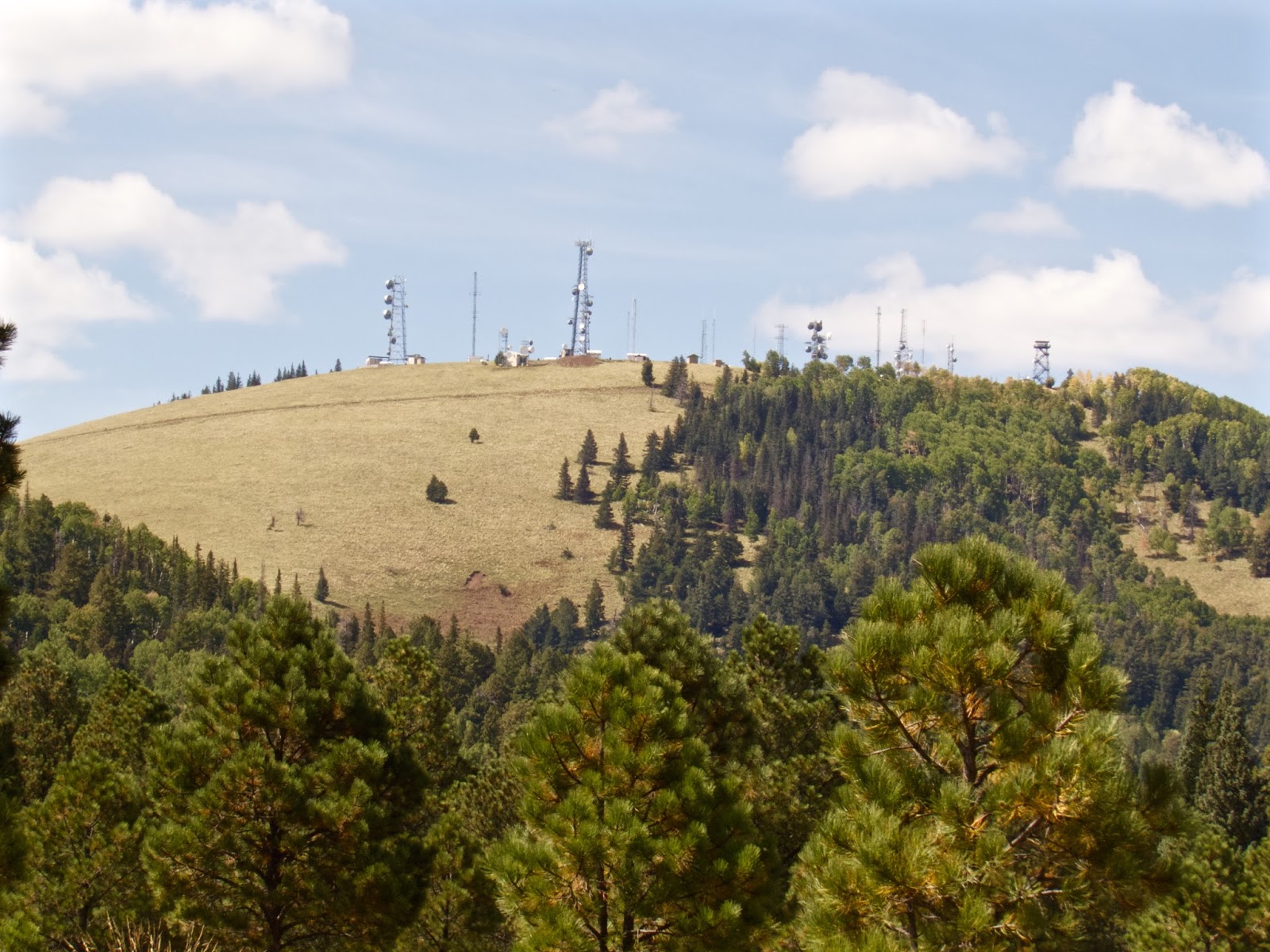 |
| Green's Peak's meadows and forests |
If we were exceptionally lucky, we might find a Dusky Grouse up there, but other neat birds can be found as well.
Thus, we took the FR 117 exit from Highway 260 and followed the directions for 18 miles to the Peak. The last 1.5 miles were a bit tricky but Marcee drove her all-wheel drive Subaru up the steep and rutted road like a trooper, white-knuckled perhaps, but with great skill. The wheels only spun once in a wet gravel rut and she simply kept going forward until we were clear.
We felt the elevation change when we stepped out of the car at 10,100 feet so took our time acclimating before birding. We enjoyed the aspens, the view from that height and the terrain around us.
 |
| Aspens just changing from green to gold |
 |
| View of Sunrise Lake west of Green's Peak |
The "parking lot" was a fairly flat spot in front of a Road Closed sign.
 |
| Marcee, happy to have driven safely to the top; and Lois |
We began our exploration by walking down the "closed road" to see what we might find. It was steep and wooded with few grasslands but we walked the grassy areas on the edges with the hope of flushing any bird.
 |
| Note length of wing on tail and lack of eye ring of the Western Bluebird |
Marcee handled the drive down as if it was nothing! It had been mostly her anxiety on the way up because actually she had been driving very capably for the rough road.
We took the road over to Carnero Lake where we came upon two people. One, a woman who was just wrapping up a good fishing time on the lake with several very large rainbow trout. Her dog, who looked like a doodle, was very happy to see us and acted like a puppy even though she was eleven years old.
As we ate our lunch there, the man, wearing a polo shirt and trousers, who had been talking to the woman, came over and told us he lived in the van parked close by. It had solar panels and looked serviceable. We didn't bother with names, but the guy has lived on the road, as he put it, for 35 years. He told us about a Western Tanager that had nested there the previous year, but not this one.
Although there was a walking path beside the good-sized lake, we birded with the spotting scope to sort through the many American Coots to find what else was out in the distance: One Pied-billed Grebe, a Northern Pintail, two Western Grebe and Lois found ten Ring-necked Ducks. Then we returned to Route 117 and down Green's Peak the same way we drove up.
Our next and final stop of the day was a long drive but it went quickly. We arrived at Lyman Lake State Park at 2:30 p.m. where the temperature had climbed to 85°. After enjoying the coolness of Green's Peak, the heat seemed unbearable!
Our first sighting there, aside from a Ferruginous Hawk was a tall shore bird that Marcee thought might be a Wood Stork. It was very stocky but far away and stood with its bill pointed downward. Through the scope from a distance, I thought it might be two birds close together but only one set of legs were obvious.
When we got closer, it became apparent:
 |
| (Fat) Great Blue Heron projecting a very unusual stance |
We drove out beyond the camping area where we could take the maintained roads to the end of several peninsulas. Most birds were quite distant but I photographed the closest ones to me -- Ruddy Ducks.

Day 3: Wednesday, 9/30/15
Explored one site: Wenima Wildlife Area northeast of Springerville.

At my usual birding rate of one mile per hour, we managed to spend about four hours at this site. First, we walked the trail into the meadow and back (total, 2 miles); then we walked the Powerhouse Trail along the Lower Colorado River to the old powerhouse and back (another 2 miles).
Although White-crowned Sparrows and American Robins were numerous, some birds perched up and then, were gone.
After two hours of birding in the meadow with some good sightings (Lincoln's and Song Sparrow in addition to the White-crowned), White-throated Swifts, Western Wood Pewee and Orange-crowned Warbler), we opted to bird along the river. I was particularly interested in finding a waterthrush and would have been happy with either a Louisiana or Northern, but all we found were beaver dams.
Some of our better sightings on the Powerhouse Trail were numerous Violet-green Swallows swirling overhead, Blue-gray Gnatcatcher and Lark Buntings.
We birded to the end of the trail where the old powerhouse is fenced off with barbed wire.
By the time we completed birding at Wenima WA (4 miles; 4 hours), we were ready to head for home.
After a stop at a Show Low Subway shop for a bite of lunch, we returned via Payson to Bush Highway to reach Apache Junction (my home) via Usury Pass Road.
In three days of relaxed birding, we had visited nine (9) sites and spotted 74 species, some of which were AZ Year Birds for me. It was the first time I had birded with both Marcee and Lois and it turned out that we were very compatible.
So, kudos to the two of you for helping make this a special 3-day birding adventure!

At my usual birding rate of one mile per hour, we managed to spend about four hours at this site. First, we walked the trail into the meadow and back (total, 2 miles); then we walked the Powerhouse Trail along the Lower Colorado River to the old powerhouse and back (another 2 miles).
 |
| Four Mule Deer watching us arrive at the trailhead from opposite pasture |
Although White-crowned Sparrows and American Robins were numerous, some birds perched up and then, were gone.
 |
| Western Meadowlark (it also sang for us) |
 |
| A "normal-looking" Great Blue Heron at edge of Little Colorado River, Wenima WA |
After two hours of birding in the meadow with some good sightings (Lincoln's and Song Sparrow in addition to the White-crowned), White-throated Swifts, Western Wood Pewee and Orange-crowned Warbler), we opted to bird along the river. I was particularly interested in finding a waterthrush and would have been happy with either a Louisiana or Northern, but all we found were beaver dams.
Some of our better sightings on the Powerhouse Trail were numerous Violet-green Swallows swirling overhead, Blue-gray Gnatcatcher and Lark Buntings.
 |
| One of the beaver dams on the river |
We birded to the end of the trail where the old powerhouse is fenced off with barbed wire.
 |
| Lois and Marcee in front of old powerhouse |
After a stop at a Show Low Subway shop for a bite of lunch, we returned via Payson to Bush Highway to reach Apache Junction (my home) via Usury Pass Road.
In three days of relaxed birding, we had visited nine (9) sites and spotted 74 species, some of which were AZ Year Birds for me. It was the first time I had birded with both Marcee and Lois and it turned out that we were very compatible.
So, kudos to the two of you for helping make this a special 3-day birding adventure!
* * *
View this checklist online at http://ebird.org/ebird/view/checklist?subID=S25247045
View this checklist online at http://ebird.org/ebird/view/checklist?subID=S25247103
View this checklist online at http://ebird.org/ebird/view/checklist?subID=S25247270
View this checklist online at http://ebird.org/ebird/view/checklist?subID=S25247401
View this checklist online at http://ebird.org/ebird/view/checklist?subID=S25247691
View this checklist online at http://ebird.org/ebird/view/checklist?subID=S25247805
View this checklist online at http://ebird.org/ebird/view/checklist?subID=S25247991
View this checklist online at http://ebird.org/ebird/view/checklist?subID=S25248076
View this checklist online at http://ebird.org/ebird/view/checklist?subID=S25252031


