Tubac Hawk Watch and more . . .

March 14 & 15, 2015
This past weekend I joined a small group of Sonoran Audubon birders to visit the Hawk Watch at Ron Morriss Park in Tubac as well as to do other birding in that general area south of Phoenix.  Although I had walked past and even birded this park last year, I didn't realize it was located directly behind the biggest draw to Tubac -- the Artist's Colony.

We arrived at the Hawk Watch on Saturday morning at 7:45 with a fair number of people already in chairs lined up facing south since most birds were flying south to north.  Having never participated in a Hawk Watch before, I was excited and wanting to learn about the process.  Despite windy weather, the hawks traveled overhead, sometimes low enough for some practice at aerial photography. At other times we would call a sighting "about 50 feet below the crescent moon" so that everyone could locate it in the sky.


Black Hawk

Among the many hawk watchers (45 estimate) was one birder, a licensed bird bander, who brought an American Kestrel over to to our area so we could see its beautiful markings. With its striped rufous back and tail, blue wings, and two vertical face stripes, our smallest falcon is fairly easy to spot. But to enjoy its colorful patterns up close and personal was a special treat.  The bird was calm during its "showing off".  It was later released away from the park.


Later in the morning, another Kestrel flew overhead and perched where it could watch us.


American Kestrel

Peter Collins
Peter Collins records the Hawk Count on an hourly basis.  The fact that the previous day, he had logged 15 species of raptors was an excellent count.  They had also enjoyed a visit from a Short-tailed Hawk.  
That was one bird I wanted to see and, on Saturday, I happened to be right next to the birder who called it but when I asked its location he shrugged his shoulders:  "It came in right over there and went down out of sight."  A reliable and known birder, his sighting was added to the day's list of hawks observed.  For me, it went on my TSID list:  "They Saw It; I Didn't".

Our group (Claudia, Barb, Susie, Kathe, Sue and I) participated in the Hawk Watch for about four hours.  Pete was very good about calling out loudly the hawk sightings by others that he confirmed.  When no hawks were in the sky, I struck up a conversation with some birders standing next to me.  They were from Dallas and were temporarily staying a bit northeast of Tucson. When I wasn't checking with other birders who had called out a sighting that I wanted to see, I kept returning to talk birds with this couple, Bob and Beth. By the end of the morning, we realized that both Bob and I will be on Melody Kehl's trip to Big Bend NP next month.  Beth isn't a birder but accompanies Bob from time to time and I was glad she had chosen to join him on the Hawk Watch. 

From Tubac, we drove farther south to Pena Blanca Lake, arriving there shortly after noontime and staying for about two hours. With many different approaches to the Lake, we explored several of them. Ruddy Ducks and a Belted Kingfisher were the best sightings at the Lake, but the trails offered up some spring blossoms as well as a Wilson's Warbler and four Mexican Jays, one of which was a sub-adult, having not yet lost all the pale color on its beak. It wasn't black like the adult Mexican Jay's bill.


Blossoms along Pena Blanca Lake Trail

We made several stops along Ruby Road as we drove back toward I-19. The Pena Blanca Spring area was rich with birds. After parking beneath a tall spreading live oak tree, we followed the birds from that area to the nearby hillside. What a treat!  More Vermilion Flycatchers, a Hutton's Vireo, Mexican Jays, Bridled Titmouse, White-breasted Nuthatch, Rock and Bewick's Wrens, Black-tailed Gnatcatchers and, best of all, a male Painted Redstart. What a grand way to end a long day of birding!

Dinner at Wisdom's that evening was an excellent choice for some good Mexican food to fill us up.  Having left the Phoenix area at Zero Dark Thirty, we were all eager to reach the motel in Green Valley for some Zzzzzz.

The next morning, we set out on Tubac's section of the deAnza Trail to try our luck at finding the rare Sinaloa Wren from Mexico. The Juan Bautista deAnza National Historic Trail runs from Nogales, AZ to the San Francisco Bay Area.  The Tubac section has been "touched" by the artists of the area with whimsical and clear designs.  The spider and cobweb captured the morning light and this unique sculpture struck my fancy. A sign, also below, explains.


When we reached the stakeout for the Sinaloa Wren, the three people intensely watching a brush pile told me they had just seen the bird.  Before they left, I heard the bird's ratchet call but had to wait 45 minutes longer before it came into view.  I was now in the primo spot for observing it and, as it emerged from beneath the sticks, I was able to see its light eyebrow and dark facial markings.  As it scratched around in the leaf litter, I also caught sight of its rusty tail. WOW!  It was not a Life Bird for me; I had seen it in Huachuca Canyon last year. But this one had a way of skulking out of sight for very long periods of time.  I felt very lucky.

As we returned on the de Anza Trail, lighting was good for a photo of this Broad-billed Hummingbird that perched in front of me.

Broad-billed Hummingbird
On our return, we diverted from the trail to visit the Hawk Watch again, but the winds were so strong, we stayed less than an hour.

Driving out of Tubac on Bridge Road, we stopped to enjoy a large flock of Cedar Waxwings in two trees, one on each side of the road.  We counted 50 altogether.


Close-up of one of the Cedar Waxwings
Next stop was Amado Water Treatment Plant pond to see if the Pacific Loon was still present.  It was!  It was swimming and preening along the western edge of the pond.


Pacific Loon

With wind gusts coming more frequently, we decided to check out Florida Canyon where we might be more protected.  The fact that another rarity has been sighted here recently was a bit of a magnet for us, too.  That I had just seen the Black-capped Gnatcatcher a week ago here was no deterrent; a rare bird is always on my radar.  Today, it was not seen as quickly or as easily as last Sunday.  It was not at the corral; it was not at the parking lot, but a person leaving the area told us it had been spotted twenty minutes previously up the trail to the water tank.  I had no idea where that was but our avid planner for the trip knew, so we followed her.  
Trail to Water Tank, Florida Canyon

Previous attempts have kept me from this trail due to high water in the stream crossing close to the parking lot. Today, a mother and her two small children were playing in it. We were able to cross easily on rocks without a drop of water touching our shoes. We saw good birds as we hiked upward: Red-naped Sapsucker, Broad-tailed Hummingbird, Red-tailed Hawk and, rather surprisingly, a female Northern Harrier riding the updrafts in and around the mountains.  We didn't see the target bird on our way to the water tank, but we paused on our way down, not far from the tank where we heard several species.  Eventually, the Black-capped Gnatcatcher came into view!  Both a male and a female were present so I soaked up everything I could see about them.  It had taken me five or more attempts at finding them last year and now, in one full week's time, I was seeing a pair of them for the second time this year!  

Back at the parking lot, we spotted a Green-tailed and Canyon Towhee as well as a Pyrrhuloxia.  A good way to end our visit to the I-19 Corridor south of Tucson.


During a brief rest stop at Sweetwater Wetlands, we decided to tally our list out at the ramada.  A Snowy Egret flew in to the same mesquite tree where a Great Egret was already perched, ruffling the Great One's feathers.  

Left: Snowy Egret and Great Egret, on the right


It was an awesome trip with keen birders and fun companions despite the high winds on Sunday.  Of all the birds spotted, I managed to tally 83 species during the two days.


* * *


Lost Dutchman SP Bird Walk

March 11, 2015
Anticipating a good number of participants for my once-a-month Bird Walk at Lost Dutchman State Park, I invited some helpers along.  Ann and Bari agreed to join me; a good thing since about 23 birders showed up.
As usual we meandered for 90 minutes a loop trail out and back to our starting spot at Saguaro Day Use parking lot. 
With some clouds in the sky but mostly sunny and comfortable weather, we set out on the 90-minute walk to the sound of Black-throated Sparrows. I always want to show off that bird but many times it doesn't show up until we're almost finished. Today, that species was present at various spots the whole distance and during an after walk with a few friends.

Black-throated Sparrow   Photo: Chris
Bari and Ann played a critical role in helping the beginners find the birds. Whether we were viewing Cactus Wrens, Verdin, Phainopepla or House Finches, the group was full of questions and smiles as they found birds in their binoculars for close-up views of a distant species.

My thanks also to Jerry who was near the front of the group.  He was a more experienced birder and helped call the location of birds so the group could share the sighting.  A thrasher whose voice I couldn't discern on the walk was, I discovered after the fact, a Sage Thrasher.  When I walked with my friends after the conclusion of the 90-minutes walk, we spotted one in a palo verde tree and I later confirmed the song as a match to what I had heard with the group. 

Sage Thrasher   Photo: Chris
Ann spotted two distant high-flying hawks at the east edge of the Superstition Mountains.  I guessed them to be Harris's Hawks but told the group we wouldn't add it to our checklist unless we got a positive identification.  Eventually, one flew down our way before we wrapped up the walk so everyone got a good view of the white at the base of its long tail and the wide black band before the white tail tip.
A substantial number of the people who had showed up for the walk made it all the way through and seemed to enjoy it as much as I did.


Birders who did the full 90-minute walk


* * *

SEAZ Birding Adventure with my Canadian "Pointers"

March 8 & 9, 2015

Day #1

With reports of Black-capped Gnatcatcher sightings in the corral area of Lower Florida Canyon arriving regularly, I was itching to try my luck.  Last year I had dipped three times before finally finding it in the parking lot area of Florida Canyon on November 2nd. 

Since I'm enjoying house guests, I asked them and two other mutual friends, to join me for a two-day Birding Adventure to Southeastern Arizona to see if I could locate that elusive gnatcatcher.   Luckily for me, they were up for it, so on Sunday morning we departed Apache Junction early enough for the five of us to arrive at Florida Canyon at 9:00 a.m., after a 3-hour drive, including a quick breakfast stop.

Detailed directions from birder friends helped us find the spot immediately.  We birded our way into the corral area and I found myself at the far end of it peering out toward a forest of leafless gray trees.  THUNK!  I turned to see two cows entering my side of the corral for a drink.  When I quickly slipped over into another section with Chris, we both heard the mewing call of the Black-capped Gnatcatcher.  My other friends had already returned to the van to bird that area. 

Tank in the Florida Canyon corral

Staying quiet at the rear corral fence, we were soon treated to multiple sightings of three (not one, but THREE) Black-capped Gnatcatchers.  It appeared to be one male and two females. The lighting of the morning sky was not conducive to long-distance photos, but we did our best.  Note the whiteness of the under tail on the male in the photo below; it is one of its diagnostic markers.  It is different than the under-tail of both the Black-tailed and Blue-gray Gnatcatcher.

Black-capped Gnatcatcher - male
I was thrilled to get such a good view of the birds flitting from tree to tree.  
Black-capped Gnatcatcher - male (photo: Chris)

In the photo below, Chris was able to get both the male and female Black-capped Gnatcatcher in one frame.  Birding can be like finding a needle in a haystack: can you find the female?  
Black-capped Gnatcatcher [female at bottom below male]

After about fifteen minutes with this treasured target bird, both Chris and I wondered if we would have any good photos to share our "find".  Above are the best we managed to get.

Turning to leave, I immediately noticed a flycatcher in a large tree behind us. This "empid" (Empidomax), the Gray Flycatcher, is one that frequents the riparian and mesquite habitat in the Phoenix area, so its familiar downward tail-wagging confirmed its identity.  It stands apart from other empids by its lack of distinctive eye-ring; the others are much more difficult to ID.  Knowing songs and chips are the keys to knowing one empid from another, but I'm not there - yet.


Gray Flycatcher


I planned several stops in Madera Canyon, the first one being at Whitehouse Picnic Area to try to locate the Red-breasted Sapsucker that's been in the area for several months.  Again, my birder friends had given me good advice as to where to look for it so, after parking, we scanned across the road toward a particular multi-trunked tree with a small white stone in front of it.  There was a bird there, but not the one I was seeking.  
Female Red-naped Sapsucker
We hung out for about half an hour before moving up canyon to Santa Rita Lodge where we could find no parking.  Higher up, we stopped at Kubo B&B where we birded the stream with feeders attracting a variety of birds.

Kubo B&B

 My best sighting there was a Painted Redstart, with a Magnificent Hummingbird, a close second.


Painted Redstart

After 15 minutes there, Chris, Sharon, Kathie, Lynne and I decided to head to the top of the road for a picnic lunch.  Construction work posed no waiting problems for us where it was one lane, but picnic tables and parking spaces up there were scarce.  We finally found one and enjoyed the coolness of the higher elevation of 3500 feet.  Located in the Santa Rita Mountains, Madera Canyon offers many hiking and birding trails as well as picnic areas that were being used to the max on this Sunday.  


Sharon, Chris, Kathie, Lynne

Returning to Santa Rita Lodge, my friends got excited about the variety of hummingbirds, the Acorn Woodpecker, Bridled Titmouse, the Mexican Jay and the Wild Turkeys.  Best sightings for me were the Magnificent Hummingbird and the Black-chinned, that I had not yet seen this season and which I understand was its first appearance for the year at the Santa Rita feeders.


Broad-billed Hummingbird;  Photo: Chris
Anna's Hummingbird;  Photo: Chris

MAGNIFICENT Hummingbird;  Photo - Chris

Wild Turkey

From Madera Canyon, we headed south on Highway 19 toward Patagonia, with a brief stop at the Amado Water Treatment Plant, a small pond on the east side of a frontage road.  My target bird was the Bronzed Cowbird reported there several days ago, but two of the birders in the car keep a life list and the Pacific Loon, a continuing rarity, would be a first sighting for them.   It was mid-afternoon when we arrived, but we spotted the Pacific Loon immediately in our northwest corner of the pond.  It did one dive, came up, then curled up into siesta mode and stayed that way for the remainder of our brief stop.


While our friends checked into the Stage Stop Inn at Patagonia, Kathie joined me in searching the City Park for the Yellow-throated Warbler, another rarity that has continued there.  I had tried for that rare bird with other birding friends in early February and dipped twice.  Dang!  We saw 10 Cedar Waxwings in a tree across the street but no YTWA in this wide median strip across from our hotel.  We were ready for pizza at Velvet Elvis with the others, so gave up our search.

E-bird references for Day #1:


DAY #2 :  March 9th
After breakfast at 7 a.m. in the Wild Horse Saloon restaurant attached to the Stage Stop Inn, I birded the City Park again while the others packed and loaded the car.  It was a fortunate thirty minutes of time spent.  While bah-humbugging the numerous Yellow-rumped Warblers in several pine trees, a Gray Hawk flew through my binocular view.  Quickly, I followed it over the park and to the east.  The Gray Hawk is a beauty and one that really touches me deeply.  So, I was thinking that all was not lost on this morning after all.  Just then, a striking gray and white bird flew into the high part of a pine.  Could it be my bird?  I was looking for the ID marks on a moving bird:  white eyebrow; white patch on sides of neck; triangular black mask; long dark bill; and, of course, its boldly bright yellow throat that extends down onto the chest.  After several quick looks, I knew I was looking at the rarity.  It was high and moving; no photo.  I've seen some awesome photos of this bird taken by friends but, on this occasion anyway, I'm not among them. 

A visit to Patagonia is not complete without a visit to Tucson Audubon's Paton Center for Hummingbirds.


While the bird on the flag above, the Violet-crowned Hummingbird, was my target bird, my friends (my Canadian "pointers") were thrilled with a Bridled Titmouse, Lesser Goldfinch and Pine Siskin.  Upon arrival at the Paton House, Larry Morgan met us and told us he needed to leave on an appointment, so we made ourselves comfortable with the many chairs and just strolled the yard.  The Violet-crowned Hummingbird is a regular there each year and did not disappoint.  

At a tree right over the Paton House, a Common Raven was persistent in nest building.  It flew in, broke off a branch with its bill, looked it over, broke another piece off, then flew off to wherever its nest was being constructed.  Then, it returned and went through the same process again but after breaking off several pieces of his chosen nesting stick, decided it wasn't going to work after all and tossed it aside.  He started the process all over….several times, sometimes taking one for nest building; other times, tossing it aside.

Violet-crowned Hummingbird
Photo:  Chris
Larry gave me the directions I needed to find the Curly Horse Road that he had guided a few of us on in February.  Today, I was looking for Chestnut-collared Longspurs.  The grasslands provide awesome wide-open space for all sorts of birds, including the many Eastern and Western Meadowlarks that we heard and saw.  Chris was able to photograph a Grasshopper Sparrow in some thick brush that had flown toward us from a small flock far out in the field.  Barely visible in the photo but enough for ID.  [Not posted here]


Grasslands; Sonoita area
Babs, birding the grasslands
After an hour of stopping and looking at many birds in the grasslands but seeing no flocks of longspurs, we headed for our next stop, Mary Jo Ballator's Ash Canyon B&B in Sierra Vista.
Sculpture at entrance/exit to grasslands

High Noon is not the best birding time of day, but that is when we arrived at Ash Canyon B&B.  Mary Jo was sitting out and greeted us warmly as we joined her in the chairs to watch the numerous feeders that she fills daily.  She has created a bird-friendly habitat that was jumping with activity.  She initiated my friends in her systematic way of locating the position of birds in the yard and she identified birds for them.  

Mexican Jay  Chris: photo


When an unknown hawk made its presence known to the birds at the feeders, they immediately FROZE. . . . not just for a few seconds.  This White-breasted Nuthatch stayed, unmoving, in this posture for eight (8) minutes.  With the black of its back and head visible from above, it was well camouflaged.


White-breasted Nuthatch, Ash Canyon B & B; held this posture for 8 minutes in response to hawk presence


Just as suddenly as each bird had simultaneously locked into position for the duration, they relaxed again and went about feeding.  I had never been present for such a long "freeze" of so many birds.
Ladder-backed Woodpecker
Our next stop, the San Pedro House is always inviting to birds and birders.  What better place to look for the rather hard-to-find Pyrrhuloxia that resembles the Northern Cardinal.
Pyrrhuloxiia


When I had checked the Arizona listserv last evening, I had seen a report of two Least Grebes at  Kingfisher Pond along the San Pedro Riparian area below the house.  Kathie and Lynne joined me for the one-mile walk to the pond; Chris and Sharon strolled down the main path to the river.


Spring Cottonwoods leafing out along the San Pedro R.

Two Pied-billed Grebes  [Saw no Least Grebe(s)]
Yellow Warbler seen by Sharon & Chris
Wrapping up our visit there, we departed for home at 3:30 p.m., returning the "back way" to avoid heavy commuter traffic north of Tucson.  We traveled a total of 845 km, saw 70 species of birds, enjoyed near-perfect birding weather and enjoyed meeting and talking with other birders wherever we went.  Chris saw 23 Life Birds on the trip and we all considered it a rather fantastic birding adventure.

E-bird references for Day #2:


* * *


Another Gem in the East Valley: Boyce Thompson Arboretum

March 6, 2015
Sharon and Chris, my friends from Ontario, had been looking forward to visiting Boyce Thompson Arboretum (BTA) and on this day it did not disappoint.  After parking the car in the picnic area, Sharon carried a chair to a spot by Queen Creek along the lower trail.  She was looking for relaxation!

Chris joined me in trying to find birds under the bushes, up in leafless branches, in and around school children, families, dog walkers and others who were taking advantage of this beautiful sunny, but windy, day.  

The many blooms and butterflies drew the attention of photographers as we walked the trails trying to hear bird songs above the wind and group activities.  We covered different territory than usual and by the time we finished up at 1:40, we had visited neither the hummingbird nor the demonstration garden!  Anna's Hummingbirds, however, were visiting many blooms throughout the arboretum.

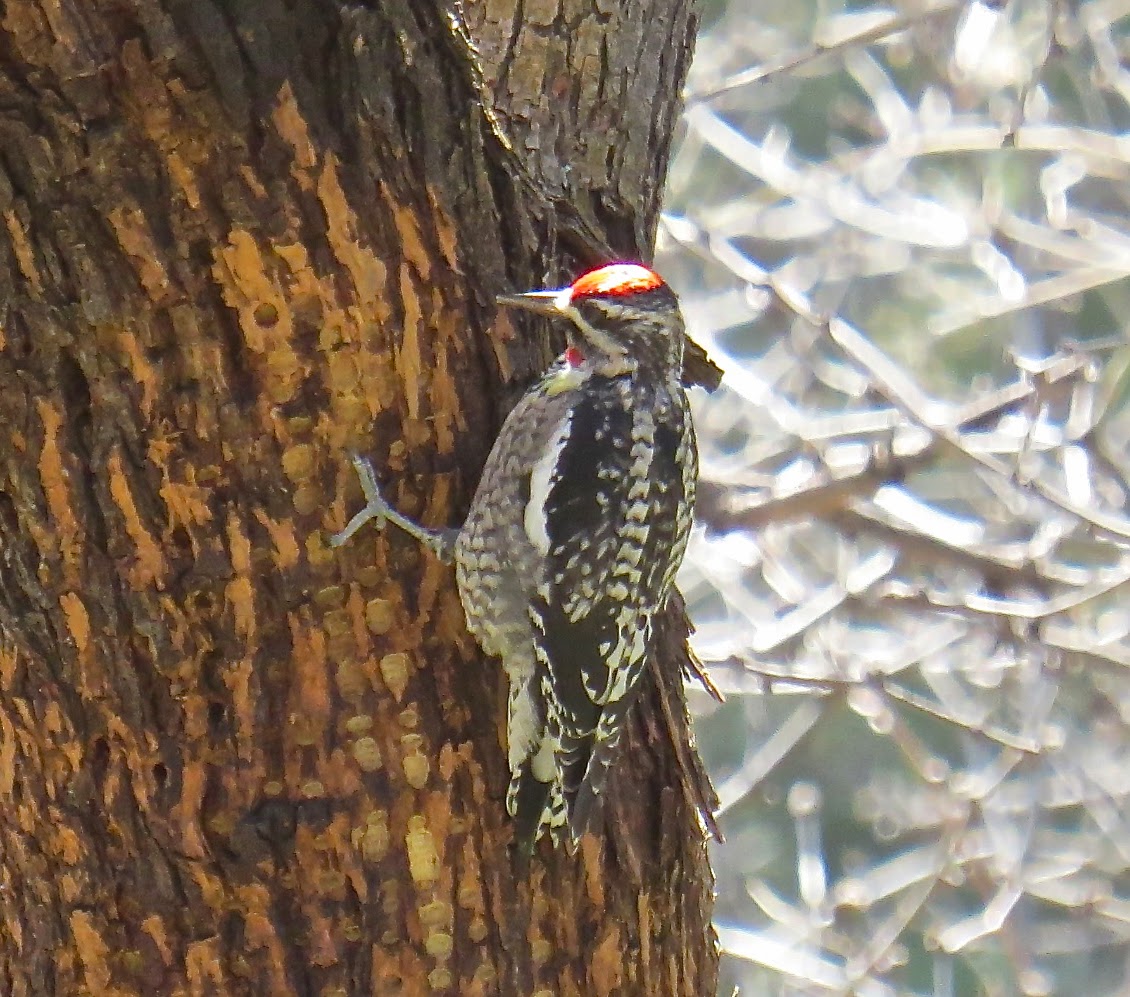
It's always satisfying to find the "target" bird for the day and in this case the vocal Yellow-bellied Sapsucker was present near the Drover's Shed as friend, Susan Fishburn had suggested to me after she spotted it there earlier in the week.

Boyce Thompson Arboretum Lower Trail
Sharon enjoyed her two and half hours of relaxation listening to the wind in the leaves and birds in the trees.  After a very enjoyable lunch at Porter's Cafe in Superior, we continued driving on up the hill beyond the city to take a brief look at Oak Flat Campground area.
Recent rains had formed a decent-sized pond on some flat land at its north edge, but we could find no waterfowl visiting it.  


Photo by Chris
Chris & Sharon at Oak Flat Campground

Water or no water, one bird that is frequently found there is the Vermilion Flycatcher.
Vermilion Flycatcher

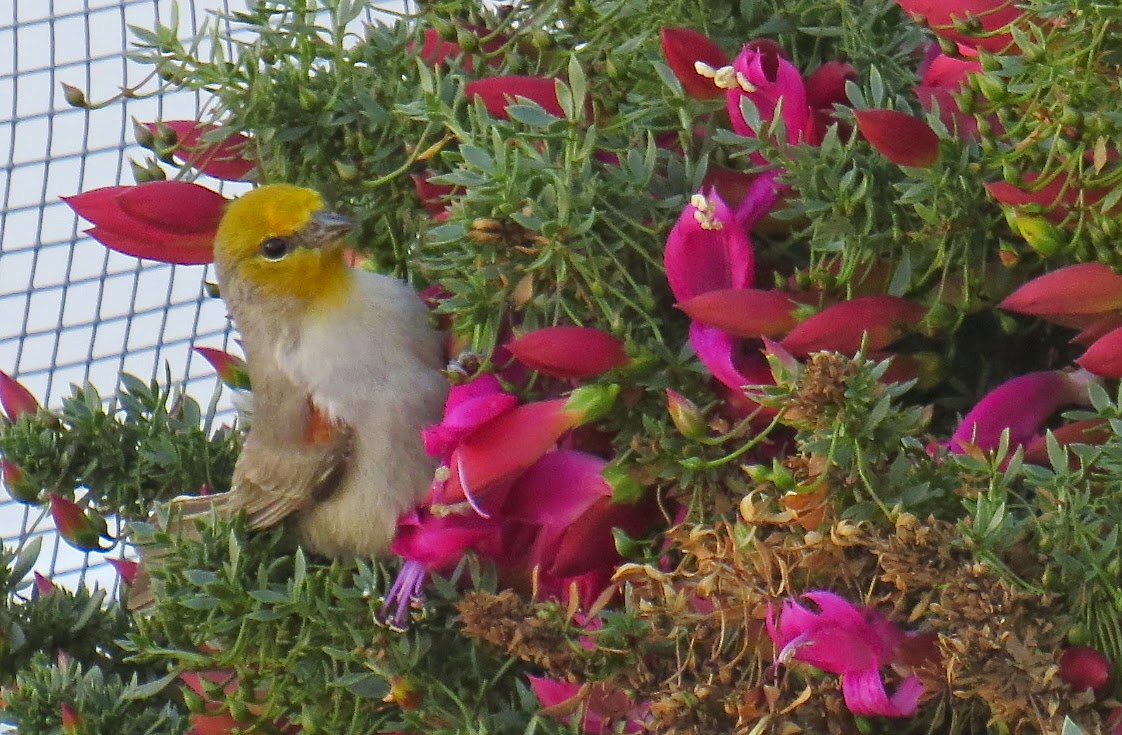
When we arrived back home, I noticed a Verdin was enjoying the Emu Valentine plant I had purchased  at Boyce Thompson (several years ago) intended for the hummingbirds.  The Verdin was so busy diving into the plant, then coming up for air, that I got my best photos of the day right here in my yard.  


That's it for another interesting day of birding!