A Cool Morning leads to Gilbert Water Ranch, Mesa, AZ


                                                                             SNOWY EGRET

Wednesday, September 9, 2020

Meeting friend, Lois Lorenz, at 5:40 a.m. in the parking lot of the Riparian Preserve felt very welcome; it had been more than six months since we had birded together!  Now, that she has retired from a very busy job, she'll be more available to get out and about.

It seemed appropriate that our hot summer temperature had taken a sudden dip overnight to 64°F for this first in a long time get together.  [Rain had happened in many nearby places last evening but I sat and watched rain on a news stream on my computer since we had none in AJ]

While rain makes the news in our hot desert environment, birds rarely do. Is that why I spend so much time with them? They are an overlooked part of our Earth Community, a part that can make us more whole and inclusive. Even prior to sunrise at the edge of Pond 7, we counted at least 80 Canada geese that had spent the night.  They were just beginning to make communal sounds that would lead to their eventual departure.

Just shy of a 3-hour visit, we saw 43 species from just the northern portion of the Preserve. Best bird of the day was not photographed; it was migratory and busily snatching insects in a large mesquite tree: HERMIT WARBLER. What a time we had trying to keep up with it as it moved from limb to limb, rarely in the clear. It was gray above with two white wing bars, white below all the way to the under tail coverts. Eventually, the flashes of yellow came more fully to us! HERMIT WARBLER face and head!  With too much cover for the bird to be seen in full at any time while we watched it for ten minutes just to ID it, there was no hope for me to get a photo. We treasured the thrill.

Focusing on the many wading birds at the Riparian area, I'll share a few species below. 

BLACK-CROWNED NIGHT-HERON, the two birds below, have shorter legs than most waders and choose to perch just above the water line where, with their red eyes, they can see the variety of prey in the water. The first is a juvenile that will grow to look like the adult (photo beneath it).        


GREEN HERON is another wader with shorter legs that will walk the shallows in search of its food, or like the BCNHs above, will perch quite close the water.


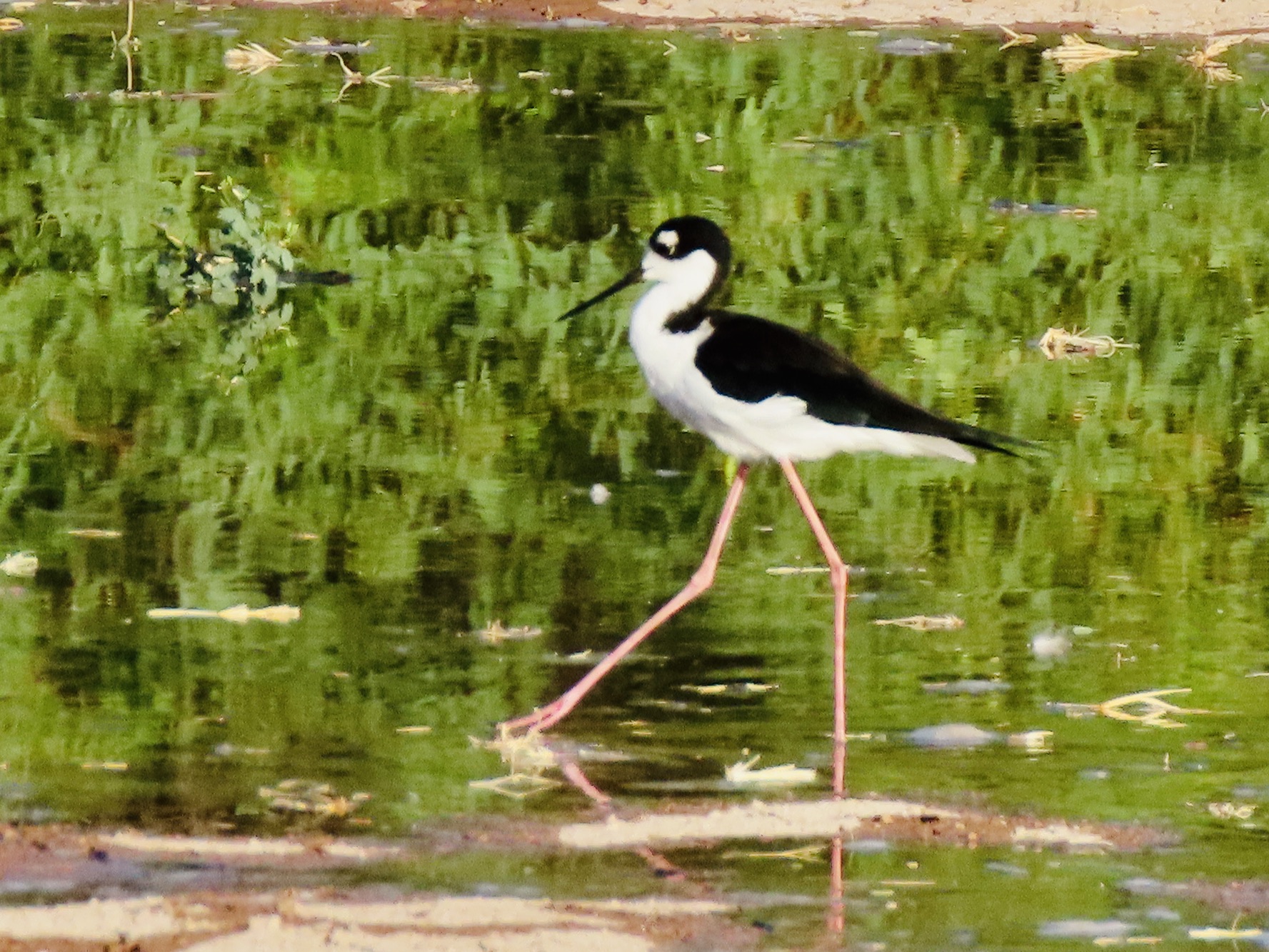
BLACK-NECKED STILT is a joy to watch as it wades through a pond.

GREATER YELLOWLEGS were gathered, it seemed, at Pond 5, where two or three were bathing while the others foraged.


GREAT BLUE HERON were present in more numbers than they have been all summer. Although its legs are plenty long for wading it, too, will perch higher above a pond. Perhaps breakfast is over and it's scanning for brunch.


Although several GREAT EGRET were present at the ponds, they were quite distant from where I was walking so I opted for the SNOWY EGRET instead -- the one with "golden slippers".


Land birds included RED-WINGED BLACKBIRD, WHITE-WINGED DOVE and a molting GREAT-TAILED GRACKLE missing its long tail feathers that will grow back.


Many flocks were in the air this morning: ducks, the CAGO, lots of doves, turkey vultures, and a hawk. It's been weeks since I've spotted a hawk at the Preserve.  We had two:  a COOPER'S that snuggled into the middle of a thin tamarisk to hide and a Juvenile Western RED-TAILED HAWK that is lighter colored than many other Red-taileds and the juvie has a barred tail.


Only 79°F when we finished up, it had turned out to be an exquisite day at the Water Ranch.

Until next time.....

* * *

View this checklist online at https://ebird.org/checklist/S73379365


Birding With the Light of the Full "Corn" Moon, Lower Salt River, Maricopa County, AZ

Wednesday, September 2, 2020 

With a welcome coolness in the morning air, I set off to check out some Salt River sites for potential migrants.

It's been many many days since morning temperatures have been as low as 79°F, so I was highly motivated. In pre-dawn, full moon light, birds were just beginning to chirp at Coon Bluff Recreation Area.  At that hour, I'm looking for owls or nighthawks as well as song birds but found no such lumps on thick mesquite branches.

High dry grasses in the picnic area had been taken down with controlled burns that would have made it easy to see any ground birds but the burn left no insects or worms above ground.

I rely way too much on birds perching out on bare snags so it took many looks at some birds behind leaves (mesquite, tamarisk, cottonwood) before I felt like I'd nailed the ID.  Then, again, some birds out in the open were hard to call. That's when I rely on photos!  But what to do when I see a bird that I call Warbling Vireo, then Philadelphia Vireo (head shape seemed wrong) and then Bell's Vireo?  Send it to someone who knows better than I do.  The photo below is of a WARBLING VIREO.


Overall, it was a delightful morning. Few people present: one kayaker, two horse followers and myself. With no close proximity to humans, I shed my CV mask several times. The air at the river seemed clear, not as dusty or smoky as in the desert.

Other birds photographed as I walked a loop east by the river and back, more inland included:

Gambel's Quail

Blue-Gray Gnatcatcher
                                                                
Bullock's Oriole (female)
                                                            Ladder-backed Woodpecker (female)


Both birds above are VERMILLION FLYCATCHER, the top being female, the lower one, male.

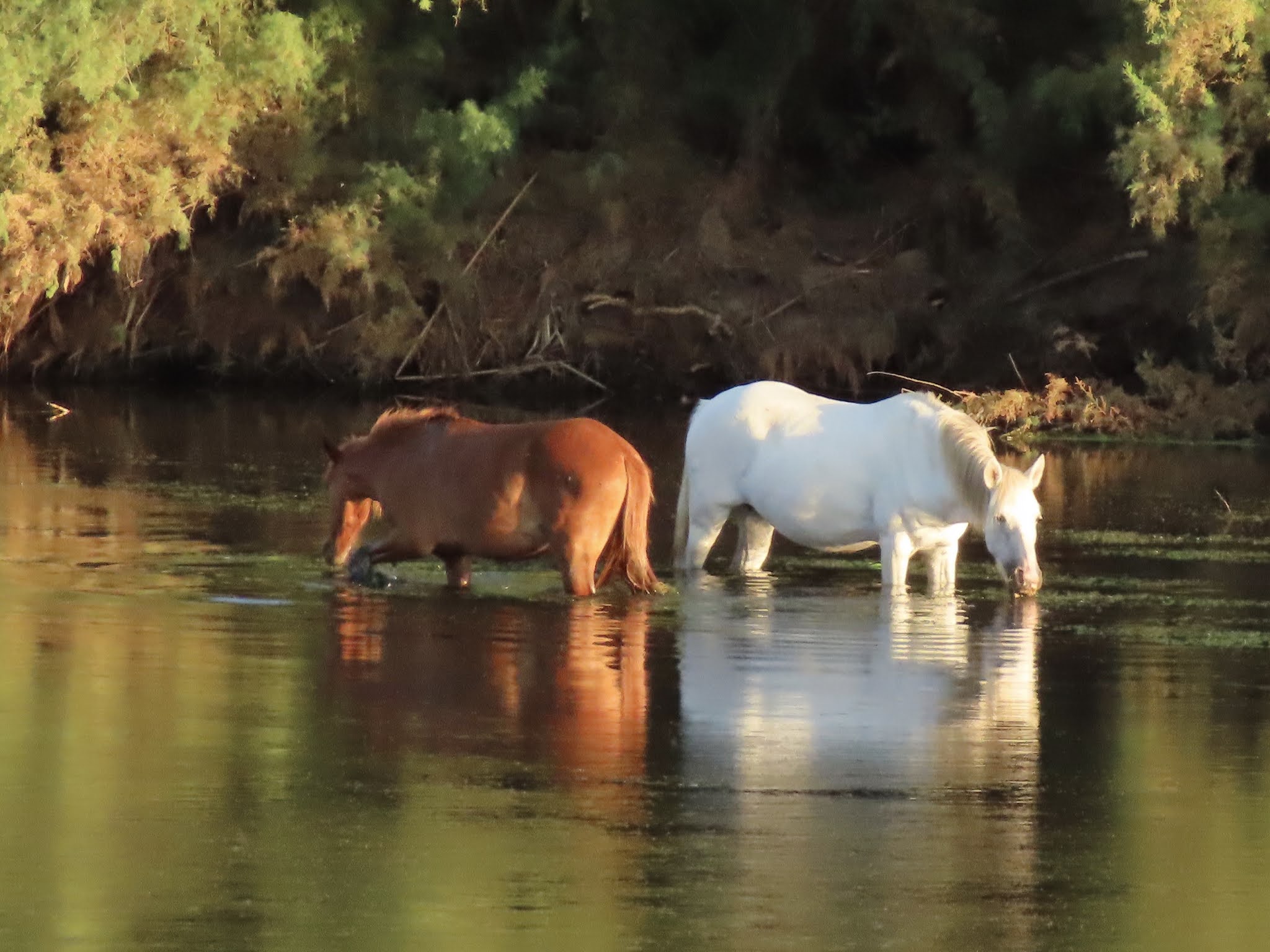
                                               Wild (feral) horses enjoying good green eats on the river

Finishing up about 8:15 a.m. at 85° was marvelous even though in our monsoon humidity, water had been running into my eyes from under my hat and my long-sleeve shirt was soaked. Actually felt good!

View this checklist online at https://ebird.org/checklist/S73101145

                                                                      * * *


Birding the western side of the Mogollon Rim; Coconino, Yavapai, and Gila Counties, AZ

Thursday, August 27, 2020

Tired of waking up quite early (4-5 a.m.) with temperatures already at 90°F, it was time I got myself up to cool country for a respite. The high heat - reaching 112-115°F by late afternoon — was now compounded with acrid smoke from nearby lightening-stoked wildfires in our Superstition Mountains. 

Friend and birding buddy, Hinde Silver happened to be staying for a while up in Show Low in the White Mountains.  She suggested I come up to the Mogollon Rim and she’d come down to meet me. Via AZ87 up to Payson, then east (right) on AZ260, the turn-off for the Woods Canyon Lake and store along the lake (our meeting place), was about a five (5) mile drive in on paved FR#300 Rim Road  located almost directly across the highway from the Mogollon Rim Visitor’s Center accessed from AZ260. I had to drive farther east to turn into the westbound lanes to get access as I must have missed the sign.


1. WOODS CANYON LAKE, Apache-Sitgreaves Forest, elevation 7500’

We set about birding the perimeter of the parking lots before setting out on the trail eastward. It can be so irritating to see these birds moving so quickly, the bird is seen in pieces. I wasn’t ready to call this one yet as I hadn’t seen its head/face but finally it confirmed my guess, NASHVILLE WARBLER. What I saw is what you get:


PYGMY NUTHATCH were calling from various corners; DARK-EYE JUNCO (Red-backed) were the only birds I noted working the ground at that point. An adult AMERICAN CROW was trying to keep her three (3) young fed and quiet — on a low thick tree limb.


At the Lake, of course, were OSPREY - both adult and juvenile.  It’s the first time I knowingly landed a photo of a juvenile OSPREY so I took many as most of them were circling the lake over and over again.


                                                                           Juvenile Osprey


Out on the trail, we found another ground bird - a thrush - YAY!  SWAINSON’S THRUSH!  Dark under the tall trees gave us no photos.


Walking up away from the trail into the forest where the birds congregated provided some good views of STELLER’S JAY; quick views of several ORANGE-CROWNED WARBLER; quick view of a TOWNSEND’S WARBLER, then single observations of GRACE’S and RED-FACED WARBLER.  

Whoop!  Whoop!  - Good birds!


                                       This file photo of Steller's Jay taken at Mt. Lemmon in 2014

                                  GRACE'S WARBLER (from my files taken in 2017 from Woods Cyn Lake)


                            RED-FACED WARBLER (file photo taken in 2017 at Woods Canyon Lake)


By its drumming, we tracked down a DOWNY WOODPECKER and on the way to the car for our first “lunch” we spotted a BALD EAGLE fly over the lake.

                                                                       DOWNY WOODPECKER

Being a first visit to this site for Hinde, I wanted her to get a good view of the edge of the Mogollon Rim from the Vista Overlooks before we continued on to our next birding site. I never quite get used to the fact that you could probably just jump off the Rim; I preferred looking out over the vistas below.


2. Personal Spot:  CHRISTOPHER CREEK LOOP — 5960’ elevation

Continuing west on Hwy 260, we pulled off to drive the loop around Christopher Creek community.  Woodpeckers were the mother-lode here:  ACORN, HAIRY and 3 NORTHERN RED-SHAFTED FLICKER. BROAD-TAILED HUMMINGBIRDs were also present in numbers but no photos!

                                                                ACORN WOODPECKER
                                                                NORTHERN FLICKER (Red-shafted)


                                                        Rear view of HAIRY WOODPECKER


3.  TONTO CREEK FISH HATCHERY - Payson;  6500’ elevation

Should have checked the website first.  Drove the 4 miles in to the Hatchery entrance only to find it blocked and closed during Covid.  Knowing that our good birds at the hatchery were found in the trees surrounding the parking lot there, Hinde started off on a trail into the forest beside the road-closed sign.


Located closer to Payson at reduced elevation, the outside temperature was 93°F.  In fifteen(15)minutes, we spotted a couple STELLER’S JAY, a CORDILLERAN FLYCATCHER,
two WESTERN WOOD-PEWEE and a pair of SUMMER TANAGER. 

With cumulus clouds growing increasingly heavy and dark overhead, Hinde departed for Show Low (through rain she reported later).  I wandered on down the entrance road toward 260, stopping only at a trailhead restroom before hitting the highway toward Payson.  When I came out from the restroom a VIRGINIA WARBLER greeted me!


4. GREEN VALLEY PARK, Payson, AZ. 5000’ elevation

As I continued down the mountain toward Payson, I was hopeful for some rain to wash my car!  Turning at Main Street in town, I headed to the lake at Green Valley Park where I pulled in at a remote spot to eat my second “lunch”.  

Directly in front of me were reeds filled with YELLOW-HEADED BLACKBIRDs!

I love them!  Raucous calls were muted among themselves as they perched, then flew down to the grass beside the lake, flew off and returned again to the reeds — giving me ample opportunity for photos.  As I prepared to back up and leave, I spotted, through my driver’s side window, a WESTERN BLUEBIRD on a wall.  Raining birds - but no water from the sky there or on my way home.

[Many other waterfowl and birds were present but I was not there for birding so did not make a complete list.]


                                                                   WESTERN BLUEBBIRD (female)


                                                                                  (Male)
                                                                                    (Female)


280 miles round trip.

Home by 4:00 p.m. after refilling the gas tank.


Very glad I decided to make the one-day trip northeast!  Good birding with Hinde!


* * *


To view eBird checklists, check links below:


View this checklist online at https://ebird.org/checklist/S72891051

View this checklist online at https://ebird.org/checklist/S72891391

View this checklist online at https://ebird.org/checklist/S72891661

View this checklist online at https://ebird.org/checklist/S72891826


A Cool Spot to Bird near Picketpost Mountain, Pinal County, AZ


                                               Ayer Lake, Boyce Thompson Arboretum, Superior, Arizona

Sunday, August 23, 2020

With only about 700’ higher elevation than where I live in the Phoenix East Valley, the temperature today was significantly cooler at 80°F in Superior than the 90°F  at home at 4:30 a.m.  Less than an hour’s drive, Arizona's oldest and largest arboretum is located in Superior.  Opening at 6:00 a.m. during the summer, it’s one of my favorite places to bird.

Birding the parking lot until it opened, I then followed the paved trail down toward the hummingbird plaza. While standing there, a call from high in a sycamore tree showed a bright red bird.  With the sun rising behind this SUMMER TANAGER, the photo is much less thrilling to view than the actual bird!


                                         ANNA'S HUMMINGBIRD at Mexican Bird of Paradise bloom


                            HOODED ORIOLE (male) seems to always find a stick or limb to "hide" behind


Already out from their roost and waiting for thermals in the sky, TURKEY VULTURE (TUVU) gathered on the cliff sides.


Later, beyond Ayer Lake, also up on the cliff rocks I noted an adult and a young TUVU preening and pecking by themselves.  I really don’t know if it is an expected event to have successful breeding pairs among the 50-75 TUVU that spend summers here, but it definitely appeared to be so in this one instance, a first such sighting for me.


                     Turkey Vulture:   Adult (left) with red face and head; Juvenal (right) with gray face and head


Up at Ayer Lake, two VERMILLION FLYCATCHERs were moving from one mesquite to the other.


                                                                            Male
                                                                           First-year female

To wrap up at the Demonstration Garden, I walked through the picnic area where I spotted a small bird running along a narrow board.  


                                                 Juvenile CANYON WREN!  

These are just a sample of the 40 species I observed in about three (3) hours of birding.


'Til next time I venture out in the heat!


Click on the checklist below to see the full list.


View this checklist online at https://ebird.org/checklist/S72730976