Two local spots: 6/10 & 6/12/2020. Maricopa County, AZ

Wednesday June 10 & Friday, June 12, 2020
At Goldfield Recreation Area along the Lower Salt River on 6/10/20, temperatures were cold enough at 4:56 a.m. to stiffen my fingers for writing legible field notations of our sightings. Unusual during these hot summer days.
(iPhone is temporarily broken and awaiting appointment with Apple to transfer, if possible, former data from kaput phone to a new one. Already missing the ease of listing with eBird online by smart phone.)

Habitat of the two places I birded exhibit a strong contrast.  At Goldfield, with Hinde Silver, we spotted two BALD EAGLE from the parking lot.  They were perched quite a bit north of the river beyond my camera range, but we got good binocular views.

Walking down the concrete path (west side of pkg lot), we reached the river rock "beach" but found no waterfowl; no herons, no egrets.

ABERT'S TOWHEE were numerous everywhere among the shrubs growing up on the rocky beach. They continued to be constant when we went up hill to the deep sandy trail leading eastward. Habitat is a mix of mesquite, willow and cottonwoods with ground cover of tiny flowering plants: blue, purple, white.  

The only heron we did spot was a GREAT BLUE perched on the north shore in the distance.
GREAT BLUE HERON - juvenile based on dark head, bi-colored bill.
Birds were actively singing and flying about. Walking into the rising sun made for difficult photography so pictures are slim; I just didn't take many.

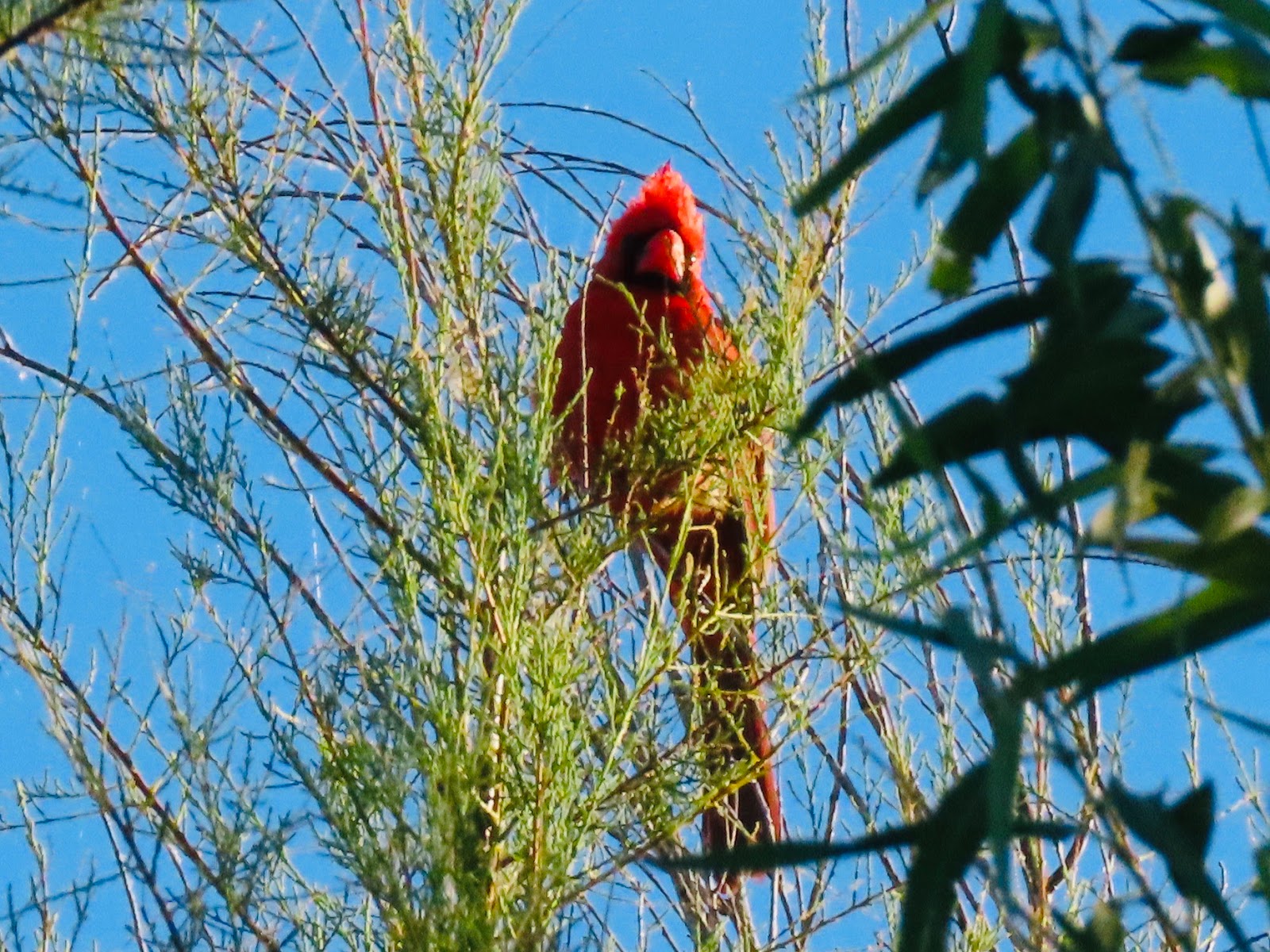
A NORTHERN CARDINAL was singing away.

ASH-THROATED FLYCATCHERs with their flashy rufous colors were active throughout to the point we weren't sure if they were the same birds or more. Our count of four sightings may be a conservative count.
Front view ASH-THROATED FLYCATCHER with pale yellow bellY
Profile view: ASH-THROATED FLYCATCHER
When we reached the sandstone bluffs and pillars, the air was full of swallows, mostly adults flying to and from their nests in the bluff with food for young. Not just three or four swallows; it looked like close to 100 in the air above us. CLIFF and NORTHERN ROUGH-WINGED SWALLOWs made up the majority with a couple VIOLET-GREEN also seen, but could not verify their nesting in the cliff. Just joined the party, I think,

Close to the shore of the river on our side of the bluff, several RED-WINGED BLACKBIRDs were displaying in hopes of attracting a female. 


While on the ground, the red on the wings is obviously in full color and thick.
The red is trimmed with a thin yellow band.
When displaying for a female, the blackbird hunches its back, bringing the wings forward to
let the sunlight catch the brilliance of its red epaulets. (Above & below)

Today at The Riparian Preserve at Gilbert Water Ranch, the seven RED-WINGED BLACKBIRDs I spotted were flying from place to place and not displaying.

Here, the hard wide dirt trails are packed and easily walked. With shrubs, bushes and trees on both sides of the trails, it is easy to spend 4-5 hours here to cover everything. I didn't do that today.

SONG SPARROWs were singing out in the open along most trails.

HOUSE SPARROW were abundant, also. The only photo I took was of a young under a ramada on a picnic table. It had been shaking its wings and calling, but the best pic was when it calmed down to see what would happen after its tantrum.
Fledgling HOUSE SPARROW waiting for food


BLACK-CHINNED HUMMINGBIRDs are not always easy to photograph but I lucked out today. See two photos below.


Many of the birds at the Water Ranch are in the ponds or dry basins.


Juvenile BLACK-CROWNED NIGHT HERON next to one of the ponds
My "spark" bird, the GREEN HERON
The BLACK-NECKED STILT can stop your breath with their dainty calm steps as they go about foraging for food.


In under two hours I had enjoyed watching 33 species in their various habitats. For me, there is not a whole lot that surpasses that experience.


* * *

Links to eBird lists:
View this checklist online at https://ebird.org/checklist/S70277007
View this checklist online at https://ebird.org/checklist/S70346646



MOUNT ORD, Maricopa County, AZ. [Summit: 7,100']

Mount Ord, in Tonto National Forest (Payson District), is part of the Mazatal Mountain range in Maricopa and Gila Counties.
Access:  Driving east on State Route 87 toward Payson, at approximately five (5) miles past Sunflower, look for a dirt road off to the right - marked either Mt. Ord or Forest Road 626. This will take you through several different habitats on the mountain from desert scrub, pinyon-juniper and oak-pine forest up to the summit parking area with side trails and the walkable dirt road past the fenced area to the summit. 


Tuesday, June 2, 2020

Our extreme desert valley daytime temperatures in May of 100-111°F had already relented to nighttime temperatures in the high 60s. Still, Mt. Ord sounded cooler to Hinde Silver and I than the high temps predicted for our homes in Pinal County.

Arriving at FR 626 at 5:45 a.m. @ 64°F, I lowered the car windows to listen for birds. First sighting was Gambel’s Quail scooting away from the road into scrub brush. Overall, It was sounding good so I pulled off at the corral where we got out to see what species might show up for us at that location.

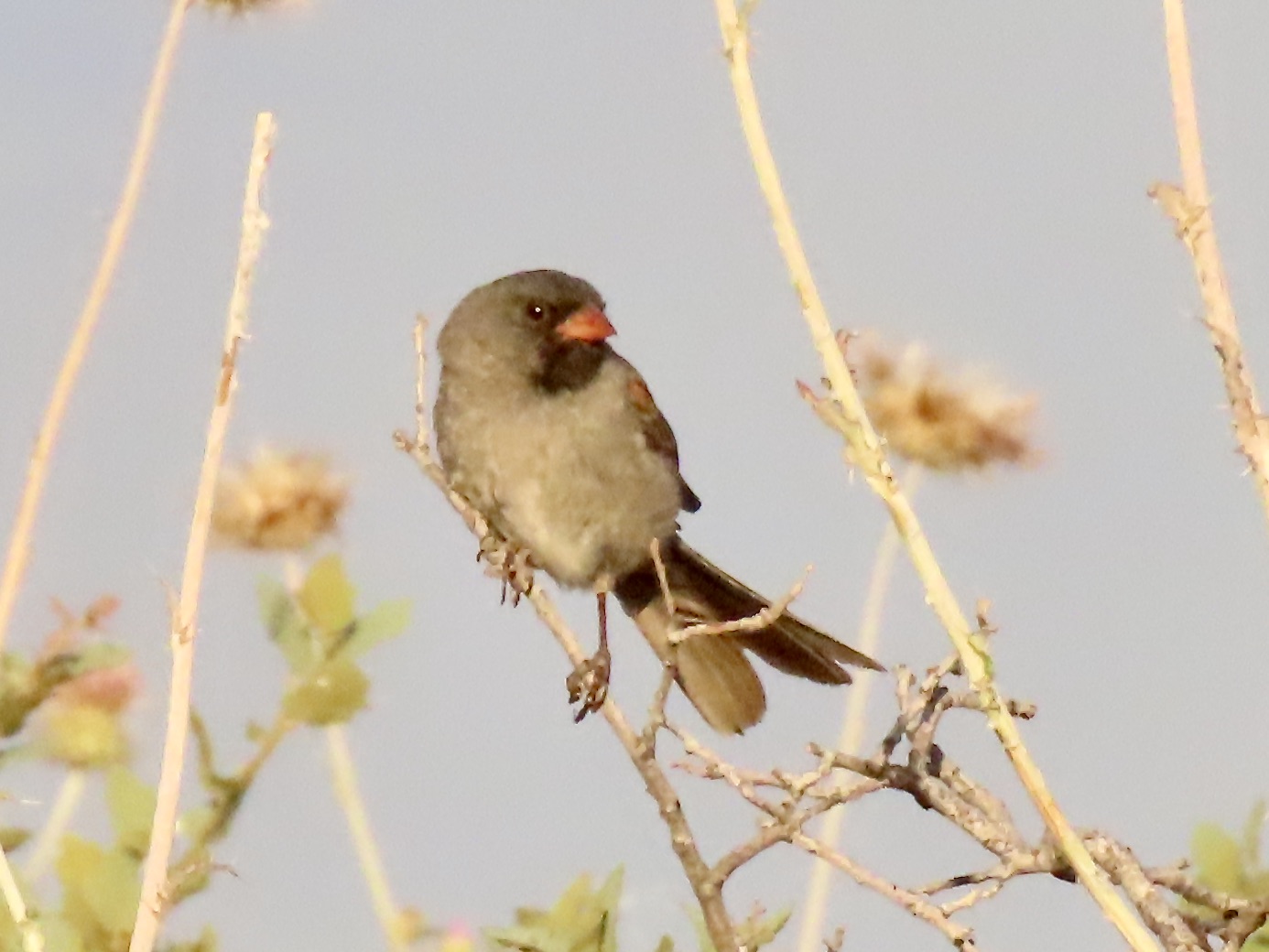
Aside from hearing and seeing BLACK-CHINNED SPARROWs, both of us wanted photos so we took our time staying still and quiet until a couple of them perched up to continue their high-pitched trill. 

BLACK-CHINNED SPARROW. (above and below)

GRAY VIREO was our second species photographed. An almost guaranteed sighting at this lower scrubland area, this was the first time I was able to get photos of it.
GRAY VIREO (above and below)

Within the half hour we stayed at that spot, WHITE-WINGED AND MOURNING DOVE were present as was a single WOODHOUSE’S SCRUB-JAY.  

View this checklist online at https://ebird.org/checklist/S69989569

Continuing up the mountain to our next stop at Forest Road 1688, I parked in a shady spot in preparation for walking the dirt and rocky road up through the pine-oak forest from where we could look down at the desert brush below that we had already birded.

Again, we heard a lot of bird song but mostly from the same species (BEWICK'S WREN and SPOTTED TOWHEE) when we first started out. I was birding slowly in an attempt to find some of the birds belonging to other calls. Hinde continued on up the trail. When I spotted the WESTERN TANAGER, I called to her but she was already beyond hearing me. Below are the pics of the tanager I managed through the pine forest.


The SPOTTED TOWHEEs seemed to be everywhere as we ascended to the first "high" campground site at 5800'.  
SPOTTED TOWHEE
View this checklist online at https://ebird.org/checklist/S69990153

After an hour or so at that location, we continued upward on FR 626 to the parking area beyond which the road is fenced off. There we ate lunch and birded side trails and a bit of the road beyond the gate (walkable).

Giving us a thrill were multiple WESTERN BLUE BIRDS, a male of which sang from various high perches continuously. Photos below:


With several very nice bird sightings, we were thrilled to get our final species: OLIVE-SIDED FLYCATCHER.  Definitely not an everyday bird and I'm not certain I ever spotted that one on Mt. Ord previously. But between its well-known call to human ears: QUICK! THREE BEERS! and the photos, we definitely had great views of that uncommon bird. Larger than a Western Wood-Pewee (also a flycatcher), it is distinguished easily by its white throat and belly set off by its olive vest. Shown below in three photos.


View this checklist online at https://ebird.org/checklist/S69986919

Off the mountain by 10:50 a.m., we checked out Sycamore Creek North (personal hot spot) and Sunflower (old Beeline Highway) on our return home where we enjoyed a few species we had not already seen. Very enjoyable mostly cool day under clear sky.

eBird links to those spots are below:

View this checklist online at https://ebird.org/checklist/S69988516

View this checklist online at https://ebird.org/checklist/S69988652


Birding Hot Spots along the I-19 Corridor south of Tucson, AZ

Sunday, May 17, 2020
With CV-19 pandemic lockdown parameters eased by our AZ Governor, Hinde Silver and I set out for some good birding hotspots south of Tucson along what is known to us as the I-19 corridor.  

The problem with our Springtime is that it resembles summer in many other parts of the country. Temperatures have been rising above 100°F already. To cope with that prospect, we left AJ at 3:30 a.m. to reach our first, and most popular site, as early as possible to avoid crowds. By 5:50 a.m., we were the first car to pull into the lot at Proctor Road Trailhead in Madera Canyon, Green Valley, AZ.  Weather seemed cool to us at 67° but I suffered it gladly. 

In full daylight already, birds were singing everywhere. With most sycamore and cottonwood trees still holding their big floppy leaves, it wasn’t easy to find each of these birds. When they flew to dense junipers or pines, we still had trouble with back-lighting.
A beautiful SUMMER TANAGER popped out on a branch in full sunlight - at quite a distance - but shining brilliantly. — The sole successful photos for that 1.2 mile loop hike in early light. 
SUMMER TANAGER (Male)

Same SUMMER TANAGER as above with the breeze lifting some of its feathers 
Moving on up the canyon, we stopped where some birders gathered on the main road next to Madera Picnic Area. Having been there only ten minutes, they had observed two ELEGANT TROGON fly up stream barking all the way. (Their call very much resembles a short sharp dog bark.)

We chose to park and walk upstream. Soon those birders were following us.  We cut through the forest behind Santa Rita Lodge as I was aware of a crossing back there. Lucked out with a piece of plywood balanced over some branches to keep our feet dry as we continued up from the stream toward the main road. A young woman who had followed us across the stream and up must have read our minds. As soon as we reached the road, she turned and said, “Is this what you’re looking for?”  Wow!


ELEGANT TROGON (male)
Although the trogon was not a Life Bird for either of us, there’s a certain joy that goes with being in the presence of these birds from south of the border (Mexico and Central America). They’ve become somewhat reliable annually in certain habitat-friendly spots like Madera and Ramsey Canyon in the s.e. corner of Arizona.

The three original birders we had seen earlier were coming up the grade of the main road. With a wave we let them know we were on the bird(s).  Both a male and a female trogon were present. 


Poor photo of female ELEGANT TROGON. 
Post to show difference in coloration between male in top photo and this one above.

To visit the Lodge’s feeding station seemed a bit anti-climatic until we began seeing birds that simply don’t visit our desert homes: White-breasted Nuthatch; Hepatic Tanager (male and female) and numerous hummingbirds including RIVOLI’S (formerly called Magnificent Hummingbird); Broad-billed; and Black-chinned. After about an hour, we got up to leave. 


HEPATIC TANAGER (Male) above and below


WHITE-BREASTED NUTHATCH
BROAD-BILLED HUMMINGBIRD. [photo by Hinde Silver]
ACORN WOODPECKER.  [photo by Hinde Silver'

Having put the cap on my camera lens and risen from my chair, I was taken aback when a very small all green hummingbird sipped at the feeder in front of me for a very short time. Yes, it had a rufous tail and yes, I called it out: BERYLLINE!  Hinde missed it. It’s a rarity that’s been present for at least a week or more at the Lodge feeders, but with no one else present to affirm and without a photo, I didn’t list it.  This is the second time I saw that hummer there with out external verification and none of my own. So I sucked it up yet again, determined that I’ll photograph it for minutes on end when I see it again! Enjoyed a sort of perverse satisfaction in seeing it yet again without adding it to my Life List.  It's not really all about the list, but I do, indeed, get caught up in it!
Lists for Madera Canyon:
View this checklist online at https://ebird.org/checklist/S69241681
View this checklist online at https://ebird.org/checklist/S69242255
View this checklist online at https://ebird.org/checklist/S69242563
View this checklist online at https://ebird.org/checklist/S69243193

Driving about 32 miles farther south on I-19, our farthest reach, we set out on the Tubac deAnza Trail in search of the ROSE-THROATED BECARDs, nesting in a nice thick strip of forest. If we find any, it will be a Life Bird for Hinde. It’s a good time of year to catch them so we head out expectantly among a symphony (cacophony) of bird song. YELLOW-BREASTED CHAT makes itself known through the woods; lighter songs are sometimes harder to pick out, one from the other. (I’m rusty…yikes.) 
Hinde at edge of our trail toward Rose-throated Becard 
Rose-throated Becard nest
Looks like it's for a big bird, doesn't it?
See how it's fastened by bark to the higher thin limb?
Female ROSE-THROATED BECARD
Smaller than a robin (a little over 7" long) but likes a really big nest.
Female sitting on top of the nest, barely visible for all the leaves, bark and clutter
She worked on adding to it and apparently re-arranging for a long time. :)
Closer to the bridge near where we parked the car:
WESTERN KINGBIRD
To be embraced by that beautiful stretch of trees, cactus, grasses and mud along the Santa Cruz River was like a fix in harmony and balance. We were not in a hurry to leave even after two hours in there.

View this checklist online at https://ebird.org/checklist/S69244374


Heading north again, we paused at Amado Ponds but saw nothing of particular interest, so continued on to beat the coming heat. 
At high noon, Montosa Canyon was quiet. Loaded with good birds, I expect early-morning birders saw them but most were scarce during our brief visit.  So, I took other photos instead.


Hinde at edge of big drain culvert in Montosa Canyon in an area many birds favor

View this checklist online at https://ebird.org/checklist/S69244768

With one more stop on my agenda, Canoa Ranch Conservation Park, I was delighted by its new entrance signage, no longer on the ground but rising in a rectangle over the road with wagon wheels to remind us of its heritage.

Our lovely desert sun was having its way with us; Hinde waited it out in the car.
Strolling quickly around the existing pond, I managed 16 species that weren’t hiding out in the shade. Few were in the water: just a domestic Mallard and a REDHEAD. 
Other water birds were hugging the shoreline; the rest were flying about or hanging out in the overflow marshland.
KILLDEER
REDHEAD
Thirsty HOUSE SPARROW

View this checklist online at https://ebird.org/checklist/S69245220


With a total of 65 species for the day from 7 locations and having counted 287 individual birds, including many not in our area of the desert, we considered our 12 1/2-hour birding day well worth the drive and effort.  We were home again by 4:00 p.m.


* * *