To me, this is a “believe it or not” report from a recent 10-day birding adventure covering about one thousand miles of driving.
The group gathered on Thursday, April 19 and continued searching for and finding birds through Saturday, April 28, 2018.
Having selected a gem of a guide that had led my last year’s Grouse Trip to Colorado, Stephan Lorenz was leading this trip, too, for High Lonesome BirdTours.
Birding friend, Glenda Jones decided to join in and drove over to Houston on her way back to Toronto to experience her first-ever formal birding trip. Together, after three days of travel we met the remainder of our group (12 participants) and the second guide, Claudia Cavazos, who, as it turned out, is Stephan’s wife! She drove the Suburban (carrying luggage and 3 participants); the rest of us filled the seats in the van and all rotated daily.
Each participant (except the relatively new birders) arrived with the list of birds they wanted to see. Some birds, like the beautiful GOLDEN-CHEEKED WARBLER and handsome BLACK-CAPPED VIREO are range restricted in the USA to Texas hill country and were on all our target lists.
The stellar guides led us to shorebirds, waterfowl, a rookery, forested land and warblers galore. We participants had arrived expecting muggy, buggy weather. For ten days, we had no rain, cloudy to clear weather, cold mornings and pleasant to warm afternoons. In swampy areas I applied insect repellent on my hands and face (only parts uncovered) as a precaution but mosquitoes were not swarming.
Stephan appears to enjoy the challenge of finding each participant’s specialty bird(s) and hustles to make it happen. He and Claudia walked a mushy field together hoping to scare up a Yellow Rail but knew it was quite a long shot. To me, his effort was what counted.
When they did the same thing in another field to scare up a hard-to-find sparrow, they were successful! It was a too-quick sighting, but I took it as a Life Bird since I had a clear view of it as it flew up a short distance, then flew about 5-6' horizonally over the weeds before diving down to the ground again. LeCONTE’S SPARROW! Unsatisfactory view and hopefully one day I’ll get a better look but the orangish head showed in early light for those quick enough to catch it.
 |
| Stephan & Claudia beginning their sweep of the marsh grasses for LeCONTE'S SPARROW |
As the days progressed, I found it frustrating to photograph warblers as they ravenously foraged from limb-to-limb and tree-to-tree to fuel their journey northward. Claudia volunteered to take photos for me, so I gladly handed off the camera to her in Sabine Woods. The place was crawling with warblers! The following pics were all taken in Sabine Woods (next to last day of our trip), and gave me ample opportunity to get great looks at the warblers. None of these birds below were Life Birds for me but it was great fun observing more details and behaviors than when I have my camera in hand.
 |
| PROTHONOTARY WARBLER |
The above PROTHONOTARY WARBLER is a favorite of mine from my days in Virginia. Known as the swamp warbler, I would look for its arrival every spring.
 |
| Male CHESTNUT-SIDED WARBLER (above & below) |
 |
| INDIGO BUNTING |
 |
| Female AMERICAN REDSTART above; Male, below |
As always, Stephan guided us to some super locations within the great expanse of Sabine Woods. In the above photo, it looks like he's hearing something good!
 |
| We saw multiple male and female BLACKBURNIAN WARBLERs; this is the male. |
Our luck was such that we spotted multiple birds of each species (14 BLACKBURNIAN WARBLERs) during our ten days giving us super looks. Lots of near-swooning over this male above as he moved around giving occasional profile and front views.
 |
| EASTERN KINGBIRD |
 |
| GREAT-CRESTED FLYCATCHER |
 |
| First-year male YELLOW WARBLER |
 |
| GRAY-CHEEKED THRUSH |
 |
| WOOD THRUSH |
 |
| Young ORANGE-CROWNED WARBLER |
 |
| NORTHERN PARULA |
Stephan's goal for Sabine Woods was to have a 20-warbler-day! Sounded outrageous to me! But the group total ended with 21 warblers of which I saw 19!
When lifting my binoculars to one tree and finding a KENTUCKY WARBLER, followed by a MAGNOLIA WARBLER and then a HOODED WARBLER is beyond soul-satisfying description.
After the group had totaled its 20th warbler, we all stood in an open area around one huge tree and counted close to 20 again right in front of us. The warblers were not raining down on us in a fall-out from bad weather but had found good eats in this wooded habitat to continue migrating from their southern hemisphere winter homes to their northern breeding grounds. I found one of my Life Birds here.
LIFE BIRDS (first seen in my lifetime) will be covered in Part II of the blog. Having been drawn to the GOLDEN-CHEEKED WARBLER, that was the bird that put me on this trip. After research, I discovered I might find a nice handful of other Lifers. The list of eight birds that I really wanted to see included:
GOLDEN-CHEEKED WARBLER (high in tree), BLACK-CAPPED VIREO (middle of tall trees), TROPICAL PARULA (anywhere in a good tree), FERRUGINOUS PYGMY OWL (day-time hunter that perches on horizontal limb), AUDUBON'S ORIOLE (positioned like most orioles) SWAINSON'S WARBLER (stealthy ground feeder, harder to find than a towhee), BACHMAN'S (very secretive and hidden in shrubs/grasses) and LeCONTE'S SPARROWs (runs in deep grass).
After our first day of birding together, I began to think I might get to see at least half of these rare birds! And that would be a good thing!
None of the birds in this Section 1 will be Life Birds.
DAY #1:
A morning and an afternoon of birding produced some of the following birds for us to enjoy. I must add that it's great fun to be in the company of other passionate birders!
 |
| GOLDEN-FRONTED WOODPECKER (its call sounds like a Gila) |
 |
| PAINTED BUNTING (above and below) |
 |
| YELLOW-THROATED WARBLER |
 |
| BLACK-CRESTED TITMOUSE |
 |
| OLIVE SPARROW |
 |
| YELLOW-BREASTED CHAT (as noisy there as they are here in Arizona) |
 |
| VERMILION FLYCATCHER |
 |
| SCOTT'S ORIOLE |
After dinner at Neal's Lodge, we headed out for "dessert" -- the Concan Frio Bat Cave area.
Not knowing much about bats, I wasn't sure what to expect. By the time we arrived at dusk, the bats were beginning to emerge from their cave. There would be 10,000+ doing this so we had plenty of time to walk up to the cave. I posted a video of this on Facebook but don't seem to be able to get it live onto this site. Check it out if you can.
MEXICAN FREE-TAILED BATS:
 |
| Emerging from the Cave |
 |
| Into the sky |
 |
| Murmuration of bats |
 |
| Close overhead |
Who eats bats? Raptors! Overhead we saw COOPER'S, SWAINSON'S and RED-TAILED HAWKS diving for some dinner-on-the-wing. A PEREGRINE FALCON also joined in.
Fascinating to me was that after many of the bats had left, CAVE SWALLOWs flew in! So we watched what might have been a perilous traffic jam resolve itself with no difficulty as wings pulled tight and each continued in its own direction. As bats flew out, the swallows flew in for the night.
DAY #2
We enjoyed breakfast at 6:00 a.m. and were traveling by 6:30 (most every day). Again, we spent a full morning at one spot and a full afternoon at another great place.
 |
| SCISSOR-TAILED FLYCATCHER |
 |
| PAINTED BUNTING |
 |
| BLACK-THROATED SPARROW |
Many of the birds observed on this day can be seen readily in Arizona. That was very appealing to the folks from PA and DE, but I took few photos. Already, I was beginning to realize how much I preferred looking at the birds!
DAY #3:
After a full morning of birding, we traveled to our next "staging area" during the afternoon hours. Good birds, though, in the morning.
 |
| PAINTED BUNTING on overhead utility wire |
 |
| HOODED ORIOLE |
 |
| BLUE GROSBEAK |
 |
| SCISSOR-TAILED FLYCATCHER (above and below) |
 |
| Female VERMILLION FLYCATCHER |
 |
| YELLOW-BILLED CUCKOO |
 |
| CEDAR WAXWING |
 |
| COUCH'S KINGBIRD |
Several excellent bird sightings at this location were not photographed due to distance, quickness of sighting or already having photos: RINGED KINGFISHER, LONG-BILLED THRASHER, PYRRHULOXIA, ORCHARD ORIOLE plus sparrows: CASSIN'S, GRASSHOPPER, OLIVE, CHIPPING, CLAY-COLORED, BLACK-THROATED, LARK, WHITE-CROWNED, SAVANNAH AND LINCOLN'S.
Day #4:
This was a huge day in every way. We birded from 7:00 a.m.-5:30 p.m.-- my kind of day!
 |
| DICKCISSEL |
 |
| GROOVE-BILLED ANI - best photos I managed of this moving target |
 |
| PILEATED WOODPECKER |
When Stephan radioed our guide for the King Ranch of this sighting of a Pileated Woodpecker, the guide couldn't believe his ears. He jumped from his truck and ran back to see it for himself - the first ever reported anywhere on the entire ranch (measured in square miles and counties).
Although that's the final bird photo posted for the King Ranch where we birded from 7:00 a.m. until 2:00 p.m., there are others that I'll post for the three (3) LIFE BIRDS I was thrilled to see on the property. Thrilled to the bone!
After traveling to Corpus Christi, we had an opportunity to view some water birds.
 |
| LEAST GREBE (above and below) |
 |
| MOTTLED DUCK |
 |
| TRICOLORED HERON |
 |
| SORA |
DAY #5:
We arrived at our first birding location at 8:00 a.m. and wound up the day at 5:15 p.m. (with some driving in between).
 |
| Claudia, our guide, helping look for birds at some sod farms in the afternoon |
 |
| WOOD THRUSH (at a local park) |
DAY #6:
 |
| Tribe of super birders from Delaware |
At High Island on this date, I saw another Life Bird that gave good looks to all of us. I didn't mess with my camera. Hopefully, Glenda did.
A CRESTED CARACARA was the only bird I photographed during our very productive visit at High Island.
Other good sightings included: BLACK-BELLIED WHISTLING DUCK; ROSEATE SPOONBILL; ACADIAN FLYCATCHER; EASTERN WOOD-PEWEE AND EASTERN KINGBIRD; YELLOW-THROATED, PHILADELPHIA and RED-EYED VIREO; SEDGE WREN, VEERY, CAROLINA WREN, OVENBIRD, SCARLET TANAGER and 12 species of warbler.
After some travel time, we arrived at Bolivar Peninsula around 11:00 a.m. and birded until 4:30 p.m. The Bolivar Flats lie along the Gulf of Mexico; Galveston can be seen across the Gulf from where we birded.
 |
| YELLOW-CROWNED NIGHT HERON |
 |
| WHIMBREL |
 |
| SEASIDE SPARROW |
 |
| EASTERN MEADOWLARK |
 |
| BLACK TERN |
 |
| DUNLIN |
 |
| SANDWICH TERN |
 |
| LEAST TERN |
 |
| SEMI-PALMATED PLOVER |
 |
| WILSON'S PLOVER |
 |
| PIPING PLOVER |
 |
| SEMI-PALMATED PLOVER |
 |
| ROYAL TERN |
 |
| WILSON'S PLOVER |
 |
| SEMI-PALMATED PLOVER |
 |
| WILSON'S PLOVER |
 |
LEAST TERN -- nesting colony
appeared to be not yet active but the birds dive-bombed me when I walked past them |
 |
| SNOWY PLOVER |
Highly unusual, we found a warbler on the beach - a female AMERICAN REDSTART.
 |
Female AMERICAN REDSTART (two above photos)
|
Not all birds could be photographed. Good ones I missed: MAGNIFICENT FRIGATEBIRD,
REDDISH EGRET, WHITE-TAILED KITE, AMERICAN OYSTERCATCHER, RED KNOT, RUDDY TURNSTONE, BLACK SKIMMER, plus these terns -- GULL-BILLED, COMMON and FORSTER'S TERN.
DAY #7:
During three morning hours of birding at Anahuac NWR and a few more hours at High Island in the afternoon, I came up with the following birds:
 |
| COMMON NIGHTHAWK with eyes open; it also flew several times but returned to its daytime perch |
 |
| BOAT-TAILED GRACKLE - found near marshes and beaches in the eastern part of the country |
 |
| PROTHONOTARY WARBLER - I always aim for a photo of this bright gem in the dark marsh |
And, then, came the big bird that blew me away the first time I saw it two years ago when I visited this place -- KING RAIL.
 |
| While walking, we observed this bird for at least 15-20 minutes as it moved through the marsh |
 |
| Same KING RAIL here and below |
 |
| WILSON'S PHALAROPE are a joy to watch as they circle to stir up food sources. Note very thin bill. |
 |
| UPLAND SANDPIPER |
 |
| Look closely at this flowering plant. PHILADELPHIA VIREO - much like our western Warbling Vireo |
 |
| ROSE-BREASTED GROSBEAK |
 |
| Female ROSE-BREASTED GROSBEAK on the ground (left); male up on the limb (right) at puddle (High Island |
 |
| Male ROSE-BREASTED GROSBEAK |
 |
| Young GREAT EGRET waiting for food - High Island Rookery |
 |
| ROSEATE SPOONBILLs (above and below) |
 |
| Thin-shelled turtle that had just extended its flippers - perhaps a good thing considering what is coming out of the water, below |
 |
| Is it smiling? Yikes. Run, turtle, run. |
DAY #8:
Today's birding took place at Sabine Woods, the same place (same day) as reported at the beginning of the blog. I had taken the photos below prior to handing off the camera to Claudia.
 |
| INDIGO BUNTING on distant tree top |
 |
| BAY-BREASTED WARBLER |
 |
| COMMON NIGHTHAWK |
 |
| PROTHONOTARY WARBLER (above & below) |
 |
| NORTHERN PARULA |
 |
| Female BLACKBURNIAN WARBLER |
 |
| Male BLACKBURNIAN WARBLER |
 |
| BLACK & WHITE WARBLER |
Among our many stops, Sabine Woods was my favorite. It was now time to turn the vans toward Houston but not without birding along the way. After leaving Sabine Woods, we visited Cattail Marsh in Tyrrell Park - a water treatment facility.
 |
| SORA (rail family) |
 |
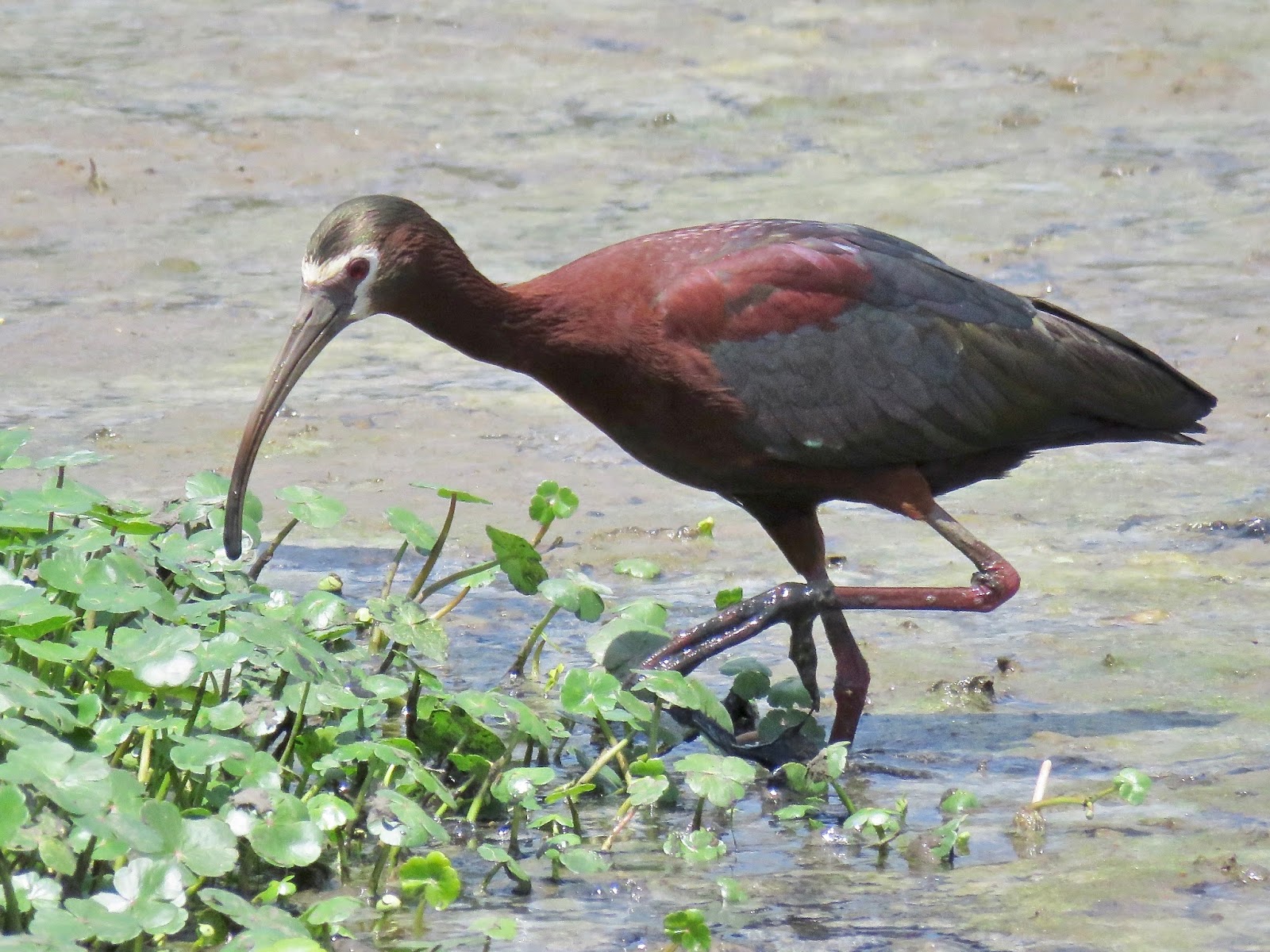
| WHITE-FACED IBIS with many more white feathers lining its face than on those in Arizona - many of them |
 |
| BLACK-NECKED STILT on nest |
 |
| Distant LEAST TERN with a bigger bird egg floating near its perch |
 |
| BLUE-WINGED TEAL - many |
Our next stop had a purpose but none of us knew that until a gorgeous strong bird appeared overhead - a SWALLOW-TAILED KITE.
 |
| SWALLOW-TAILED KITE - above & below - Photos by Glenda Jones |
DAY #9:Stephan must like to work under pressure. Many of us were still holding out hope for another Life Bird or two and this would be our final day of birding.
Spending four early-morning hours in a forest/prairie land, I was not disappointed. Having rolled out of bed early for a 5:40 a.m. departure from our hotel, I knew what our first objective would be...the RED-COCKADED WOODPECKER.
We stood now, waiting for it to come out of its hole. It was the first bird protected by the Endangered Species Act in 1973 for its loss of habitat. Now, it is recovering and we hoped to see one soon.
Bingo! There it is!! Where? Where? There! There! - Gone.
Stephan had warned us of the woodpecker's morning habit of exiting its hole, perching shortly, then taking off. This is precisely what it did -- which was not a good thing for those wanting a photo. For me, it provided behavioral context to a bird I had seen in these same Piney Woods two years ago.
Then, I had photographed the RED-COCKADED WOODPECKER. To me, the name is misleading. The male, only, has a few red feathers behind its eye. But what stands out are its white cheeks that contrast with its black head and nape.
 |
| RED-COCKADED WOODPECKER - from my files - above and below |
Next stop in the Piney Woods was designed to find a BACHMAN'S SPARROW, a sleuth of shrubs and grasses within the forest. Stephan bushwhacked into an area until he had one in sight. It's great to see the leader get excited about a bird!
We followed as quietly as possible to the location where we were able to get our binoculars on a brown object seemingly wrapped with foliage that was the back of the BACHMAN'S SPARROW crouched low in a shrub. It stayed very still for minutes. However, it was not a satisfactory sighting and eventually the bird ran from us. Again, I looked at its back long enough to see stripes and know that it was a bird of the shape, color and kind that we wanted but it was a poor view.
We moved on to a more open area. Bonanza!
 |
| BLACKBURNIAN WARBLER |
 |
| PRAIRIE WARBLER (above and below) |
Not too far for my camera, was a perched BROAD-WINGED HAWK, below.
 |
| BROAD-WINGED HAWK taking off |
 |
| Female EASTERN BLUEBIRD (above & below) |
Many other birds were present, including CAROLINA CHICKADEE, TUFTED TITMOUSE, BROWN-HEADED NUTHATCH, CAROLINA WREN and four previously-seen warblers.
Stephan's finishing stroke at this location delivered another LIFE BIRD for me!
Leaving the Piney Woods, we continued on toward Houston with one more stop where we spent several hours prior to our final dinner together.
 |
| TRI-COLORED HERON |
Other birds at this location included RED-BELLIED and RED-HEADED WOODPECKERs; WHITE-EYED, RED-EYED AND YELLOW-THROATED VIREOs; BLUE JAY and AMERICAN CROW; PINE, HOODED and PROTHONOTARY WARBLER plus another NORTHERN PARULA. ANHINGA were in the distance.
A local Arizona birder, who was also on this trip, shared some of his photos for me during the period when I didn't use my camera. Duane Morse sent me his following photos:
 |
| RUBY-THROATED HUMMINGBIRD - Photo by Duane Morse |
 |
| OVENBIRD - Photo by Duane Morse |
 |
| CAVE SWALLOW (at the Bat Cave) - Photo by Duane Morse |
 |
| RED-HEADED WOODPECKER - Photo by Duane Morse |
 |
| CERULEAN WARBLER - Photo by Duane Morse |
 |
| SCARLET TANAGER - Photo by Duane Morse |
We tallied our lists each night at dinner. At the completion of our ten days, with 24 checklists, Stephan provided us with a total species of 268 of which I saw 262.
My Life Birds will be given some space in Part II of the blog...that will be indexed under the month of May.
* * *