White Mountains, Apache County, Arizona August 30th & 31st

Day #1 - Wednesday, August 30th
Our planned mid-week getaway for 40°F cooler than our triple digits in Phoenix East Valley worked out with lots of super bird sightings.

On our way to Sheep Crossing, a perched hawk caused me to do a quick turn-around for a second look. Yes! — a SWAINSON’S HAWK!  

SWAINSON'S HAWK perched up along entrance road to Sheep Xing (Route 273)
Reaching Sheep Crossing, I told Hinde Silver, my birding companion, that I frequently found the AMERICAN DIPPER right along the Little Colorado River below the parking area. At one of the openings in the shrubbery across the narrow and full running river, I spotted a bird fly into the bottom of a thick shrub. By the time I told Hinde it might be “our bird”, it promptly flew just a short distance up onto a fallen log aimed toward the river where it began walking back and forth flicking its tail up and down. Not a plain all-gray bird like the Dipper, the one I was looking at had a plain brown back and dark streaking on its white flanks and belly. It showed us its face as it walked toward us and its rear walking away from us. With a long light supercilium above its dark eye and a warbler-like longish bill, I felt confident of calling the bird for the first time ever in Arizona--NORTHERN WATERTHRUSH! Previously, I’ve chased this bird to find it but ended up either missing it entirely or having other birders point out this sought rarity. Too dark for photos in the early morning light and thick shrubs, but we got excellent binocular views before the bird flew off.

Feeling a bit of a rush with these first two sightings - SWAINSON’S HAWK & NORTHERN WATERTHRUSH - I felt a good birding adventure coming on.

That all-gray AMERICAN DIPPER was not at its territory below the parking lot. We walked along the Little Colorado for quite a stretch through wet willow thickets without finding the bird, but continued back up on the trail for a while longer. Each time we came upon openings to the river, we scanned and searched. Found it!  -  Can you?
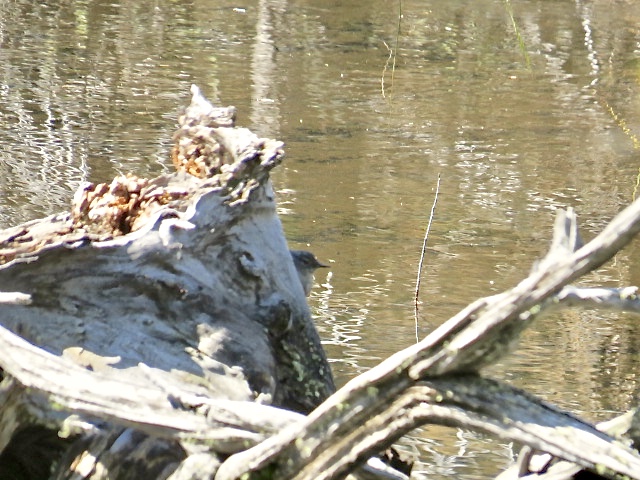
AMERICAN DIPPER
Staying focused on the bird as it poked around at the edge of this bleached root structure of a fallen tree, we were finally rewarded with its hopping out onto an open limb for a great look. It then dived into the water, swam just a short distance, dipped down once more and came up with a worm to eat...away from our eyes and camera! We also got to see its white eyelid that protects its eye under water...giving us a thorough sighting.


Exploring West Baldy Trail #94 proved interesting, too.  We were really searching for the American Three-toed Woodpecker and Williamson’s Sapsucker.  

Out of only nine (9) species observed during our 1.2 mile walk, we didn’t feel badly about not seeing those two birds when we got good views of several raptors overhead: very light FERRUGINOUS HAWK, a PRAIRIE FALCON and several RED-TAILED HAWK (already included in our count at Sheep’s Crossing adjacent to this trail).
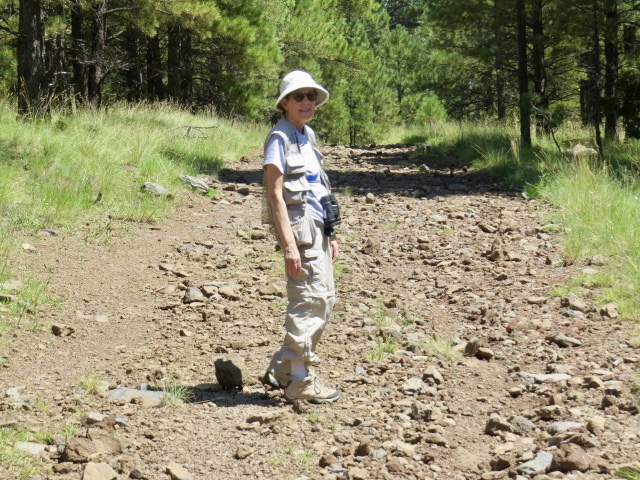
Hinde Silver
Three GRAY JAYs showed up here, loud and visible, then continued to follow us both up and back on the trail.

GRAY JAY (above and below)


Catching a glimpse of one of my favorite birds flying overhead, we both followed it to where it landed and perched on top of a very tall spruce with the morning sun lighting up this mellow-colored gray bird — CLARK’S NUTCRACKER. Its short tail and long bill stood out even in the distance; and when it flew, we were able to see the white undertail as well as the white wing patches on its black wings. In the Jay family, my first acquaintance with this bird was at a parking lot begging for a handout in the Badlands of South Dakota. It is not exactly common here in Arizona but during the summer months is often seen in the area we were visiting.


Next destination: Butler Canyon Nature Trail in Greer.
Hoping to find the two woodpeckers we dipped on along the West Baldy Trail #94, we slowly birded up the trail to its highest point and then followed drumming a bit higher. For over two hours we searched, listened and looked for the Williamson's Sapsucker and American Three-toed Woodpecker. What we found were: DOWNY and HAIRY WOODPECKERs.  
This HAIRY WOODPECKER had been drumming for a long time and we finally reached its tree way up on the hillside where the woodpecker was hidden from our view below.
HAIRY WOODPECKER (above and below)


One of many asters growing beside the trail
Feeling an affinity to GRAY JAYs, we also had three (3) follow us around while we explored Butler Canyon Trail. Two noisy STELLER'S JAYs showed up while a COOPER'S HAWK slipped quietly through the trees. A NORTHERN FLICKER wanted us to know it, too, was a woodpecker!

NORTHERN FLICKER (Red-shafted) 
Nuthatches were the most prevalent birds here at mid-day (WHITE-BREASTED and PYGMY) when many birds were resting.

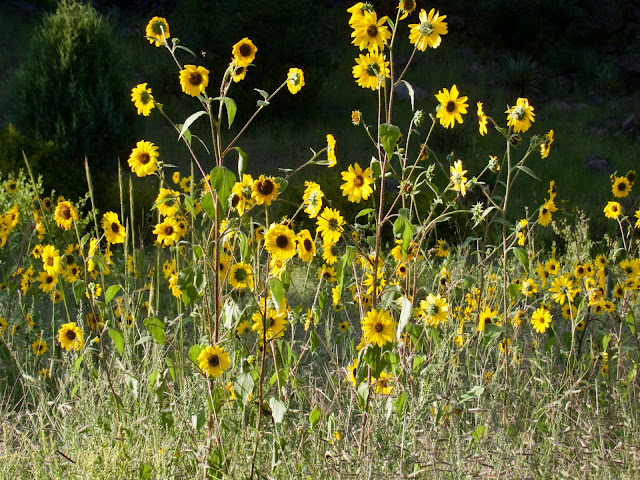
Almost 4 p.m. when we reached Greer Lakes, we birded from the parking areas and didn't search out all the goodies along the three lakes. Even so, we tallied twenty (20) TREE SWALLOWs, an OSPREY, a VESPER SPARROW and a handful of DARK-EYED (RED-BACKED) JUNCOs. What was most striking about the lakes were the blooming wild flowers all around them.


Having never birded "South Fork" so late in the day (4:45 to 5:15 p.m.), we gave it a try, but decided the next morning would prove more interesting. Best bird in our thirty minutes there was a female RUFOUS HUMMINGBIRD.


Day #2 - Thursday, August 31st
A quick visit to Becker Lake had the usual high count of AMERICAN COOT, but also 14 PIED-BILLED GREBEs of various ages (love the striped heads of the young) foraging on the lake. Best find there was the BALD EAGLE perched on a dead snag of a tree across the lake possibly, like us, having already finished breakfast. 

Then, it was on to the South Fork of the Little Colorado River to see what might be present around 8 a.m. With a very low species count in our 20-minute timeframe, each one was special:  

CALLIOPE HUMMINGBIRD (very very small hummer, short thin bill, metallic green back, light buffy sides); 

PINYON JAY - 40 birds (in two successive flocks of 20 each) flew over close enough for us to see their blue under color.  Voices gave them away anyway!

MOUNTAIN BLUEBIRD - a male; first and only one of that species seen on the whole trip

GRAY CATBIRD - with shrubs and willow thickets wet with dew beside the river, we opted for a possible "call and response" to locate the bird which is known to reside there this time of year. It was definitely in there and was quick to respond to our playing its call from iBird app.

From there, we continued farther on the road across the South Fork of the river up to the Campground area. One surprise: the dilapidated structures from an old group camp site were missing. No more windowless wooden structures with boards missing; all that remained were the concrete foundations. We didn't enter as it wasn't very birdy on the open side prior to the "old camp site" fenced off area.

Driving farther up to the trailhead, we looked forward to another nice walk in the woods.  


When I visited this area about a year ago with other good birding friends (Chris, Gordon and Muriel), it was raining off and on so we didn't walk as far then as we did today. Again wildflowers and tall grasses lined the forest floor.


With the river gurgling and running beside the trail and pooling at the beaver dam, we took time to enjoy our quiet surroundings. All seven NORTHERN FLICKERS were individually foraging at different locations in the deep grasses, not in the trees. A RED-TAILED HAWK circled silently overhead and a high-pitched BROWN CREEPER gave us great views, almost indiscernible on the tree trunk. (It was our second visual of a Brown Creeper on this trip.) 

Can you find the BROWN CREEPER? - low, center of photo against tree bark


Again, GRAY JAYs showed up to follow along as we bird-walked (not exactly a hiking pace).
STELLER'S JAYs couldn't drown out the voices of the MOUNTAIN CHICKADEEs or GOLDEN-CROWNED and RUBY-CROWNED KINGLETS, both of which were present.
Among the other birds we saw, the five (5) TOWNSEND'S SOLITAIRE proved to be the most of that species I think I've ever seen together. I don't know if it was a family group including young or not, but we observed at least that number and possibly more that flew from that particular area.


As we drove back along toward Greer, it seemed to be time for the cows to cross the road. No other traffic at this time (around noon) so we just stopped until there was a break in their lumbering across the highway. Got too much of the inside of the car in the photo, but this was it:


After eating our packed lunch at the end of the road in Greer, we pointed the car homeward, arriving 40°F hotter than in the 9,000' elevations of some of the White Mountains. 

Among the 53 species we saw in 1.5 days, Hinde was able to observe twelve (12) Life Birds and learned that habitat makes a big difference in the birds we see.


* * *

To view our eBird checklists, click on the following links:


View this checklist online at http://ebird.org/ebird/view/checklist/S38929015


View this checklist online at http://ebird.org/ebird/view/checklist/S38929302


View this checklist online at http://ebird.org/ebird/view/checklist/S38929453


View this checklist online at http://ebird.org/ebird/view/checklist/S38929908


Migratory Vagrants at Glendale Recharge Ponds, Maricopa County, AZ

August 24, 2017
Recharge Pond at Glendale
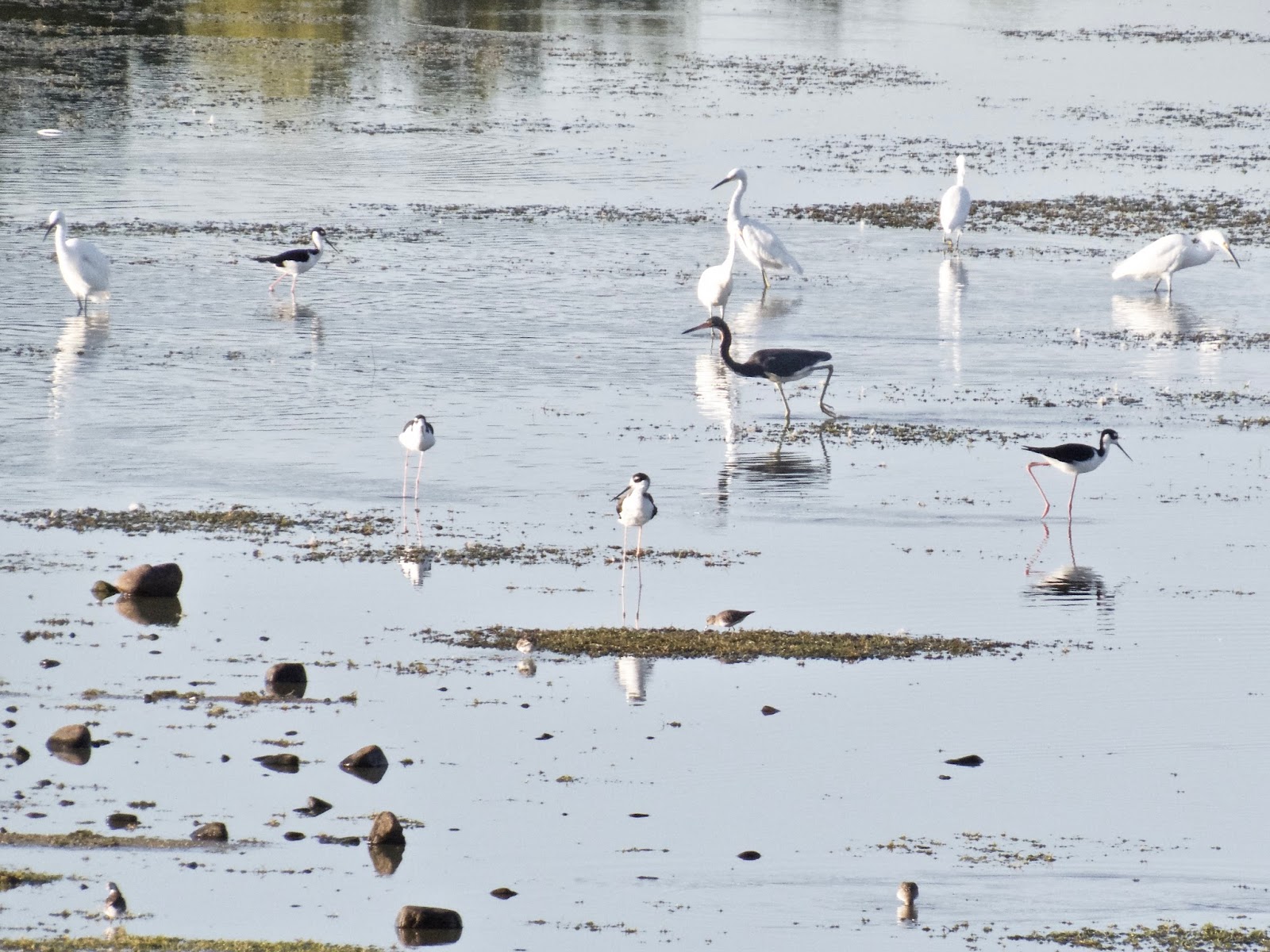
Since I've talked about these ponds over in the West Valley of Phoenix several times, I've posted a scene that shows a piece of Pond 5 (out of 6). It's a failed photo of a Bald Eagle (look closely) that stirred up all the birds in all the ponds. I'm standing on the far side of the pond so this photo shows the southeastern quadrant.

Birds on these ponds are great fun to observe.


TRICOLORED HERON (right); Great Egrets (left)


In the above photos, an assortment of shorebirds are feeding in the early morning. Birds include SNOWY EGRET (white bird, black bill); GREAT EGRET (tall white bird, yellow bill); BLACK-NECKED STILT (black and white bird, needle thin bill and pink legs); and another dark bird, taking center stage in the third photo from the top - TRI-COLORED HERON. In early August, I had traveled the sixty miles across town to see that bird that remained too distant for my camera. Perhaps it was so brand new, it hadn't yet accommodated to its environment or it just decided to stay still and preen far from me. (see "East-Coast Shorebirds in Phoenix West Valley blog of 8/4/2017).

The TRI-COLORED HERON has been visiting the ponds off and on and it was present today even though that was not the bird I drove west to see. But there it was -- fairly close to shore - hanging out with the egrets. Note the above wing posture on the GREAT EGRETs. Sometimes that's done to produce "shade" so the bird can quickly stab its prey without being detected. Sometimes it's done as a non-aggressive marking of its feeding territory. Since the TRI-COLORED HERON is present, it may have felt it necessary to say, "This area is mine." 


TRICOLORED HERON (foreground); Black-necked Stilts (background)


WILSON'S PHALAROPE (a delightful bird that swims in circles to stir up food; sometimes a flock will be spinning simultaneously)
GREEN HERON
But the bird I drove across Phoenix to see was a species I had never seen in Arizona. A RED KNOT, in basic plumage, had shown up two days previously (thank you, Tommy D. for alerting us) and this was my first opportunity to see if it was still there.  It was! (thanks to Jeff Ritz for daily updates).

If you follow my blog, you know that I went all the way to Cape May, NJ, to see this species in early May when the RED KNOT was migrating north from the tip of South America to its Arctic breeding grounds. It stops off there to fill up on horseshoe crab eggs. Whether or not this is the same subspecies (rufa) or not, I really don't know. It would not be on its migratory route back south.

So, I'll post photos of the RED KNOT at Glendale and then a few from Cape May, NJ, to show the different plumages but the same essential bird size and shape.


RED KNOT- Glendale - basic plumage

RED KNOT - Cape May NJ - breeding plumage

RED KNOT - Glendale - basic plumage (with Least Sandpipers)


Looking at the same bird, its differences and similarities are fascinating to observe.

Although I arrived at dawn and lasted for 2.5 hours at the wide open (no shade) ponds, I managed to sort through many sandpipers to pick out some more specialities before the heat told me to get back to the car. Again, two rare shorebirds in our Arizona desert! 


* * *


Birding along the I-19 Corridor, south of Tucson; Pima and Santa Cruz Counties, Arizona

Sunday, August 13th
Summer birding in Arizona plays havoc with my sleep patterns! When daylight begins at 5 a.m., the alarm is often set for 2:30 or 3:00 in order to wake up sufficiently to get out the door with my gear and drive to a specific birder meeting place to continue on to a distant location.  

The sun is now rising later, but the drive will be long. After planning my little excursion to see three specific birds, I contacted Hinde Silver to see if she had a free day to join me. She was up for it, so I picked her up at 4:15 a.m. despite the continuing drizzle of rain. This summer’s monsoon has behaved as I always expected it would - but never did. Instead of many rainy days, most of the past summers’ years have been full of dust storms in the Phoenix area so great they make the national news: Wave of Dust One Mile High and Five Miles Wide! They’re called: DRY MONSOONS. This year: WET MONSOON! Lots and lots of rainy days —very unusual here in the desert.

Monsoon’s heavy rains
Too much for roadway storm drains
Cars not in their lanes

Heading to the I-19 corridor south of Tucson, I hoped we could drive out of the dark clouds and rain. It didn’t clear until we reached Tucson but then, as the sun rose, we could see white clouds and glimpses of clear sky ahead.

I tend to look for birds that can be found seasonally and that I particularly like. Without success, I had already searched known locations in the Phoenix West Valley for the Black-bellied Whistling Ducks and the Tempe Town Lake for the Brown Pelican that had taken up residence there the past couple years. With both being reported at the Amado Water Treatment Ponds, that was our first stop at 6:50 a.m.

The BROWN PELICAN was easy to see perched out on one of the mechanisms in the water.

BROWN PELICAN
It also lifted and flew around a couple times prior to returning to its “spot”.


Since the ducks I wanted to see were not on the water, I set up the spotting scope to search for the BLACK-BELLIED WHISTLING DUCKs that had been reported there - with young. (Less chance of them leaving the area before I arrived!)

And, there they were-all the way across the pond! Two adults and a couple young at water’s edge on a bit of mud and stones in front of the reeds.

BLACK-BELLIED WHISTLING DUCKS (above and below)

Then, it was on to Montosa Canyon farther north off of I-19 where we picked up Mt. Hopkins Road, following it past the Smithsonian Astrophysical Observatory base camp buildings to the dirt road leading into another rich birding area.

Normally, the Mexican Five-striped Sparrow is usually found in one spot way south toward the border in California Gulch or other canyons there. This year they seemed to be found at the confluence of the gulch with Warsaw Canyon — all of which requires very high clearance four-wheel drive vehicles.

The first time I saw this bird was in 2014 on a Melody Kehl guided trip into California Gulch - a bone jarring ride over rocks called a road. Being Melody’s last trip into the Gulch that year, she knew the birds would be harder to see but told us she had never “dipped” on them. This particular late afternoon trip stretched into evening as we could hear the birds skulking around thick shrubs. Finally, a few other species began to perch up and sing and then, the FIVE-STRIPED SPARROW did likewise. It was a quick look before the bird dove down into the shrubs again, but enough to call it a LIFE BIRD, despite it being an unsatisfactory view (for me).

Today, I hoped to see my second such Mexican bird that was being reported in various locations farther north (like Montosa Canyon and Box Canyon) where ordinary birders could drive. Possibly, our very wet monsoon (with water and more shrubs) has enabled them to come north.

Other birders were present when we arrived and told us where they had seen the bird and where they were presently looking. We didn’t see IT, but did see lots of other good birds. After checking out - without success - the specific locations these other birders had first seen it, Hinde and I just wandered up the main dirt road listening…listening. 

Rarely do I use feedback these days, but to make sure I knew the song I was listening for, I played it briefly. Then waited…waited....nothing. As we turned to walk back toward the car, I couldn’t believe my eyes.

The FIVE-STRIPED SPARROW had flown in and perched on a bare limb of a dead shrub behind us where it sat quietly looking right back at us!

It provided us ample viewing over the next several minutes. I took photos; we watched it preen; we watched it turn this way and that. NOW, with this, just my second time seeing this stealthy Mexican bird, I was overjoyed with the looks it gave. Five photos of the FIVE-STRIPED SPARROW below:


Preening its toe


It had been three years since I had re-visited Montosa Canyon after a “lost and found” incident that just a few of my birding friends know about. The incident made us cancel our first-scheduled trip with Melody Kehl for this bird so we had caught her final trip into California Gulch that year. Today, with such great looks at the FIVE-STRIPED SPARROW, I felt a poetic resonance. It also felt good to bird this area again.

After about an hour watching hummingbirds and others at the Santa Rita Lodge feeding station, Hinde and I headed back home as dark clouds began to gather down south. Nice and toasty under the desert sun when we returned home.

* * *


View this checklist online at http://ebird.org/ebird/view/checklist/S38630875


East-coast Shorebirds in Phoenix West Valley, Maricopa County, Arizona

Glendale Recharge Ponds, Glendale, AZ
August 4 & 10, 2017


With the desert heat cranking up a bit again, I needed some good birds to flavor my day. What better place to visit than a spot where two east-coast favorites somehow showed up in the past week — Glendale Recharge Ponds.

Marsha joined me for my first drive across Phoenix from the East Valley where we arrived at the ponds and began birding by 6 a.m. Although the early morning felt comfortable, temperatures have a way of riding up quickly in the desert. 

The first eastern shorebird to arrive at the ponds was the TRI-COLORED HERON, the same species that had flown into the Gilbert Water Ranch ponds last year. Although it wasn’t in its last-reported location, another birder, Jeff Ritz, had watched it fly from Pond #1 where we started looking for it, so he quickly pedaled his bike back to let us know it was on Pond #3. 

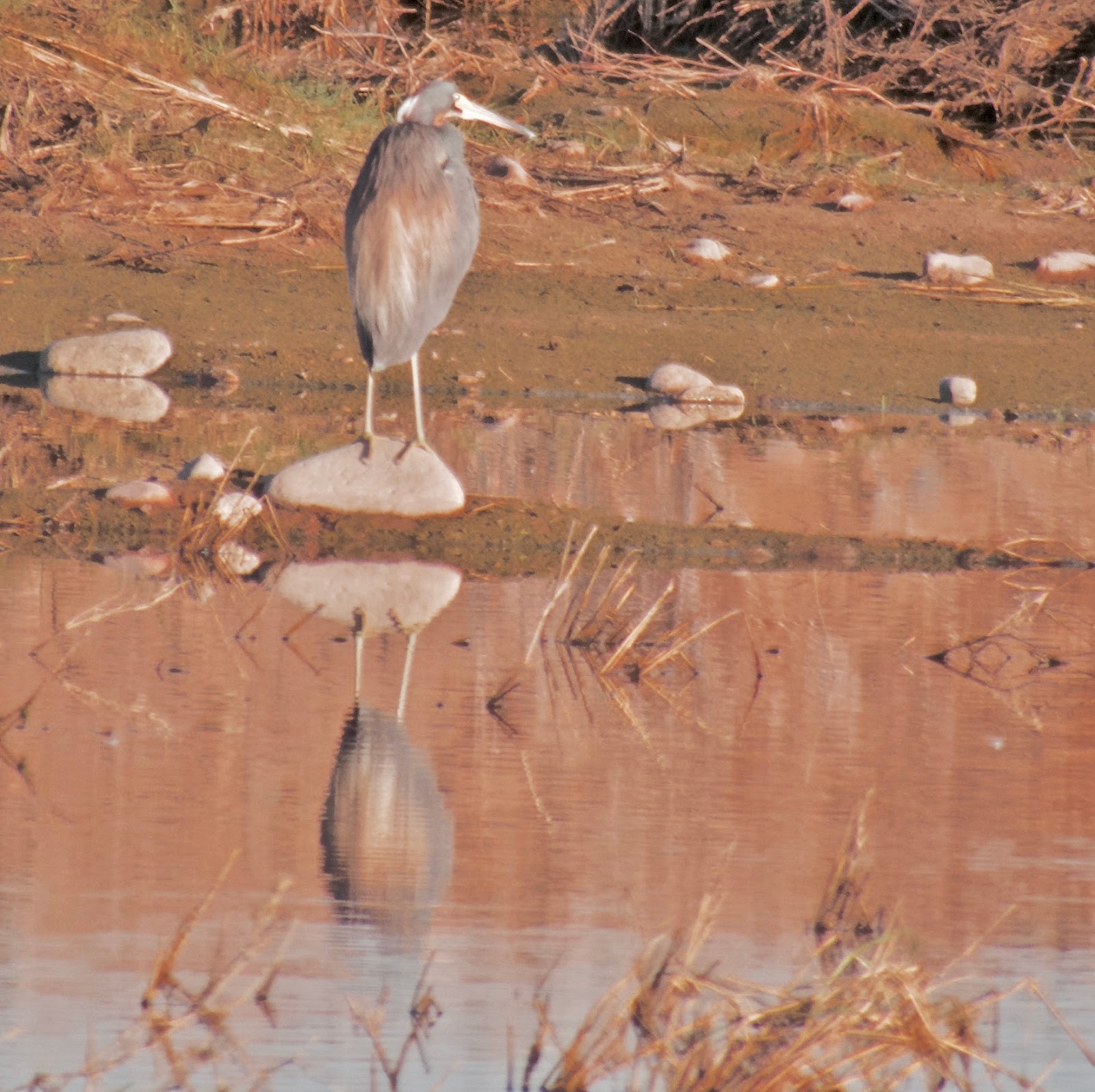
Not wanting to spook the TRI-COLORED HERON, we took photos from a distant corner. The long-slender-necked heron was perched on a smooth rounded light rock where it was busy preening. For me, clear photos were tough to come by so I’m posting Marsha’s that were somewhat better. (We don’t carry big cameras.)

The bird was an adult in mating plumage evidenced by its white head plume and the pale golden plumes on its rump. For me, the question becomes: How did it come to this pond? Was it blown off course? Did it just know it needed more food to complete its migration?  Generally, the TRI-COLORED HERON is found along the Atlantic seaboard, but does wander northward and inland and will forage on inland lakes and freshwater marshes just about anywhere. So, we were lucky today! Will it stay?

Tri-colored Heron [Photo by Marsha Wiles]

Adult Tri-colored Heron with white head plume and golden rump feathers  [Photo by Marsha Wiles]
After feasting at the Glendale Ponds for several days, the TRI-COLORED HERON would fly off to other unknown places but would occasionally return.

On my second visit to the ponds about a week later (8/10), it wasn’t there but had shown up the previous day when many birders descended to see the REDDISH EGRET that had also come in to Glendale’s Pond #4. Since its habitat is almost always in coastal areas (tidal flats, lagoons) and rarely inland or in fresh water, this seemed like a more important find.

Eagerly, I headed out pre-comuter traffic and arrived at the ponds while it was still mostly dark (5-ish). I set up my spotting scope and scanned Pond #4 with binoculars testing my ability to discern silhouettes. At least five GREEN HERONs were hugging the shore closest to me but not yet moving. GREAT BLUE HERONs were scattered throughout the pond (unless they were white egrets looking black in the still-darkness).

I thought (correctly, as it turned out) that the sought-after bird (REDDISH EGRET) was located, more or less, in the SE corner of Pond 4.  I also thought the TRI-COLORED may have been in the NW corner, but Jeff Ritz who was sitting along the eastern edge of the pond (not visible until dawn arrived), told me it was a GREAT BLUE, one that had flown off.

Dawn seemed to signal the GREAT BLUEs and the GREEN HERONs to lift off to fly to their preferred breakfast buffets but the REDDISH EGRET stayed among the GREAT and SNOWY EGRETs in the SE corner.

As you can see in the photos below, the REDDISH EGRET is bigger than the SNOWYs, but smaller than the GREAT EGRET.  Many birders were calling it a juvenile bird, but the distinctly bicolored bill (pink with black tip) is an ID marker for adults in breeding plumage. What was missing was its remaining shaggy neck feathers that I associate with having seen this bird on the Atlantic and Gulf Coasts. No expert, I don’t need to call its age but would guess it’s intermediate between first-year and adulthood. Below (and lead-in photo) are all of the REDDISH EGRET.

REDDISH EGRET

REDDISH EGRET with SNOWY EGRETs

REDDISH EGRET beside a GREAT EGRET

The ponds were full of birds, including a CASPIAN TERN in our desert waters.


CASPIAN TERN background; BLACK-NECKED STILTs foreground

NEO-TROPIC CORMORANTS
WHITE-FACED IBIS
Same WHITE-FACED IBIS lifting their heads out of the water
Staying out there at the six open ponds with no shade is a challenge, but I lasted three hours while I scoped the smaller waders and sandpipers. While I got a good scope view of the PECTORAL SANDPIPER, it was too distant for photos. It appeared to be an adult bird (approx. 9"), with greenish legs and close streaking on the nape, throat and breast reaching down to the belly where the stripes stop precisely and cleanly.

As if my day had not already been full of a nice variety of birds, as I placed my gear into the trunk of my car, a male LAZULI BUNTING flew past with sunshine lighting up its special color of new blue feathers!  What a day!

* * *