I see it! I see the bird — the one that inspired me to travel 2500 miles to Cape May. I watch from behind a rope restraining people from the beach where a feeding frenzy is ongoing. A few RED KNOT walk away from the crowd of gulls and shorebirds toward us. On their migrating journey from Tierra del Fuego at the southern tip of South America to their breeding grounds in the Canadian Arctic, the rufa Red Knots will fly a total of 9,000 miles (farther than my round-trip to see them).
And, I’m looking at a shorebird the size of a robin. This Red Knot Iooks fit and trim so it must have landed a week or so ago. Some of the knots hopscotch their way (2-3 stops) up to the Delaware Bay while experienced and fattened ones may make the journey nonstop, arriving exhaused and emaciated. This is its final feast on Horshoe Crab eggs before heading on to Southampton Island on the north end of Hudson Bay…many miles distant so it will probably try to fatten up now that it has its energy back. Horseshoe Crab eggs provide its premium-grade fuel. In the photos, you may notice the pea-sized eggs and/or the tracks of the Horseshoe Crabs that came on shore to lay them.
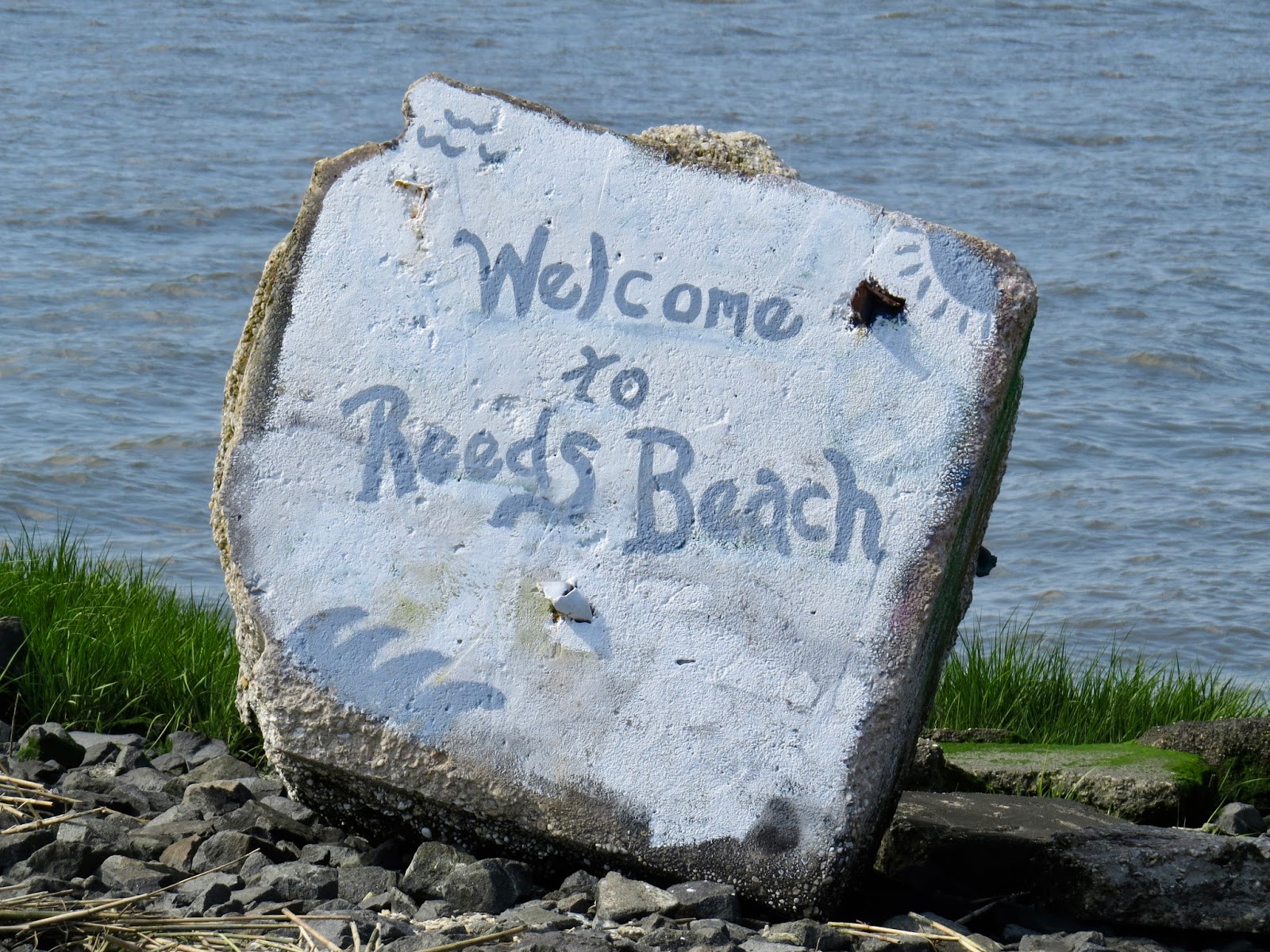
With Toronto birding friend, Glenda Jones, we stand at the beginning of a stone jetty at Reed’s Beach watching this crowded noisy beach scene with hundreds of LAUGHING GULLS crowded so tightly at one spot that their wings are lifted. RUDDY TURNSTONES and DUNLIN are visible by their color but many peeps are lost in the crowd.
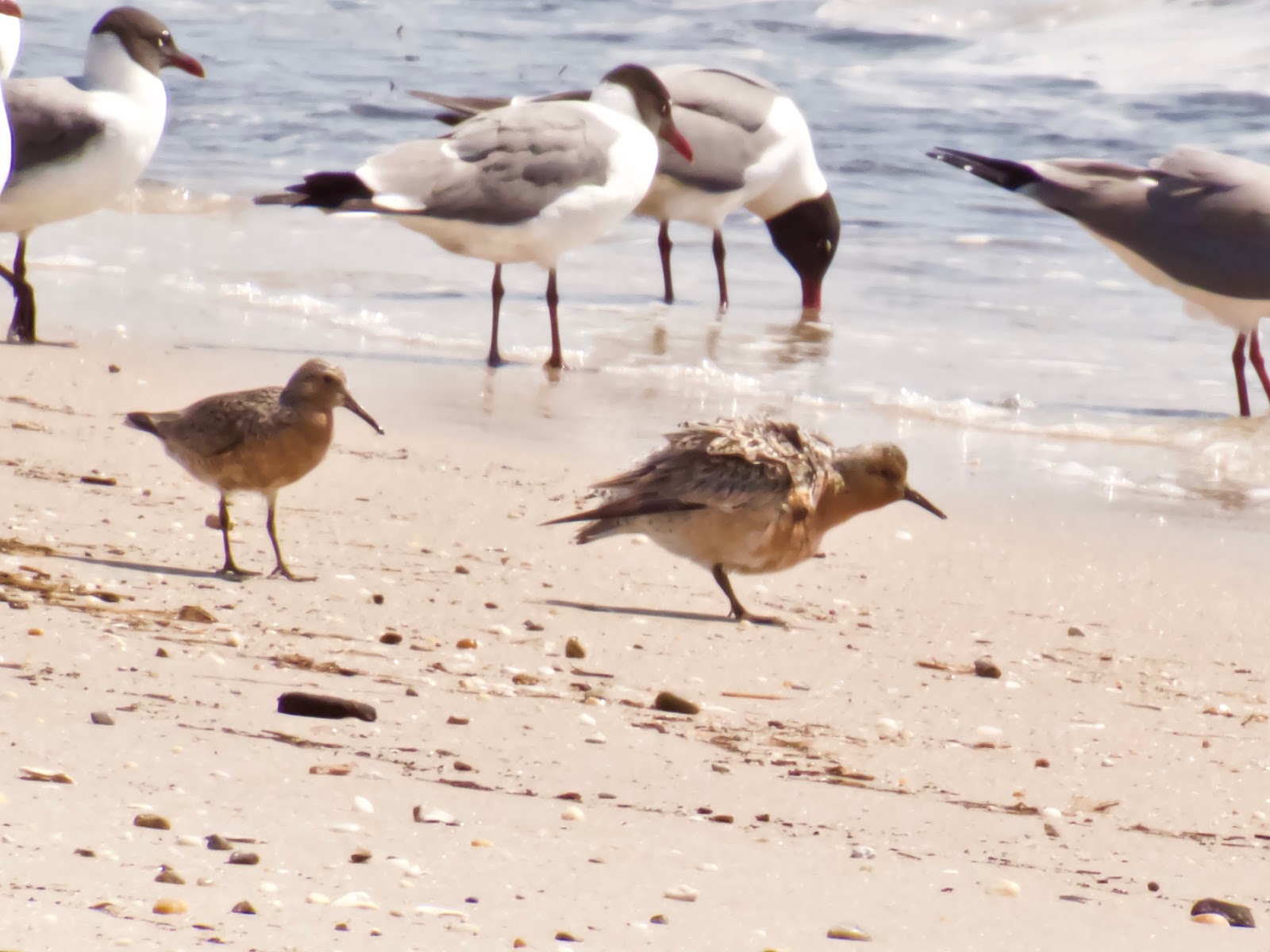 |
| These were the first two RED KNOTS I saw; they walked away from the crowd toward us |
 |
| These six RED KNOT are following the Horseshoe Crab eggs |
 |
| Lots of competition at the dining area: RED KNOT among LAUGHING GULLS |
 |
| RED KNOT with DUNLIN (black belly) at Delaware Bay waters; Cape May, New Jersey |
 |
| Are these three RED KNOT thinking about starting the last leg of their journey to the Arctic? |
 |
| Note the Horseshoe Crab shell (they shed as they grow bigger); RED KNOT eating more slowly at Reeds Beach [Where have all the eggs gone?] |
MOONBIRD is the name of a book by Phillip Hoose given to me a couple years ago by my son, David. It’s a thriller of a book (to a birder) about the rufa Red Knot, including one in particular known by its Banding Code: B95. The story is data based and I strongly recommend it as I’ll not be going into the detail of how and why this species of Red Knot has been drastically reduced. But B95 was a super hero!!
Having seen my primary Life Bird on Day 3 of our birding trip, I will thrilled to have had it happen on Mother's Day!
There would be a few other Lifers to come; one of which was exceedingly rare - so rare it wasn't even on my list.
A map may help you understand where Glenda and I were birding. Cape May is at the very tip of New Jersey, a long rather narrow state, that stretches south from its New York border along the Delaware River (shared with PA on much of the western side) until it becomes a peninsula, located south of Philadelphia. Delaware is across the bay from Cape May on the point.

Pete Dunne is a giant in the birding world and I didn't want to miss his usual Monday Walk at "The Meadows". Pete is director of natural history information for the New Jersey Audubon Society's Cape May Bird Observatory in Cape May Point, New Jersey. A widely published writer on birding, he is also author of (among other books): The Feather Quest: A North American Birder's Year, Hawks in Flight, Bird Droppings (about watching birds and bird watchers), and his latest, Birds of Prey.

Pete Dunne is a giant in the birding world and I didn't want to miss his usual Monday Walk at "The Meadows". Pete is director of natural history information for the New Jersey Audubon Society's Cape May Bird Observatory in Cape May Point, New Jersey. A widely published writer on birding, he is also author of (among other books): The Feather Quest: A North American Birder's Year, Hawks in Flight, Bird Droppings (about watching birds and bird watchers), and his latest, Birds of Prey.
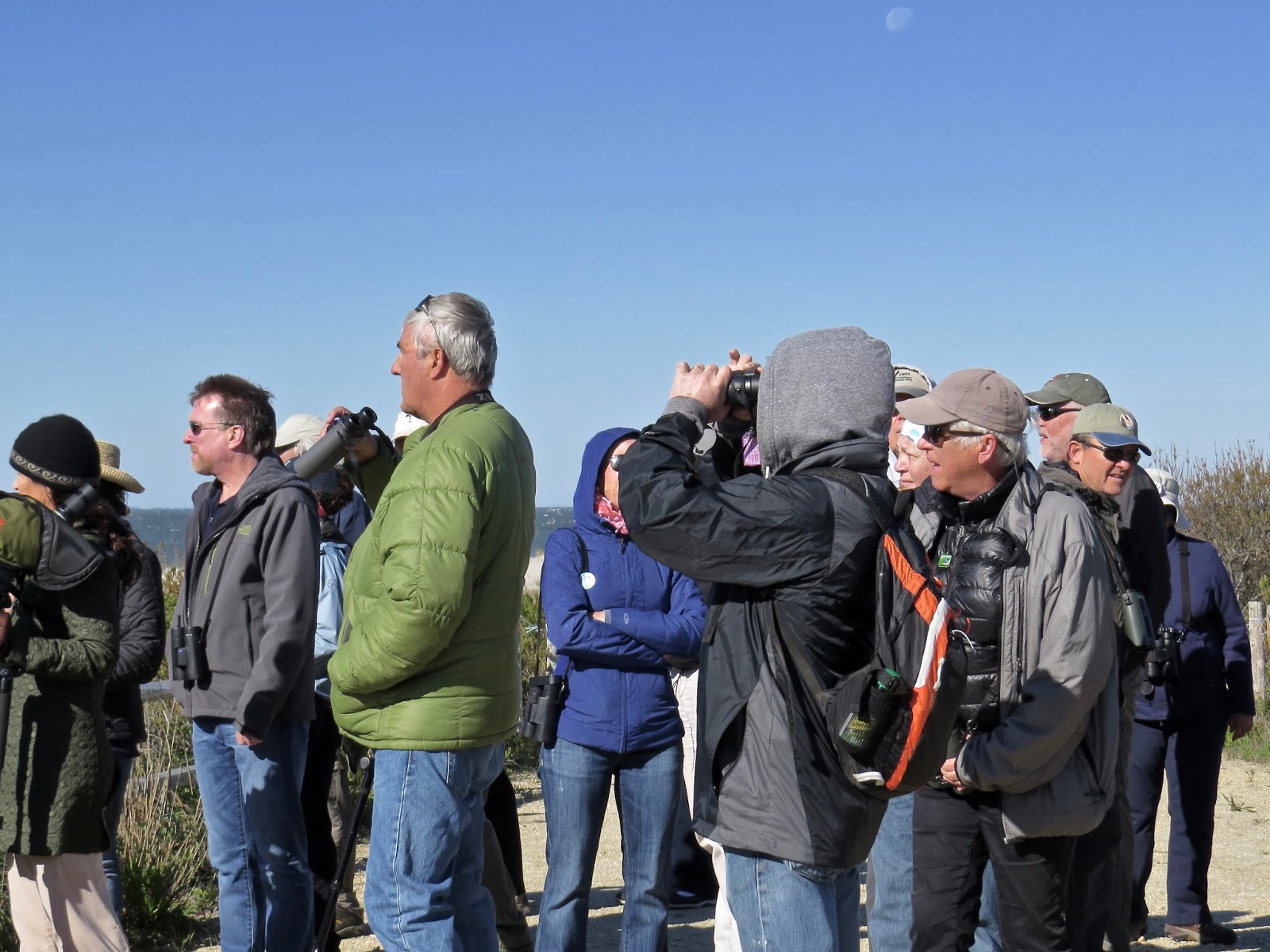 |
| In his green jacket, Pete Dunne's Monday Bird Walk |

Pete's walk on May 15th at The Meadows was the coldest windiest day of our visit. On Saturday, we had already birded Belleplain in the rain--mostly a wipe out but all of us stuck it out for two hours. Now with an icon in the birding world leading a 2-hour walk that we could join for a $10 donation to CMBO (Cape May Bird Observatory), we were excited about the potential. Wind, however, is the birder's enemy; we collected no ocean birds at all and the warblers in the marsh did their "duck for cover" routine when they flew in. Collecting 32 species seemed special in those conditions.
Birders were shocked a few years ago when Pete Dunne suffered a stroke. It was good to see him able to walk the 2-hour trip and speaking slowly and clearly, communicating very well with us. When I told him how much I used his Essential Field Guide Companion(2006), he said it was the hardest book he had written. So, I thanked him again because it offers context to the few lines provided in our field guides. His latest book is Birds of Prey.
 |
| PETE DUNNE and BABS BUCK |
Glenda and I had explored this same Meadows on our first day (5/12/17). With much more walking, we had spotted 31 species in two hours, including COMMON GALLINULE, AMERICAN OYSTERCATCHER, RED-NECKED PHALAROPE (rarity); GLOSSY IBIS, WILSON'S SNIPE, CHIMNEY SWIFT, GREAT-CRESTED FLYCATCHER, SHORT-BILLED DOWITCHER, GREAT BLACK-BACKED GULL as well as 15 LEAST TERN and 9 FORSTER'S TERN. And, MUTE SWAN are wild here.
On Pete's walk, we added a RED KNOT, DUNLIN, HERRING GULL, KILLDEER, WILLET, FISH CROW, and SONG SPARROW and maybe a few others, making the Meadows a definite hot spot for finding a variety of good birds.
On Pete's walk, we added a RED KNOT, DUNLIN, HERRING GULL, KILLDEER, WILLET, FISH CROW, and SONG SPARROW and maybe a few others, making the Meadows a definite hot spot for finding a variety of good birds.
Photos from The Meadows on our first walk:
 |
| GLOSSY IBIS with dark facial skin unlike WFIB's pink/red Looking closely, you may spot the Wilson's Snipe and Semi-palmated Plover in background This is the only photo I managed with the Ibis's head above water; feeding constantly |
 |
| AMERICAN OYSTERCATCHER |
 |
| Critters are always part of the landscape; this was just below a short boardwalk: Black Snake |
 |
| WILSON'S SNIPE |
 |
| MUTE SWAN with CYGNET |
 |
| Distant Rare Red-necked Phalarope; I viewed it through spotting scope Photo: Glenda Jones |
We had packed a lunch, so after Pete's walk was over, Glenda drove us north (Atlantic County) to explore:

We were amazed at the variety and number of shorebirds at this drive-the-loop wetlands. Sorting out what we were seeing became our obsession! Thus, the 8-mile loop took us three (3) hours to complete! I'm posting just a few of our sightings below because this was still a very windy day and we had already decided to return the next morning at LOW tide.
 |
| BLACK SKIMMER (love that bird) |
 |
| Mostly BLACK SKIMMERS but several gulls present |
 |
| SNOWY EGRET |
We had heard about a few "rarities" at Gull Pond at a turn-off from the wetlands' drive, so we took it to see the primary rare bird: BLACK-NECKED STILT, and, secondarily, a COMMON GALLINULE. While rare to this location, these two birds are common in my part of Arizona.
To us, the best birds out there were two terns that provided side-by-side views: CASPIAN and ROYAL TERN. They were perched far out, so again, Glenda managed some great ID photos of the pair.
 |
| ROYAL TERN (left); CASPIAN TERN (right) Photo: Glenda Jones |
***
Next morning, by 7:50 a.m. we started birding the same place (Edwin B. Forsythe NWR (Brigantine Unit) in Atlantic County). Took us 3.5 hours this time! With low tide, we spotted two VIRGINIA RAIL and heard (4) CLAPPER RAIL (Atlantic). In addition to our sightings yesterday, we were surprised to find three (3) RED-BREASTED MERGANSER, many OSPREY (18), half on nest; half on pedestal below.
Also found WHIMBREL on the sand spits and shallow waters; SHORT-BILLED DOWITCHER; WILLET; LESSER YELLOWLEGS (19); both COMMON (48) and FORSTER'S (26) TERN; FISH CROW; PURPLE MARTIN (4); TREE (9) and BARN SWALLOW (23); COMMON YELLOWTHROAT (11); SONG (7) and SAVANNAH SPARROW (1) as well as a single BOAT-TAILED GRACKLE.
 |
| COMMON YELLOWTHROAT were present throughout the wetlands |
 |
| Although I had seen RUDDY TURNSTONE on jetties in VA, I had never witnessed this digging |
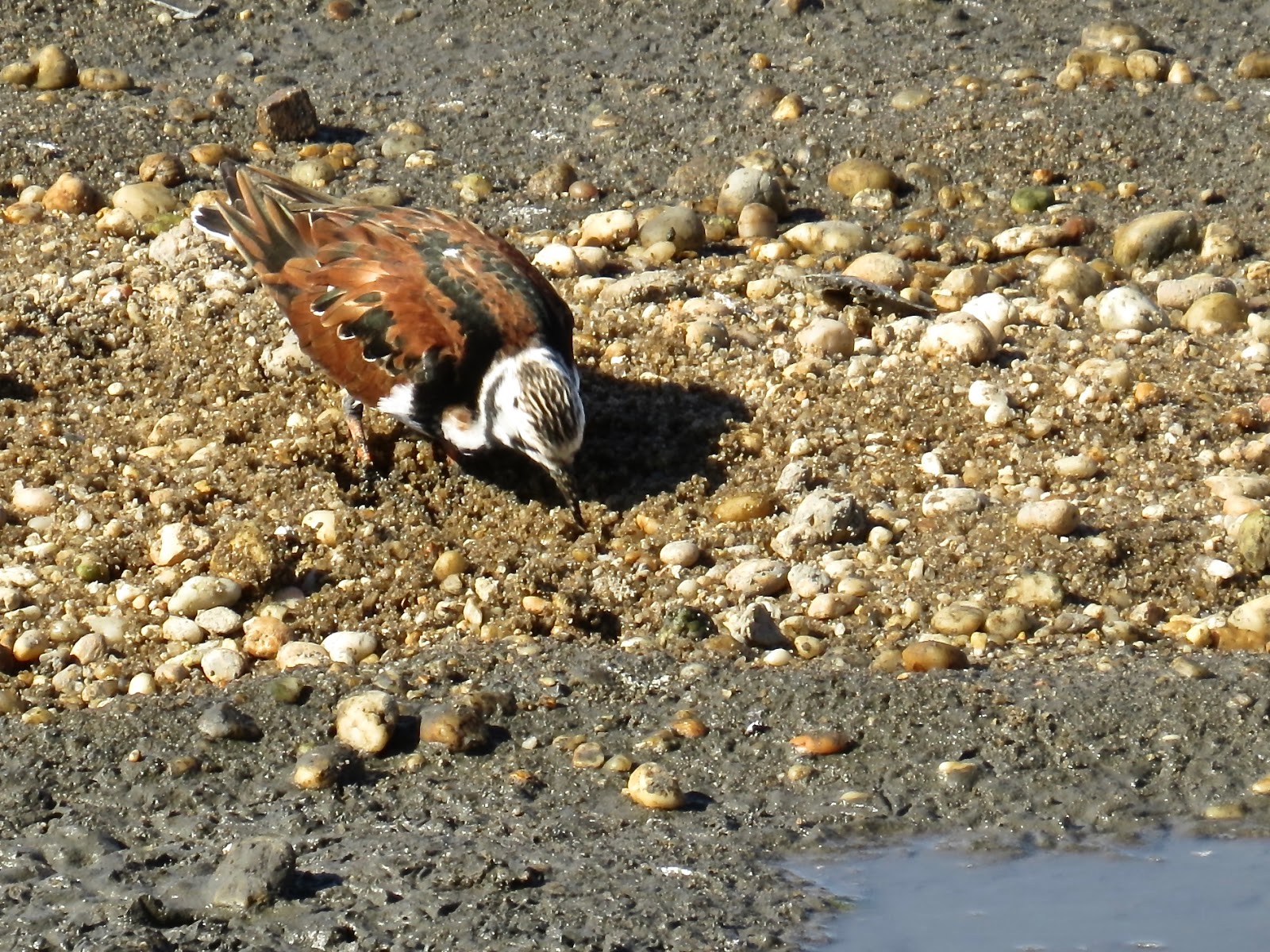 |
| Very busy, beautiful RUDDY TURNSTONE; perhaps the incoming tide brings food to its hole |
 |
| RUDDY TURNSTONE |
 |
| WILLET working the Ruddy Turnstone's hole |
 |
| AVIAN or HUMAN BUILT?? Clamshell mound -- several of them along that spit. |
 |
| DUNLIN so easy to ID in breeding plumage compared to the occasional winter ones that show up in AZ |
 |
| BLACK SKIMMER giving a shout out to ????? |
 |
| WHIMBREL bathing |
 |
| All clean |
 |
| GREAT BLACK-BACKED GULL |
 |
| SAVANNAH SPARROW |
 |
| SONG SPARROW |
 |
| FORSTER'S TERN |
 |
| Typical sight looking out into the wetlands in and around islands and sand spits |
 |
| Beyond each OSPREY nest was a pedestal landing for the hunting/feeding bird |
 |
| SNOW GOOSE (rarity; one suspected of being injured) |
Following our 8-mile tour around the wetlands, we stopped to walk Jen's Trail, even though the temps were rising and mosquitos were present.
Among the 23 species of songbirds seldom seen in AZ, we enjoyed REB-BELLIED WOODPECKER; WHITE AND RED-EYED VIREO (1each); TUFTED TITMOUSE; HOUSE AND CAROLINA WREN; AMERICAN ROBIN (2); GRAY CATBIRD (8); BLACK & WHITE WARBLER (2); HOODED WARBLER (1); a pair of AMERICAN REDSTART; YELLOW WARBLER (4); EASTERN TOWHEE (3); INDIGO BUNTING (1) and BALTIMORE ORIOLE.
So far, most of our birding had been done on Delaware Bay beaches or inland, so today we checked out the Atlantic Ocean and Sound at Stone Harbor Point.

Last fall when Eric Bruhnke posted his sighting of a Purple Sandpiper on his day off as a Hawk Watcher during the Fall Migration at Cape May, I made a note to check the status of its presence in the spring. Looked like a good possibility. [Eric was my Duluth guide in January for the Great Gray and Snowy Owls, plus many more good birds.]
So, as our second stop of the morning, Glenda and I pulled into the free parking area at Stone Harbor Point. She lives with East-coast birds, but she had yet to see a PURPLE SANDPIPER so, if we could find it at the jetty, it would be a Life Bird for her, too.
Bay waves make almost silent sounds as they roll gently ashore and retreat. Ocean waves announce themselves. Not super high in size nor super strong, yet these ocean waves made sure we knew on which side of the peninsula we stood -- the Atlantic.
 |
| RUDDY TURNSTONE may have been snacking on some innards of this Horseshoe Crab shell |
An AMERICAN OYSTERCATCHER was snoozing close to the dunes.
 |
| Or not. Its long red-orange bill tucked beneath its feathers |
Another AMOY came along and got it moving.
One of my favorite shorebirds in breeding plumage is the Black-bellied Plover. Note its shorter thicker bill than sandpipers.
 |
| AMERICAN OYSTERCATCHER on Stone Harbor Point beach |
 |
| Stunning bird. |
 |
| BLACK-BELLIED PLOVER; Stone Harbor Point beach; 5/17/17 |
As any professional photographer knows, getting on eye level with your subject is preferred. These two gentlemen went for it...soaking their clothes in the process. But a Black-bellied Plover is worth it, right?!
 |
| Two bird photographers; Stone Harbor Point beach |
But where is the bird we came for??? Oh, yes. Let's check that jetty again. I'm sure I saw a bird up there.
 |
| Dark stocky bird, round body; short, dull orange legs; especially dark on head and breast. And Sibley goes on to say, heavily streaked flanks. Whoop! Whoop! LIFE BIRD #2. |
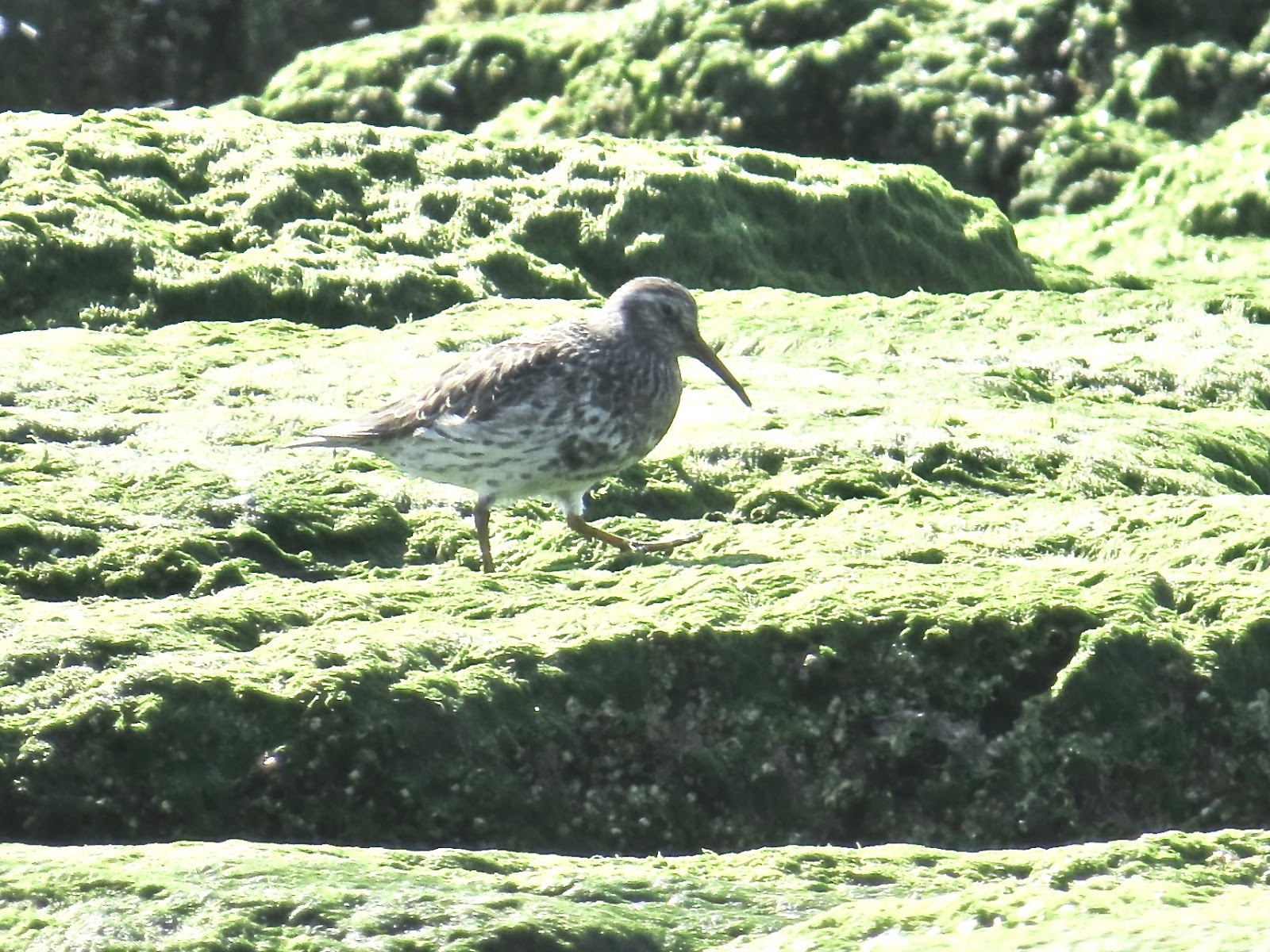 |
| PURPLE SANDPIPER, Stone Harbor Point; 2nd Avenue Jetty |
Driving to the Point, we had passed a Bird Sanctuary, so we returned there to see what songbirds might be around at mid-morning. These birds are just too fast for me, so I tucked my camera aside. Wouldn't you know? First bird Glenda spots is a male ROSE-BREASTED GROSBEAK! As usual, it was behind sticks and limbs and even when it was joined by a second male, it took all of Glenda's talent to pull in an identifiable piece of it.
 |
| ROSE-BREASTED GROSBEAK |
As usual, I enjoyed what are routine sightings for Glenda: CAROLINA CHICKADEE, CAROLINA WREN, AMERICAN ROBIN, GRAY CATBIRD, BROWN THRASHER, COMMON YELLOWTHROAT, COMMON GRACKLE, RUBY-THROATED HUMMINGBIRD and a FISH CROW and a few others.
We had two favorite spots we visited several times. One was Higbee Beach Wildlife Management Area. We had joined a scheduled walk there one morning, giving us an opportunity to meet some of the volunteer leaders whom we would see on other jaunts, too.
The most unusual sighting for me that first morning were nine (9) EASTERN KINGBIRDS perched on top of grasses in one field. Unbelievable memory!
Other notable species for me there: PRAIRIE WARBLER (3); WHITE-THROATED SPARROW (2); INDIGO BUNTING (10); ORCHARD ORIOLE (2- a pair); and a GREAT-CRESTED FLYCATCHER (1).
 |
| WHITE-THROATED SPARROW |
Another morning, Glenda and I returned to Higbee Beach to follow some of the trails through the woods, down to the Bay, north to a parking lot and back to our starting place by way of a road through many trees. Best birds there for me that day were: a singing SONG SPARROW; PRAIRIE WARBLER (6); YELLOW-BREASTED CHAT (2); INDIGO BUNTING (1) and OSPREY.
 |
| SONG SPARROW - so much darker than our Southwestern species |
 |
| Familiar but hard-to-photograph YELLOW-BREASTED CHAT |
 |
| INDIGO BUNTING |
 |
| PRAIRIE WARBLER |
 |
| PRAIRIE WARBLER |
Our second favorite spot was Jake's Landing. Anytime we went north for birding, we could easily stop along the way to check out this boat-access to a tidal canal with its surrounding marsh grasses.
MARSH WRENS were vocal and numerous; SEASIDE SPARROWs were abundant and singing; the Atlantic Coast CLAPPER RAIL made itself known; and from time to time, we witnessed bird drama at this location. A BALD EAGLE tried to take prey from an OSPREY who, in turn, turned on the eagle and drove it away. I cherish bird behaviors and tuck them away as happy circumstances to have shared it.
Glenda had been to Jake's Landing about twenty years ago with another good birding friend; it's where she got her Lifer, Seaside Sparrow.
Photos of SEASIDE SPARROW at Jake's Landing:
 |
| SEASIDE SPARROW with yellow supraloral and gray/bone bill; light, Atlantic subspecies |
 |
| SEASIDE SPARROW with yellow supraloral and gray/bone bill; dark Gulf Coast subspecies |
The marsh grasses were loaded with Marsh Wrens; this is the only time I took photos - rather unsuccessfully as it turns out:
 |
| MARSH WREN who knows how to hide |
 |
| MARSH WREN still hiding in plain sight |
Although I had been searching for a Saltmarsh Sparrow there, it failed to materialize!
In late afternoons or early evening, we would sometimes stop by the Cape May Point State Park (where the lighthouse is situated) to walk its trails through the riparian forest. State parks are free in New Jersey.
In late afternoons or early evening, we would sometimes stop by the Cape May Point State Park (where the lighthouse is situated) to walk its trails through the riparian forest. State parks are free in New Jersey.
Specialities here included: NORTHERN BOBWHITE (heard only on two different visits); EASTERN WOOD-PEWEE; PURPLE MARTIN; CHESTNUT-SIDED WARBLER; BOAT-TAILED GRACKLE; BALTIMORE ORIOLE (juvenile male) and HOUSE FINCH that was so red all over, I thought it was a Purple Finch, but its brown cheek patch and rounded head confirmed the brilliant raspberry-colored bird was a HOUSE FINCH.
Belleplain State Forest had been the site of our drenching rain day when we arrived in town. So, we signed up again for a tour with the volunteers of the hot spots throughout the forest. Good plan! Cape May Point wasn't getting many migrating warblers but Belleplain was loaded.
Some birds not seen previously during our week's visit included: YELLOW-BILLED CUCKOO (2); ACADIAN FLYCATCHER (7); WHITE-BREASTED NUTHATCH (Eastern); BLUE-GRAY GNATCATCHER; EASTERN BLUEBIRD; WOOD THRUSH, CEDAR WAXWING; OVENBIRD (30-heard throughout the forest); BLACK-AND-WHITE WARBLER; PROTHONOTARY, HOODED, AND YELLOW-THROATED WARBLER; SUMMER and SCARLET TANAGER; BALTIMORE ORIOLE and AMERICAN GOLDFINCH.
But, by far, the memory of my visit to Cape May and its extensive calendar of bird activity happened on the CMBO Birding-by-Boat trip through the wetlands of Jarvis Sound.
New on this trip were: BRANT (100 est.); COMMON LOON (2 adults; 3 juveniles); BLACK-CROWNED (7) and YELLOW-CROWNED NIGHT HERONS (4); RED-SHOULDERED HAWK and a sighting of an extremely rare bird.
Sibley indicates that this specific bird is a "very rare vagrant along both coasts with about one record annually along Atlantic Coast. All records of single birds, sometimes mixed with flocks of other large shorebirds."
Our birding guides had waited for the tide to lower to see if the prize was still present. Yes; it was.
BAR-TAILED GODWIT.
Possibly the only such one to touch down along the Atlantic this year and here it was - in Jarvis Sound! It was keeping company with a few Whimbrel on a small island with vegetation. Vince Elia (CMBO) confirmed that its last sighting in Cape May happened 32 years ago. And, today, May 14, 2017, I was viewing it there!
 |
| BAR-TAILED GODWIT - 1-year old female |


Although the above photos aren't sharp and clear, they provide proof of the bird's presence in Jarvis Sound on Sunday, May 14, 2017. (It continues to be seen there.)
 |
| Faint bars on tail can be seen on above BAR-TAILED GODWIT. |
While the BAR-TAILED GODWIT was not on my Wish List of birds to see in Cape May, it blew the rest of the list out of the water. Counted as my 3rd and final Life Bird on this trip, the historical quality of the sighting outweighs anything else I may have wanted to see.
BAR-TAILED GODWIT - a winner for sure!
* * *
 |
| Sunset from Cape May Point State Park |
As many of you know, my three sons came to the Jersey Shore for a long weekend visit after I wrapped up birding in Cape May. With Megan and Ethan on the front deck of our VRBO, they both commented on the "sea gulls". I took it upon myself to educate. We talked about where they observe gulls in addition to the beach and where they observe sea birds (they didn't know what I meant by this - until I explained).
 |
| Giant in the birding world, Pete Dunne with Babs Buck at The Meadows |
* * *


